

Ghana’s banking sector is making steady progress in integrating environmental, social and governance (ESG) standards into its operations, with compliance with the Sustainable Banking Principles reaching 73 percent as of September 2025.
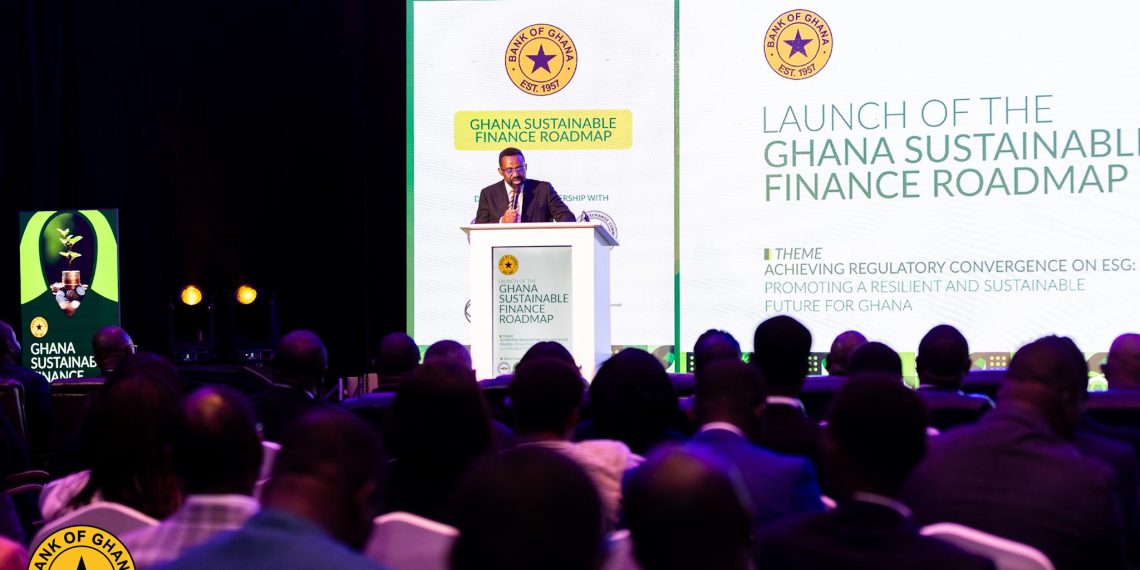
The achievement was announced by the Governor of the Bank of Ghana, Dr Johnson Pandit Asiama, during the launch of the Ghana Sustainable Finance Roadmap in Accra. He described the milestone as a strong indication that banks are increasingly embracing sustainability as a core business priority rather than merely a regulatory requirement.
According to Dr Asiama, all 23 commercial bank chief executives in Ghana voluntarily signed on to the Sustainable Banking Principles, committing their institutions to incorporate sustainability considerations into governance structures, risk management frameworks and business operations.
“The unified commitment marked a turning point, signalling the readiness of Ghana’s banking sector to embrace sustainability not as an obligation, but as a strategic imperative,” he said.
The Sustainable Banking Principles were introduced in 2019 to help banks identify and manage environmental and social risks, encourage sustainable investments and align financial activities with Ghana’s long-term development goals.
Dr Asiama noted that the current level of compliance is the result of years of collaboration among key stakeholders. The journey began in 2015 when the Bank of Ghana established a multi-stakeholder committee that later became the Sustainable Banking Principles Steering Committee. The committee brought together the central bank, the Ghana Association of Banks and the Environmental Protection Agency to develop a framework for sustainable banking practices.
To monitor implementation, the Bank of Ghana, with support from the International Finance Corporation and the Swiss Secretariat for Economic Affairs, introduced a standardised compliance assessment framework in 2021. Since then, banks have steadily improved their performance, resulting in the industry-wide compliance rate of 73 percent recorded by September 2025.
The Governor also highlighted measures taken by the central bank to strengthen climate resilience within the financial sector. These include the launch of a four-year Strategic Plan on Sustainability and Climate-Related Risks covering 2024 to 2028, as well as the introduction of a Climate-Related Financial Risk Directive for regulated financial institutions.
He explained that climate-related risks are increasingly affecting economies and financial systems, making it necessary for regulators and financial institutions to rethink traditional approaches to risk management.
Referencing recent flooding incidents in Ghana, Dr Asiama said climate-related events can directly impact asset values, insurance claims and the quality of bank lending portfolios.
“The instruments and structures of the past were not built for them and meeting them asks us to recalibrate how we supervise, how we price risk, and how we plan,” he stated.
Beyond risk management, he stressed that sustainable finance presents a significant opportunity for Ghana to attract new sources of global capital, finance critical infrastructure projects, support the energy transition and strengthen long-term economic growth.
“Sustainable finance is increasingly central to financial stability, to long-term investment, and to economic resilience,” he added.
The Ghana Sustainable Finance Roadmap is built around three key pillars: ESG integration, climate-related risk management and financing sustainability. The framework is expected to guide coordinated action among regulators in the banking, insurance, securities and pensions sectors.
Dr Asiama believes the roadmap will move Ghana beyond isolated sustainability initiatives and create a more unified approach to sustainable finance across the financial sector.
He said successful implementation could unlock greater access to climate and development finance, strengthen the resilience of financial institutions and position Ghana as a leader in sustainable finance within the region.
“Done well, this is not a cost we carry. It is a market we open,” he said.
With compliance levels continuing to rise, attention is now shifting from policy adoption to practical implementation. The challenge for the banking sector will be ensuring that sustainability principles translate into stronger governance, improved climate-risk management, better lending decisions and increased financing for sustainable economic activities.
As investors around the world place greater importance on ESG standards and climate-risk disclosures, Ghana’s banking industry appears increasingly well-positioned to compete for sustainable investment capital and establish itself as a credible regional leader in sustainable finance.