

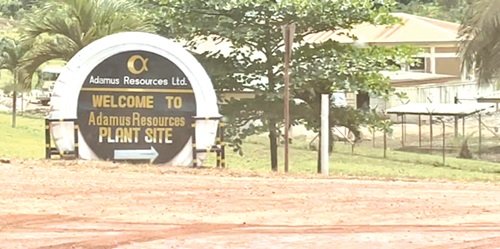
The government is seeking to recover about GH¢377.30 million in outstanding taxes and mineral royalties from Adamus Resources Limited, adding a major financial dimension to the ongoing dispute over the company’s mining leases in Ghana’s Western Region.
The amount comprises approximately GH¢86.80 million in unpaid royalties and GH¢290.50 million in outstanding taxes. The government has also cited about US$2.56 million in unpaid mineral-right fees.
The figures form part of the government’s case following its decision to uphold the revocation of Adamus’ mineral rights covering the Akango, Salman and Nkroful concessions.
However, the amounts remain claims arising from the government’s regulatory review and should not be treated as finally established liabilities, as Adamus is contesting the broader process.
The Ministry of Lands and Natural Resources has maintained that the company breached aspects of Ghana’s mining regulations, including allegations that it assigned portions of its mineral rights to third parties without the required ministerial approval.
The Minerals Commission has also accused Adamus of allowing mining activities outside approved operational arrangements, citing provisions of the Minerals and Mining Act, 2006 (Act 703).
Adamus has rejected the allegations and challenged the revocation of its leases. The company maintains that it was a duly licensed operator and has argued that it was not given adequate notice of the allegations or sufficient opportunity to respond before the government’s decision.
Following a petition from the company, Lands and Natural Resources Minister Emmanuel Armah-Kofi Buah established an independent committee to review the revocation.
The ministry had also indicated that an interim management arrangement would oversee the mine while the review was ongoing. The government has since upheld the revocation, leaving Adamus to pursue its objections through the courts.
The dispute has now moved beyond the question of who controls the concessions.
With the government seeking hundreds of millions of cedis in taxes and royalties, the case has also become a major test of how mining revenues are assessed and collected.
This comes as Ghana strengthens its fiscal framework for the mining sector.
A new minerals and mining royalties regime introduced in March replaced the previous flat-rate structure for gold with a sliding-scale system. Under the new framework, gold royalties start at 5% and can rise to 12% when international prices reach specified thresholds.
The government says the reform is intended to ensure that the country receives a greater share of windfall gains when mineral prices are high while maintaining lower rates when market conditions weaken.
Against this backdrop, the unresolved royalty claims involving an operating gold mine raise broader questions about production verification, revenue assessment and the effectiveness of the state’s collection systems.
The Minerals Income Investment Fund (MIIF) and other state institutions have also revived an inter-agency mechanism involving revenue, regulatory and enforcement bodies to strengthen the verification and collection of mineral royalties and reduce revenue leakages
The Adamus case is complicated by the ongoing dispute over the underlying mining leases.
If the company contests the amounts claimed by the government, the eventual recovery could depend on how the liabilities were calculated, the periods they relate to and whether the assessments withstand administrative or judicial scrutiny.
The distinction is important because revoking a mineral right and recovering a tax liability are separate legal processes.
A lease revocation does not, by itself, establish the final amount of tax owed. Similarly, a company’s challenge to the revocation does not automatically eliminate statutory payments that may already have fallen due.
Government will therefore have to clearly demonstrate what Adamus owes, how the figures were calculated and the legal basis for recovering the money.
Adamus, on the other hand, will have to challenge those financial assessments separately from its broader argument that the leases were unlawfully revoked.
The controversy has also been complicated by reports of Chinese nationals appearing at the Salman concession after the government upheld the revocation.
Their exact status and authority at the site have not been publicly established, and there is currently no verified evidence that the affected concessions have formally been transferred to them.
The development has nevertheless raised questions about who currently has the legal authority to operate, manage or access the concessions, particularly because alleged foreign participation in mining activities previously featured among the concerns raised against Adamus.
Government could reduce the uncertainty by clearly identifying the current management and operational arrangements at the affected sites and ensuring that any future allocation of the mineral rights follows a transparent and legally defensible process.
The Adamus dispute has implications beyond the company and the three concessions.
Ghana needs mining companies to comply with tax, royalty, environmental and operational requirements. At the same time, the country depends on a predictable regulatory environment to attract the long-term capital required to develop its mineral resources.
Strong enforcement and investor confidence are not necessarily contradictory. A transparent and consistently applied regulatory system can strengthen confidence in the sector.
The greater risk arises when disputes over regulatory decisions or financial obligations are perceived to be handled outside clearly defined legal procedures.
For now, the government’s push to recover GH¢377.30 million in taxes and royalties, alongside the disputed US-dollar mineral-right fees, has added a significant financial dimension to the Adamus case.
The dispute is therefore no longer simply about control of the Akango, Salman and Nkroful concessions. It is increasingly a test of regulatory enforcement, revenue collection and the legal process governing Ghana’s mining industry.