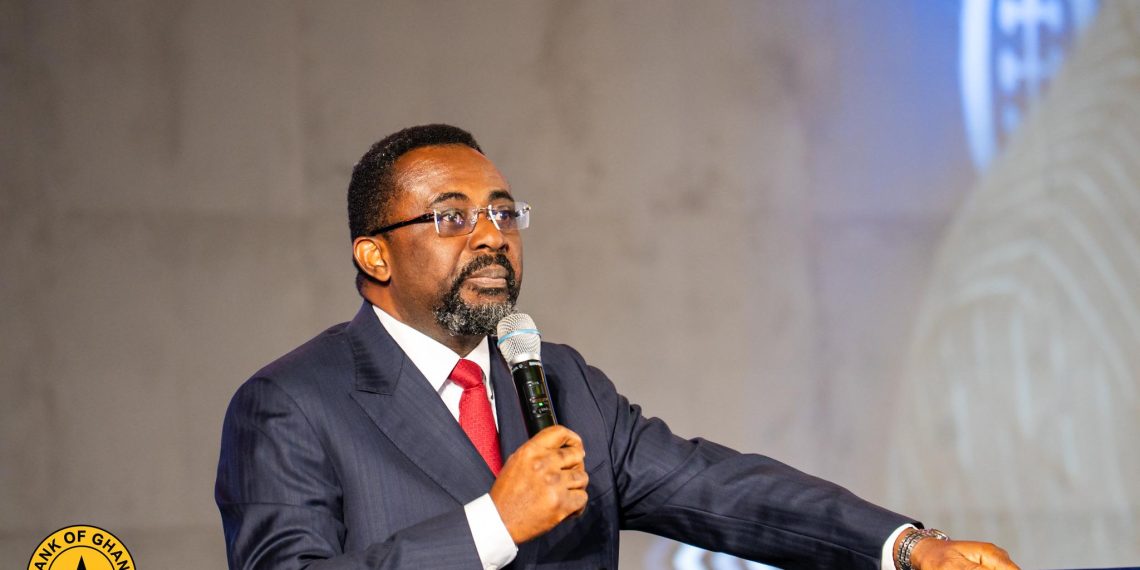
Ghana is positioning itself not just as a participant in global finance, but as one of the countries helping to shape its future, Governor of the Bank of Ghana Dr Johnson Pandit Asiama has said.
Speaking at the ACI FMA World Congress 2026 in Accra on Thursday, Dr Asiama said the global financial system is undergoing a major transformation driven by digital payments, artificial intelligence, virtual assets, central bank digital currencies and regional financial integration.
According to him, emerging economies like Ghana are increasingly moving from simply adopting financial systems created elsewhere to actively designing solutions that reflect their own realities.
“Financial markets are becoming more digital, more connected, and more shaped by emerging economies than they have ever been,” he said.
Addressing delegates under the theme “Ghana at the Centre of a New Financial Markets Era,” the Governor said Ghana’s hosting of the congress itself demonstrates that major conversations about the future of finance now require African economies to have a stronger voice.
Dr Asiama stressed that macroeconomic stability remains the foundation for any successful financial market development.
“Macroeconomic stability is not only good for financial market development. It is the infrastructure on which financial market development becomes possible,” he stated.
He recalled that Ghana faced severe economic pressures just three years ago, with inflation reaching 54.1 percent in December 2022, declining reserves, debt restructuring challenges and weakened market confidence.
However, he said measures implemented by the Bank of Ghana and the Ministry of Finance have helped restore stability. Inflation, he noted, had fallen to 3.4 percent by April 2026, while international reserves had risen above 13.9 billion dollars, providing more than five months of import cover.
He also pointed to a 1,400 basis-point reduction in the policy rate since early 2025, ongoing fiscal consolidation and renewed lending activity within the banking sector following recapitalisation efforts.
Despite the progress, Dr Asiama cautioned that global uncertainties and geopolitical tensions still pose risks to economies like Ghana.
The Governor outlined three major areas driving Ghana’s financial market transformation — payments, digital finance regulation and regional market connectivity.
On payments, he said financial transactions have evolved from being a “back office” function to becoming the “front door” to formal finance. He highlighted Ghana’s interoperable payment system, mobile money integration, instant transfers and QR-code interoperability as examples of progress positioning the country as a regional leader in digital payments.
Dr Asiama also disclosed that the e-Cedi project has completed its pilot phase, with the Bank of Ghana now exploring its use for cross-border settlements and wholesale payments.
On regulation, he argued that innovation can only thrive in an environment built on trust and credible oversight.
“Markets that lack credible regulatory architecture do not innovate faster. They fragment, they fail, and they erode the trust on which the next wave of innovation depends,” he said.
He revealed that Ghana’s Virtual Asset Service Providers Act, passed in 2025, is currently being operationalised through detailed regulations. He added that the central bank is also investing in fintech sandbox programmes, cybersecurity systems and supervisory technology while collaborating with the Securities and Exchange Commission and the Ghana Stock Exchange to strengthen oversight across the digital finance ecosystem.
Dr Asiama further emphasised the need for stronger African financial integration, arguing that disconnected markets would struggle to compete globally.
He said Ghana is working with regional partners to develop harmonised payment systems and licence passporting frameworks that would allow fintech companies to operate across borders more easily.
“A fintech licensed in one African jurisdiction should be able to serve a customer in another without rebuilding its compliance stack from scratch,” he said.
According to him, Ghana’s ambition is not to claim perfection, but to demonstrate that emerging economies are now increasingly influencing the direction of global financial policy and innovation.
“A growing number of emerging economies, Ghana among them, are no longer countries to which financial market policy happens. We are countries in which financial market policy is being designed,” he stated.
Dr Asiama concluded by saying the redesign of global financial markets is already happening in real time, and Ghana intends to play a meaningful role in shaping that future.
“Ghana has chosen to be part of that redesign. Not as a participant. As a contributor,” he said.