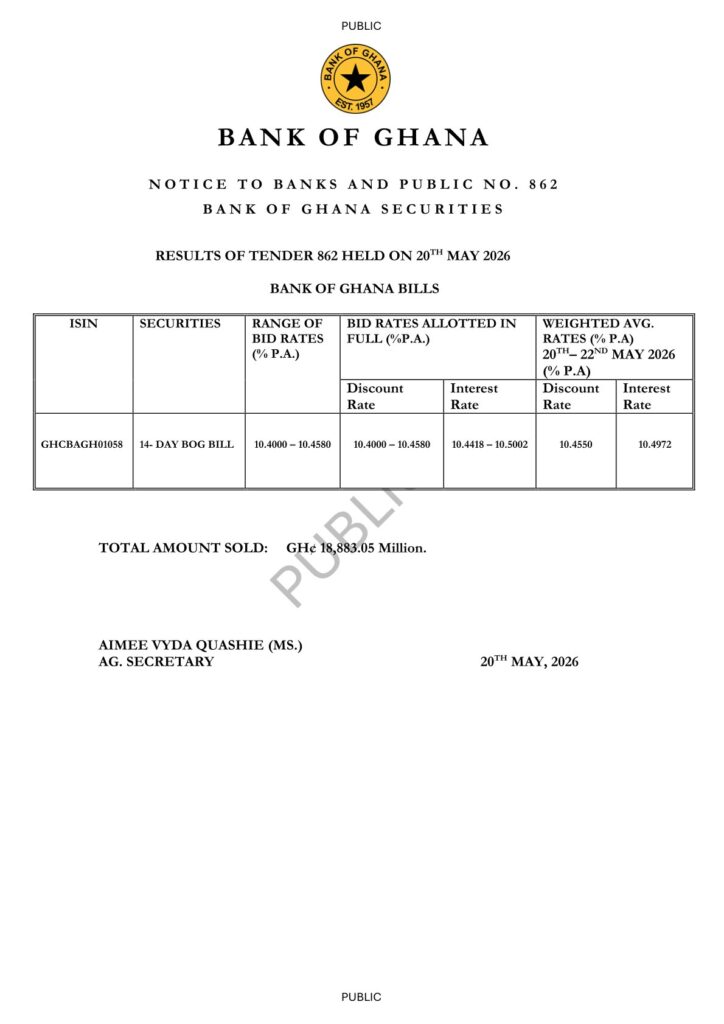
The Bank of Ghana has absorbed GH¢18.88 billion from the banking system through the sale of 14-day bills, highlighting the central bank’s continued efforts to manage liquidity and maintain stability in the money market.
According to Notice to Banks and the Public No. 862, the auction was conducted on May 20, 2026, under the ISIN code GHCBAGH01058.
The short-term BoG bill attracted bids with interest rates ranging between 10.4000 per cent and 10.4580 per cent per annum, with all submitted bids accepted within that range. The weighted average discount rate settled at 10.4550 per cent, while the weighted average interest rate stood at 10.4972 per cent.
In total, the central bank raised GH¢18.883 billion through the operation, making it one of the notable liquidity absorption exercises in recent weeks.
The latest auction comes at a time when interest rates in Ghana have been trending downward following significant reductions in the Bank of Ghana’s policy rate over the past year. Treasury bill yields have also eased considerably, reflecting improving market conditions and softer inflation pressures.
Despite the lower interest-rate environment, the sizeable uptake indicates that the central bank remains committed to actively managing liquidity in the financial system to support macroeconomic stability.
BoG bills are commonly used as open market instruments to absorb excess cash from banks and other financial institutions. This helps the central bank control inflationary pressures, stabilise short-term interest rates and reduce potential pressure on the cedi.
The 14-day bill’s average interest rate of 10.4972 per cent also suggests that the Bank of Ghana is keeping its liquidity operations closely aligned with prevailing money market conditions and its broader monetary policy objectives.
The liquidity management exercise comes amid ongoing concerns about preserving Ghana’s recent disinflation gains while navigating external risks, including movements in global crude oil prices, commodity market pressures and exchange rate volatility.
For commercial banks, the BoG bill provides a secure short-term investment option for excess liquidity. For the central bank, it remains a key tool in maintaining price stability and orderly financial market conditions.