

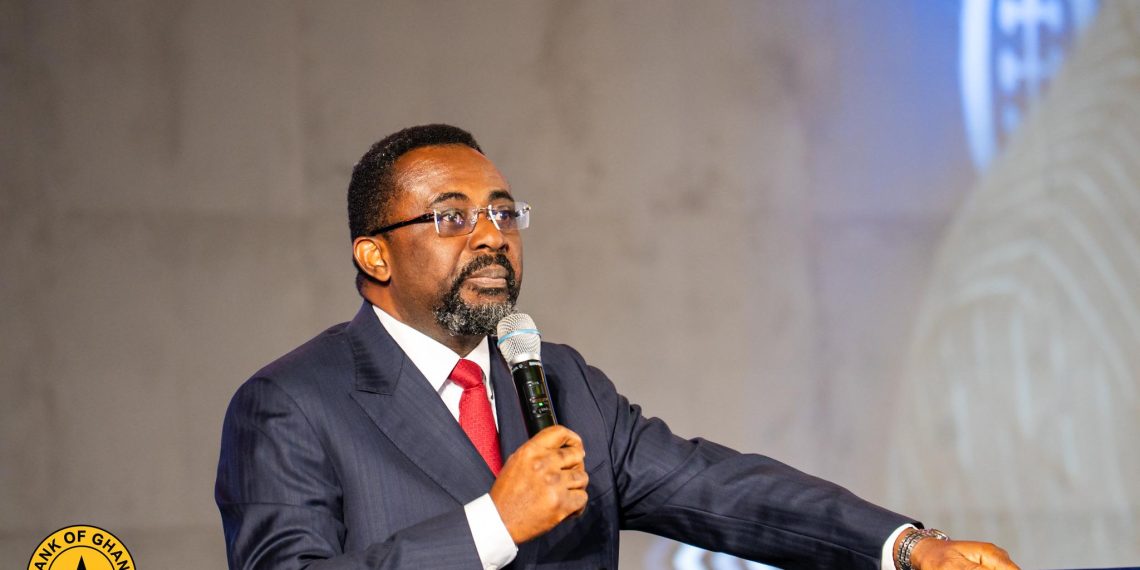
Ghana’s recovery from one of its most challenging economic crises offers valuable lessons for African countries seeking to strengthen their financial systems and reduce vulnerability to external shocks, Bank of Ghana Governor Dr. Johnson Pandit Asiama has said.
Speaking at the Bank for International Settlements (BIS) Roundtable of African Central Bank Governors in Basel, Switzerland, Dr. Asiama highlighted the critical role domestic debt markets can play in promoting economic resilience, safeguarding financial stability and reducing dependence on external borrowing.
According to him, Ghana’s journey from crisis to recovery demonstrates that well-developed local debt markets can provide governments with reliable sources of financing while limiting exposure to foreign exchange risks.
“Ghana’s economic journey from crisis to recovery offers important lessons on the growing role of domestic debt markets in strengthening resilience while safeguarding financial stability,” he stated.
His remarks come as many African countries face increasingly difficult financing conditions marked by high debt-servicing costs, tighter global financial markets and limited access to international capital. These challenges have forced governments across the continent to reconsider their borrowing strategies.
For years, many African economies relied heavily on Eurobonds and external commercial loans to fund development projects. However, rising global interest rates, exchange-rate volatility and changing investor sentiment have made such borrowing more expensive and riskier.
Ghana’s experience illustrates the dangers of overdependence on external financing. During its recent economic crisis, the country lost access to international capital markets, prompting a debt restructuring programme, fiscal reforms and efforts to rebuild confidence in domestic financial markets.
Dr. Asiama stressed that the focus should not simply be on replacing external borrowing with local borrowing. Instead, countries must develop domestic debt markets that are deep, transparent, diversified and supported by sound fiscal management.
He cautioned that excessive domestic borrowing can create its own challenges, including higher interest costs, pressure on bank balance sheets and reduced access to credit for private businesses.
“Domestic borrowing is not a risk-free substitute for external borrowing,” he noted, stressing the importance of maintaining balance and discipline in public debt management.
Ghana’s domestic debt market was at the centre of both the crisis and the recovery. The Domestic Debt Exchange Programme (DDEP) placed significant strain on banks, pension funds, insurance firms, asset managers and individual investors. While painful, the programme sparked renewed discussions about investor protection, fiscal credibility and long-term market resilience.
Since then, improvements in macroeconomic indicators, fiscal consolidation measures and stronger policy coordination have helped restore investor confidence. Participation in government securities has increased, while the Bank of Ghana continues to use monetary policy tools to maintain price stability and support market development.
Dr. Asiama argued that domestic debt markets should be viewed as more than channels for financing government deficits. He described them as essential infrastructure that can support economic stability, mobilise domestic savings and provide long-term investment opportunities.
A strong local bond market, he explained, enables governments to finance development projects in local currency, reduces exchange-rate risks and helps create benchmark yield curves that support broader capital market growth. It also offers institutional investors such as pension funds and insurance companies access to long-term investment assets.
With Africa facing substantial financing needs in infrastructure, healthcare, education, housing and energy, Dr. Asiama said strengthening domestic markets has become increasingly important.
He noted that countries overly dependent on external financing remain vulnerable to global shocks. When international financial conditions tighten or local currencies depreciate, debt-servicing costs can rise sharply, placing additional pressure on public finances.
To build resilient domestic markets, he urged policymakers to improve transparency in government securities issuance, strengthen debt management frameworks, broaden the investor base and encourage the development of longer-term financial instruments beyond short-term Treasury bills.
He also stressed that sustainable domestic debt markets require fiscal discipline and predictable government borrowing practices. Excessive borrowing can crowd out private-sector investment and undermine financial stability.
For central banks, strong domestic debt markets improve the effectiveness of monetary policy by enhancing the transmission of interest-rate decisions throughout the financial system. Weak or poorly structured markets, on the other hand, can complicate policy implementation and increase systemic risks.
Dr. Asiama’s message resonated strongly at the BIS roundtable, which brought together African central bank governors to discuss financial stability, economic resilience and development financing amid growing global uncertainty.
While acknowledging that Ghana’s recovery remains ongoing, he said the country’s experience demonstrates how confidence can return when fiscal reforms, credible monetary policy and financial-sector stability work together.
He urged African countries to strengthen domestic investor capacity, modernise settlement systems, encourage corporate bond issuance and create conditions that support long-term financing.
According to him, Africa’s development ambitions cannot be sustained through repeated cycles of external borrowing and debt distress. Instead, the continent must build financial systems capable of mobilising domestic savings and directing them into productive investments.
Dr. Asiama said Ghana’s experience serves as both a cautionary tale and a roadmap, showing the risks of weak fiscal buffers and excessive reliance on foreign borrowing, while highlighting the benefits of strong and credible domestic financial markets.