

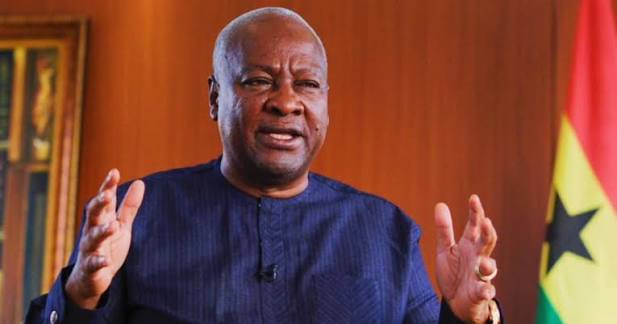
President John Dramani Mahama has called for a major shift in global health cooperation, arguing that countries in the Global South cannot achieve genuine ownership of critical services while financing, production and key decisions remain largely controlled from outside.
Speaking at a high-level Accra Reset event on the sidelines of the 81st United Nations General Assembly in New York, President Mahama said the initiative had moved from identifying challenges to implementing practical measures aimed at strengthening national capacity, regional production and control over development priorities.
The event marked one year since the Accra Reset was launched and saw the unveiling of a new report, A Sovereign Future for Health.
President Mahama said the initiative was responding to what he described as the growing vulnerability of health and social programmes that depend heavily on external financing and shifting donor priorities.
“We refused to accept that our people’s health, dignity, and future should remain perpetually tied to the shifting political winds of donor magnanimity,” he said.
According to the report, disruptions to international health financing have exposed weaknesses in systems that rely heavily on programmes financed or managed from outside the countries they serve.
The Accra Reset therefore seeks to move the conversation beyond the amount of aid available to how countries can build the productive, financial and institutional capacity needed to determine their own development priorities.
For Ghana, President Mahama linked the approach to his government’s domestic economic programme, including fiscal management, governance, industrialisation, local value addition, public health infrastructure and the 24-Hour Economy.
“You cannot successfully reset a national house if the global architecture around it remains fundamentally flawed,” he said, while stressing that global reform must also be matched by stronger discipline and accountability at the national level.
Health manufacturing is a major part of the strategy. President Mahama said Ghana should move beyond building hospitals while depending on foreign suppliers for vaccines, intravenous fluids and essential medicines.
He called for stronger local pharmaceutical production, supported by predictable government procurement and access to regional markets.
The approach would link healthcare spending with industrial development by creating opportunities for local manufacturers to supply medicines and medical products instead of treating healthcare largely as a consumer sector.
The Accra Reset report outlines five proposed political shifts and 10 recommendations intended to reshape global health cooperation around stronger national capacity, regional systems and global public goods.
It argues that international partnerships should help countries build sustainable institutions, financing systems and production networks rather than create parallel structures that remain dependent on external programmes.
President Mahama said the concept of ownership must go beyond governments formally being responsible for outcomes.
“Today, through the Accra Reset, we declare unequivocally that there can be No Ownership Without Control,” he said.
He, however, cautioned that greater national control must come with stronger accountability.
“No ownership without control, yes, but no control without absolute accountability to our people,” the President added.
He said the initiative was not intended to promote isolation or an outright rejection of international assistance, but rather what he described as “pragmatic interdependence”.
The Accra Reset is seeking partnerships with institutions in Brazil, India, Indonesia, the Gulf and across Africa to strengthen links between research, regulation, manufacturing and distribution.
President Mahama said the next phase would focus on translating the report’s recommendations into country-level compacts involving governments, development finance institutions, global health organisations, philanthropies and the private sector.
Maternal and child health is expected to be among the first areas where the approach will be applied. President Mahama noted that sub-Saharan Africa continues to account for a significant share of global maternal deaths, while Ghana remains above the Sustainable Development Goal target.
Programmes such as Mother Africa and the Business United for Mothers, Babies and Youth campaign are expected to bring government and private-sector resources together to improve maternal and child health outcomes.
The President also linked the agenda to Ghana’s wider role in African policymaking, noting that the country is preparing to assume the chairmanship of the African Union in 2027.
He said Ghana would use platforms including the African Union, the Non-Aligned Movement and the G77 plus China to push the reform agenda beyond individual countries.
The ambition is to transform the Accra Reset from a Ghana-led initiative into a broader coalition focused on stronger national capacity and more balanced international cooperation.
The success of the initiative, however, will ultimately depend on implementation. For Ghana, the push for greater control over development financing and production will also require stronger fiscal management, transparent procurement, effective institutions and accountability in the use of public resources.
President Mahama’s message was therefore directed both at international partners and governments in the Global South: greater sovereignty requires greater control, but control must be matched by accountability.