


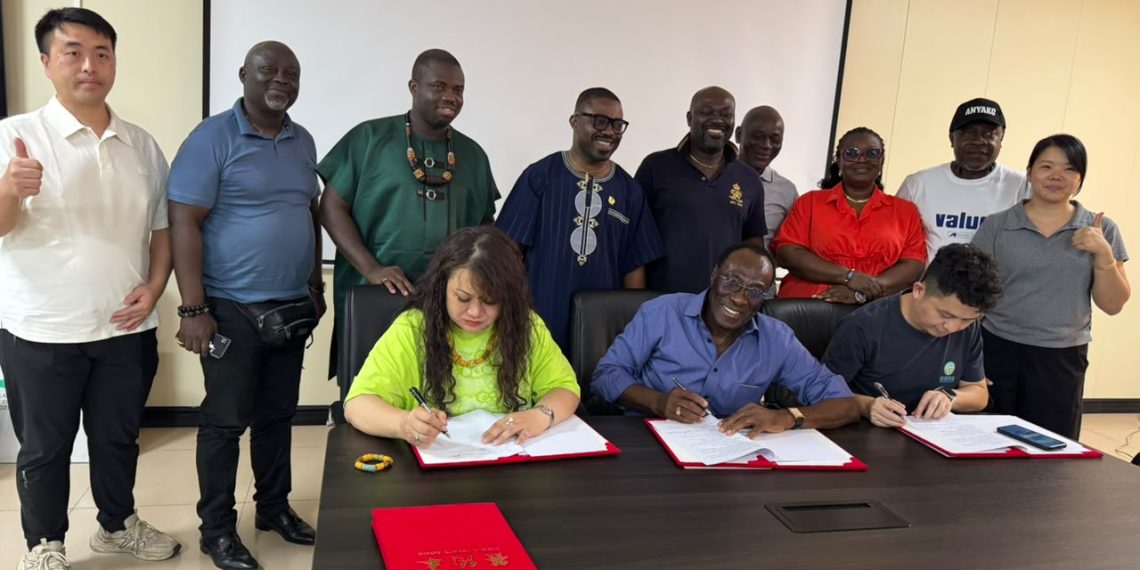
The Volta Regional House of Chiefs has signed a memorandum of understanding with Chinese aquaculture processor Maoming Yuantian Food Co. Ltd to explore the development of commercial fish farming in the Volta Basin.
The agreement forms part of efforts by traditional authorities in the region to attract foreign investment, technology and expertise into aquaculture and other sectors with the potential to create jobs and boost local production.
The deal was signed during a week-long investment mission to China led by the President of the Volta Regional House of Chiefs, Togbe Tepre Hodo IV, with engagements facilitated under Ghana’s Ambassador to China, Kojo Bonsu.
The aquaculture agreement was one of four arrangements signed by the Volta delegation with Chinese companies. The others involved Guangdong Welleap Information Technology Company, Foshan Jinting Construction Engineering Company and SINOHUI Investment Ghana Limited.
The agreement with Maoming Yuantian is focused on attracting investment into commercial aquaculture within the Volta Basin. The proposed development could eventually involve fish farming, processing, cold-chain infrastructure and access to export markets.
However, details on the proposed investment, including the amount of capital involved, production targets, financing arrangements and implementation timeline, have not yet been made public.
Togbe Tepre Hodo said the partnerships were aimed at positioning the Volta Region and Ghana for long-term economic development through international cooperation.
He said the agreements could provide access to Chinese capital, technology and expertise while creating jobs, strengthening local production and supporting sustainable economic growth.
Maoming Yuantian Food Co. Ltd is an aquatic-products processor based in Gaozhou City in China’s Guangdong Province. The company specialises in frozen tilapia fillets, processed tilapia and whole frozen fish.
According to information published by the company, it was established in August 2024 with registered capital of RMB100 million. It operates on a 56,000-square-metre site with nine fillet-processing lines and has an annual processing capacity of 35,000 tonnes, alongside cold-storage facilities with a capacity of 2,500 tonnes.
Some reports surrounding the Ghana agreement have attributed larger figures to the company, including a daily processing capacity of 150,000 kilogrammes, more than 260,000 tilapia ponds and exports to over 70 countries.
However, the company’s own published information confirms nine production lines and international exports but does not independently support all of those figures.
There also appears to be some confusion between Maoming Yuantian and the wider tilapia industry in Maoming. Chinese industry sources indicate that the broader production area covers more than 260,000 mu, equivalent to about 17,333 hectares, and produces over 280,000 tonnes of tilapia annually.
The wider Maoming industry is also reported to export tilapia products to more than 70 countries and territories, meaning some of the figures associated with the Ghana agreement may relate to the region’s aquaculture industry rather than Maoming Yuantian alone.
Despite the distinction, the proposed partnership could provide the Volta Region with access to experience in commercial fish production, processing and cold-chain management.
The potential economic benefits extend beyond fish farming. A large-scale aquaculture industry could create demand for fingerlings, fish feed, technical services, veterinary support, cold storage, processing, packaging, transportation and marketing.
It could also contribute to increasing domestic fish production and reducing Ghana’s reliance on imported fish products, although no specific production or employment targets have been announced under the agreement.
The Volta Basin provides a significant natural base for aquaculture, but any expansion will also have to address environmental and biosecurity concerns.
Issues such as water quality, fish diseases, stocking levels, feed management, waste disposal and the impact of intensive farming on communities that depend on the basin’s water resources will require careful attention.
Environmental approvals, community engagement and compliance with Ghana’s regulatory requirements will therefore be important if the proposed investment moves into actual commercial operations.
Traditional authorities could also play a key role in facilitating community engagement, land access and local participation in any projects that emerge from the agreement.
Chiefs who participated in the signing included Togbega Gabusu VII of Hohoe, Togbe Atikpladza Agbi Yao VIII of Kpalime, Togbega Sei II of Botoku, Togbui Dagadu IX of Kpando, Torgbui Tenge Dzokoto Gligui VII of Anyako and Torgbiga Adamah III of Some.
For now, the agreement represents an investment commitment in principle rather than a confirmed commercial project. It does not yet establish the amount to be invested, where the farms will be located, who will finance the infrastructure or when production will begin.
The success of the partnership will ultimately depend on whether the MoU leads to committed capital, operating farms and a wider aquaculture value chain.
For Ghana, the bigger opportunity could lie in ensuring that any eventual investment includes local processing, feed production, skills development and access to export markets, allowing more of the value generated by the fish industry to remain within the country.