

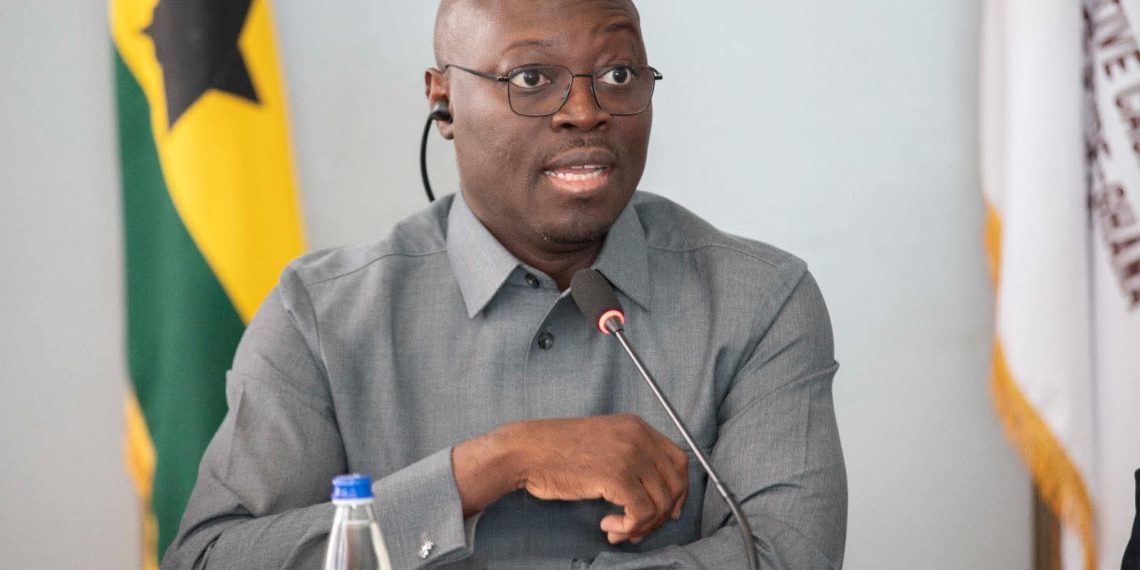
Finance Minister Dr. Cassiel Ato Forson has assured investors that the government will remain committed to fiscal discipline and structural reforms as Ghana seeks to turn its recent economic gains into lasting investor confidence.
Speaking during a high-level engagement with investors, Dr. Forson said the government would not ease up on the reforms that have helped stabilise the economy, stressing that the progress achieved so far should be seen as a foundation for sustained recovery rather than an end in itself.
“We will not relent,” the Finance Minister said, signalling the government’s determination to maintain the policies and measures underpinning Ghana’s economic recovery.
Ghana has recorded significant improvements in key macroeconomic indicators in recent months. Inflation has fallen sharply from the levels recorded during the economic crisis, the cedi has become more stable, foreign exchange reserves have improved and fiscal management has strengthened under the country’s IMF-supported programme.
The government has also made progress in restructuring Ghana’s domestic and external debt, helping to gradually restore confidence following a period of severe economic instability.
However, Dr. Forson’s message comes at a time when investors are increasingly looking beyond short-term improvements and assessing whether Ghana can maintain its fiscal discipline over the long term.
Financial markets, analysts say, place greater emphasis on consistent policy implementation than on government promises. Investors will therefore be watching closely to see whether Ghana can sustain prudent spending, improve domestic revenue mobilisation, strengthen public financial management and keep public debt on a sustainable path.
The challenge is particularly significant because Ghana still faces major development needs, including infrastructure, healthcare, education, industrialisation and social protection. Youth unemployment and the high cost of financing also remain concerns for businesses and households.
Government must therefore strike a careful balance between maintaining fiscal discipline and creating room for productive investment that can support economic growth and job creation.
The focus, according to the Finance Minister’s message, should not only be on how much government spends but also on the quality and impact of that spending.
Investments that improve energy reliability, reduce transportation and logistics costs, strengthen export competitiveness and support productive sectors could help expand the economy without placing unnecessary pressure on public finances.
The private sector will also have a major role to play. Ghana’s development needs cannot be financed entirely through government borrowing, making domestic and foreign investment critical to sectors such as manufacturing, mining, agribusiness, renewable energy, financial services and technology.
A more stable economic environment could help attract that investment by reducing uncertainty around inflation, exchange rates, interest rates and government borrowing.
However, investors who experienced Ghana’s recent debt crisis are likely to remain cautious. Restoring confidence fully will require a sustained record of fiscal discipline and policy consistency.
For the government, this means ensuring that the reforms being implemented become embedded in Ghana’s institutions rather than remaining dependent on the conditions of an IMF programme.
The eventual transition from IMF support will therefore be judged not simply by whether Ghana exits the programme, but by whether the country can maintain prudent fiscal management, improve tax administration, control expenditure and prevent state-owned enterprises and other public entities from creating unexpected liabilities.
Completing the debt restructuring process will also not automatically return Ghana to cheap access to international capital markets. Investors will continue to assess the country’s debt trajectory, growth prospects, fiscal performance and institutional credibility before deciding how much risk they are willing to take.
For this reason, the government may need to resist the temptation to return too quickly to heavy external borrowing and instead use the current period of relative stability to rebuild fiscal buffers and attract investment into productive sectors.
Ultimately, the success of Ghana’s economic recovery will be measured by more than falling inflation or a stable currency.
Investors and citizens alike will want to see stronger private-sector activity, increased exports, more jobs, higher productivity and improved public services without a return to the fiscal weaknesses that contributed to the previous crisis.
Dr. Forson’s “we will not relent” message is therefore a commitment that will be tested over time.
For investors, the real proof will come through government budgets, revenue performance, expenditure controls, debt management and the quality of public investment.
Ghana has made significant progress in stabilising its economy. The next challenge is to ensure that those gains are sustained long enough to restore confidence and create the foundation for durable, investment-led growth.