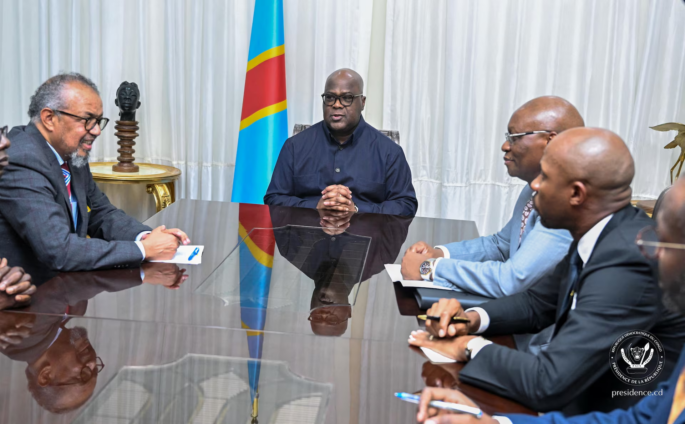
The World Health Organisation (WHO) says efforts to contain the Ebola outbreak in the Democratic Republic of Congo (DRC) are beginning to catch up, even as confirmed cases continue to rise.
According to the global health body, the outbreak has now recorded 344 confirmed cases and 60 confirmed deaths in the DRC. WHO Director-General Dr. Tedros Adhanom Ghebreyesus noted that while the outbreak initially spread rapidly, coordinated response efforts under the DRC government are now helping to close the gap.
“The outbreak had a big head start, and we’re still behind, but under the leadership of the government of the DRC, we’re catching up,” he said during a press briefing.
Health authorities say the outbreak is linked to the Bundibugyo strain of the Ebola virus, which has also been detected in neighbouring Uganda, where 15 cases and one death have been confirmed.
WHO officials explained that improved access to testing has helped rule out hundreds of suspected cases that were initially thought to be Ebola. However, they also noted that some standard tests are not fully effective in detecting this particular strain, creating an initial backlog.
WHO emergency operations director Abdirahman Mahamud said field teams are actively working through the backlog of samples, with more than 1,400 tests already conducted. He added that surveillance efforts are improving daily as new suspected cases continue to be identified.
At present, 116 suspected cases are still awaiting confirmation, while investigations are ongoing into around 220 reported deaths to determine whether they are linked to Ebola.
The agency also reported that six patients in the DRC and two in Uganda have recovered, stressing that early treatment significantly improves survival chances.
Despite progress, WHO says major challenges remain, particularly in contact tracing and testing capacity. Currently, only about 45 percent of identified contacts are being followed up, far below the 90 percent target needed to effectively control the outbreak.
Tedros also suggested the outbreak may have begun as early as January, though investigations are still ongoing. He emphasized that the priority now is to strengthen containment efforts.
WHO estimates it will need at least 115 million dollars over the next three months to support the response, with only about 35 percent of the funding currently secured. A broader fundraising and response plan is expected to be launched in collaboration with African health authorities and partner governments.