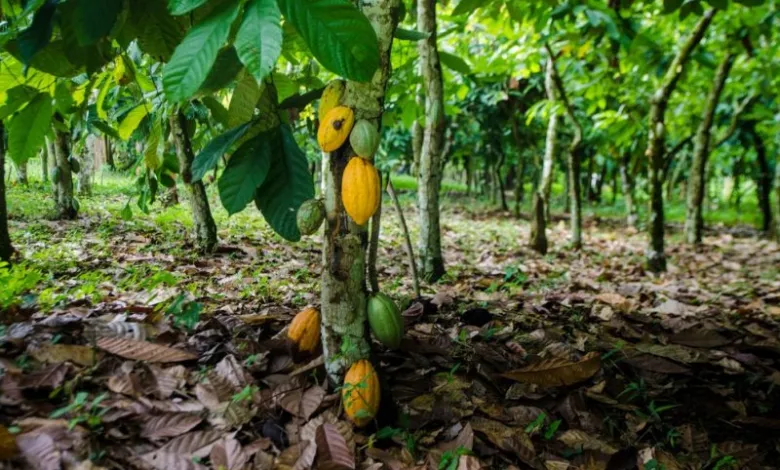
The Ghana Cocoa Board (COCOBOD) has increased the producer price of cocoa by 2.4 per cent to GH¢42,400 per tonne for the 2026/27 crop season, giving farmers an additional GH¢63 for every standard 64-kilogramme bag.
The new price, which took effect on Friday, September 25, translates into GH¢2,650 per bag, compared with the previous rate of GH¢2,587.
The increase means farmers will receive GH¢1,008 more per tonne under COCOBOD’s tonne-equivalent pricing system, up from GH¢41,392.
COCOBOD Chief Executive, Randy Abbey, announced the adjustment at a press conference in Accra, saying the new price had been approved following consultations with key stakeholders.
“COCOBOD and all the key stakeholders have approved that the producer price of cocoa be increased from GH¢41,392 per tonne to GH¢42,400 per tonne for the 2026/2027 cocoa season,” he said.
The new producer price represents 71.18 per cent of the realised gross free-on-board (FOB) value of cocoa, slightly above the 70 per cent statutory minimum established under the Ghana Cocoa Board Act, 2026 (Act 1182).
The law requires cocoa farmers to receive at least 70 per cent of the gross FOB value and provides for producer prices to be reviewed based on international cocoa prices, exchange-rate movements and other relevant factors.
According to COCOBOD, the decision followed consultations with the Ministry of Finance, cocoa farmers and the Chamber of Cocoa Marketers, which represents licensed buying companies, hauliers and processors.
Mr Abbey also indicated that the price could be reviewed during the season if market conditions changed.
He said any adjustment would be treated as a review of the producer price rather than a discretionary bonus.
“At every point in time, if there is a need for a review, the stakeholders will meet and look at that and it will not be a bonus or any other thing, it will be a review of the price,” he said.
The new pricing arrangement comes after a difficult period for Ghana’s cocoa sector. In February, the government reduced the producer price for the remainder of the 2025/26 season from GH¢58,000 to GH¢41,392 per tonne following a decline in international cocoa prices.
The adjustment came amid challenges with unsold cocoa stocks, delayed payments and financing difficulties faced by licensed buying companies.
The latest increase partly restores the earnings of farmers, although the 2.4 per cent adjustment remains relatively modest compared with the sharp price increases recorded during the period of exceptionally high international cocoa prices.
The actual benefit to farmers will also depend on inflation, the exchange rate and the cost of inputs such as fertiliser, labour and transportation.
COCOBOD is also pursuing changes to the way cocoa purchases are financed. The government is seeking to reduce reliance on the traditional annual international syndicated loan and mobilise more domestic financing, including through a proposed Cocoa Notes Programme.
Under the proposed model, funding would be raised from Ghana’s domestic capital market and linked more closely to cocoa sales within the same crop year.
The reforms are expected to help reduce exposure to delays in securing external financing, although investors would need greater clarity on cocoa volumes, export contracts, repayment arrangements and COCOBOD’s existing financial obligations.
The new cocoa law also places restrictions on COCOBOD’s quasi-fiscal activities and strengthens legal protection for cocoa farms affected by illegal small-scale mining.
COCOBOD says it will continue productivity programmes, including the distribution of free fertiliser and hybrid cocoa seedlings, as well as disease and pest-control interventions.
For farmers, the new GH¢2,650 per bag provides an immediate increase in earnings. However, the broader impact will depend on whether farmers are paid promptly, purchasing companies have adequate financing and productivity support reaches cocoa-growing communities.
The new pricing system will therefore be tested not only by the amount announced at the beginning of the season, but by how effectively it is maintained throughout the 2026/27 crop year without creating new payment arrears or leaving cocoa stocks unpurchased.