

President John Dramani Mahama has called for a new partnership between Ghana and global philanthropic organisations, urging a shift away from fragmented, short-term projects towards programmes that strengthen national institutions and create lasting development capacity.
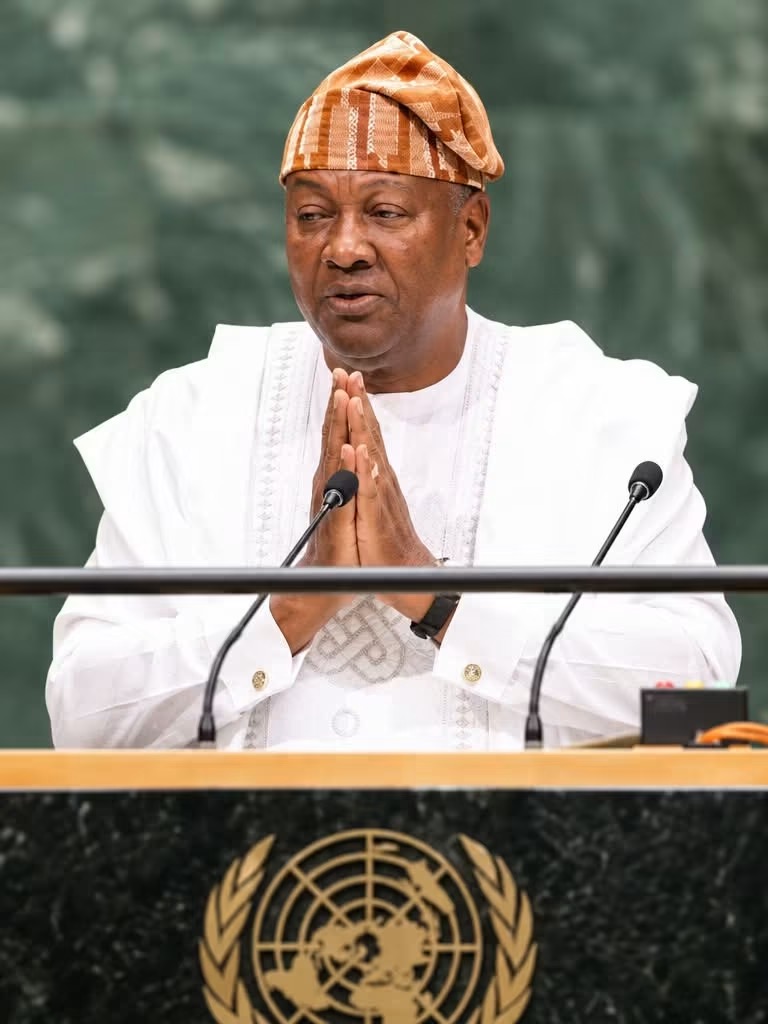
Speaking at a presidential funders’ roundtable in New York, President Mahama said changing political priorities and growing uncertainty around traditional development financing meant countries in the Global South needed greater control over their development agendas.
The meeting, organised by the Open Society Foundations on the sidelines of the 81st United Nations General Assembly, brought together representatives of about 20 US-based philanthropic organisations, including the Gates Foundation, Rockefeller Foundation, Ford Foundation, Hilton Foundation and Open Society Foundations.
President Mahama said the changing development finance landscape required a different approach to the relationship between governments and external funders.
“Development finance can change quickly,” he said. “Funding priorities shift, and political decisions taken thousands of miles away can have immediate consequences for programmes, institutions and communities in our countries.”
For Ghana, he said, philanthropy should not simply be viewed as a source of funds to fill gaps created by declining or unpredictable development assistance.
Instead, foundations should help strengthen institutions, generate evidence, develop programmes and create the conditions needed to attract larger pools of public, private and multilateral financing.
President Mahama pointed to the African Union’s Agenda 2063 as evidence that Africa already has a long-term development vision, but said the challenge was translating that vision into practical results.
“That requires institutions that can execute, the ability to mobilise and manage resources well, stronger negotiating capability, programmes that can attract the right forms of finance, and systems that allow us to account properly for results and learn from them,” he said.
He also raised concerns about the way some externally funded programmes operate through separate implementation structures, procurement systems, reporting requirements and funding cycles.
According to him, while such projects can deliver important services, they can also place additional pressure on government institutions and leave limited capacity behind when funding ends.
Under the proposed model, philanthropic organisations would align their support more closely with Ghana’s national priorities and work with government on larger and more coordinated programmes.
President Mahama said the real value of philanthropic support could be seen in stronger institutions, better evidence for public policy and programmes that become ready for larger-scale financing.
“The value of an intervention may lie in the institution that becomes stronger, the evidence that leads to a better public decision, the programme that becomes ready for larger-scale financing, or an approach that proves itself and can then be taken further,” he said.
He identified the Millennium Development Authority (MiDA) as Ghana’s focal institution for international philanthropic partnerships and grant coordination.
MiDA, which has managed Ghana’s programmes under the United States Millennium Challenge Corporation, has experience in procurement, financial management, project implementation and accountability under international standards.
“MiDA gives us an institution with experience of working to demanding international standards of procurement, financial management, delivery and accountability,” President Mahama said.
Under the proposed arrangement, MiDA would serve as a central point of contact for global foundations seeking to partner with the Ghanaian government. It would connect funders with relevant ministries and agencies while working with the Accra Reset team, civil society organisations and other delivery partners.
The arrangement is expected to help reduce duplication and provide a clearer framework for coordinating philanthropic support around Ghana’s development priorities.
President Mahama linked the proposal to the government’s Accra Reset agenda, which seeks to promote greater country ownership of development policy.
He stressed, however, that greater national ownership should come with stronger accountability and institutional capacity.
“We cannot ask our partners to give us greater room to lead while avoiding the difficult work that leadership requires,” he said.
He said Ghana must strengthen policy coordination, financial management and institutional capacity while ensuring that external resources could be properly tracked and their results demonstrated.
“Our responsibility is to build institutions capable of meeting those standards and to give partners confidence that resources can be traced, results can be demonstrated and lessons from implementation can inform what happens next,” he added.
President Mahama also encouraged philanthropic organisations to look beyond the traditional donor-recipient relationship and contribute their expertise, networks and institutional capabilities to Ghana’s development priorities.
He acknowledged that philanthropy alone could not replace bilateral aid, concessional financing or domestic revenue, particularly given the scale of resources required for infrastructure, healthcare, education and climate adaptation.
Instead, he said philanthropic capital could play a strategic role by supporting research, policy development, institutional strengthening and early-stage programmes that could later attract larger public, private or multilateral financing.
“Ghana, for its part, must be prepared to lead, coordinate and account for what follows,” President Mahama said.
The proposed partnership will ultimately be tested by whether it helps Ghana build stronger institutions and development programmes that can continue beyond individual grants.
For the government, the objective is therefore not simply to attract more philanthropic funding, but to use such resources to build a development system that can increasingly mobilise and manage financing on its own terms.