

For decades, the FIFA World Cup has been a stage dominated by Europe and South America, with every trophy since the tournament began staying within those two continents. For African nations, it has always been a pursuit filled with hope, talent, and near misses but never the final breakthrough.
As the 2026 World Cup approaches, that long-standing narrative is beginning to shift.
There is a growing sense that Africa is no longer arriving at football’s biggest tournament just to participate or cause occasional upsets. Instead, the continent is stepping in with increasing confidence that a genuine title challenge is no longer beyond reach.
Much of that change in outlook has been shaped by recent performances on the global stage. Morocco’s remarkable journey to the semi-finals at the 2022 World Cup forced a rethink of what African teams can achieve. Their victories over established football giants such as Spain and Portugal were not isolated surprises — they were proof of a team that could match the world’s best over an entire tournament.
That run broke a long-standing mental barrier. It showed that African teams can go deep into the competition, not just compete in the early rounds.
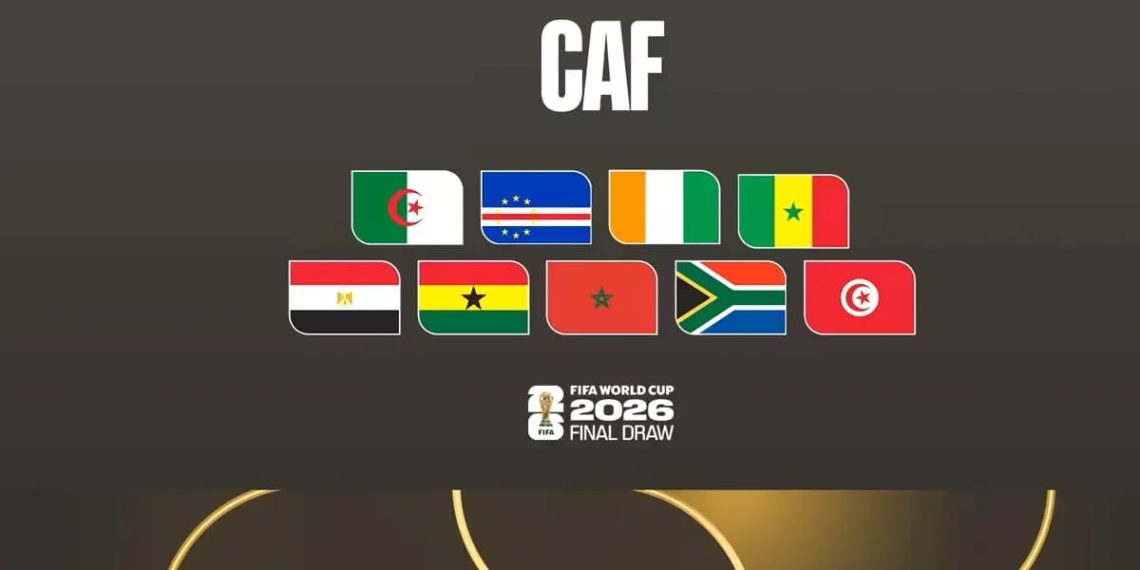
The expansion of the World Cup to 48 teams for 2026 also changes the landscape significantly. Africa will now be represented by 10 nations — Morocco, Senegal, Ghana, Egypt, Algeria, Côte d’Ivoire, Tunisia, South Africa, Cape Verde, and DR Congo. That increase in representation is more than symbolic; it provides more opportunities for African teams to build momentum and push further into the knockout stages.
Alongside this structural change is a deeper transformation in the quality of African football itself.
Across Europe’s top leagues, African players are no longer supporting figures — they are central to some of the biggest clubs in the world. Mohamed Salah continues to deliver at the highest level with Liverpool, Sadio Mané has long been a decisive force in major competitions, and Achraf Hakimi has established himself among the world’s elite defenders at Paris Saint-Germain.
This growing presence at elite clubs reflects a wider reality: the gap between African football and traditional powerhouses has narrowed significantly. Players are arriving at the World Cup with more experience in high-pressure matches than ever before.
Historically, African teams have had moments that hinted at what was possible. Cameroon’s breakthrough to the quarter-finals in 1990 was followed by Senegal in 2002, and Ghana came agonizingly close in 2010 before a dramatic penalty shootout loss to Uruguay. Morocco’s 2022 achievement, however, pushed the continent one step further than ever before.
Each generation has gone a little further than the last.
What makes the current moment different is the combination of experience, depth, and belief. African squads heading into 2026 are more balanced, more tactically disciplined, and better prepared for the demands of a long tournament. Many players are used to competing at the highest club level week in and week out, which strengthens their ability to handle pressure on the international stage.
There are also environmental factors that could play a role. The 2026 tournament, hosted across the United States, Mexico, and Canada, is expected to present challenging conditions in some venues, including heat and humidity. While all teams must adjust, several African nations may find familiarity with such conditions to their advantage.
Still, no single factor guarantees success at a tournament of this magnitude. What is clear, however, is that African football is no longer approaching the World Cup with hesitation.
There is a growing sense of belonging among the continent’s top teams a belief that they can compete with anyone on equal terms.
Whether 2026 delivers Africa’s first world champion remains uncertain. But for the first time in World Cup history, the idea no longer feels like a distant dream. It feels like a possibility that is slowly coming into focus.
Source: Norvanreport