


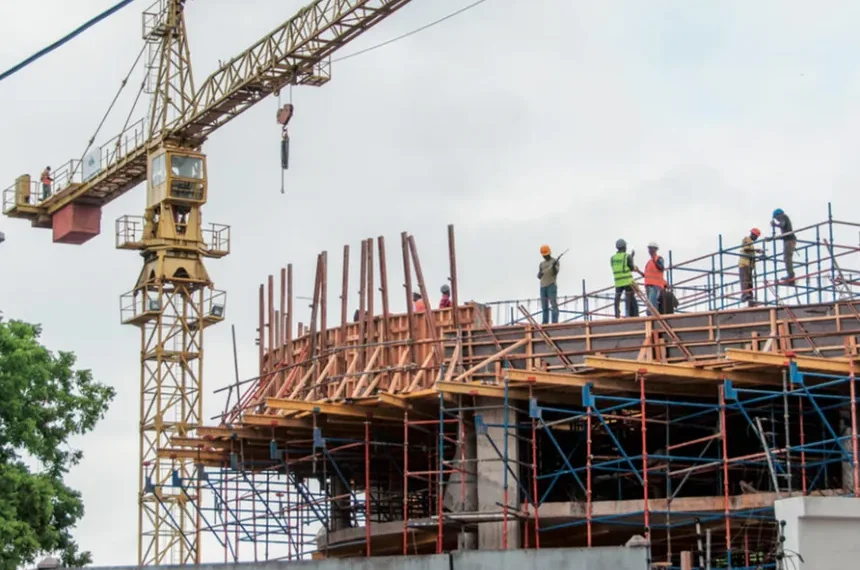
Ghana’s construction sector is expected to enjoy a stronger performance in 2026 before gradually losing momentum over the following two years, according to new projections by Fitch Solutions.
The research firm forecasts that the country’s construction gross value added (GVA) will grow by 5.20% in real terms in 2026, up from an estimated 3.10% in 2025. Growth is then expected to ease slightly to 5.10% in 2027 before slowing further to **4.50% in 2028.
Construction GVA measures the value the sector adds to the economy after accounting for the cost of materials and services used in production. It reflects activity across residential and commercial buildings, roads, bridges, utilities and other infrastructure developments.
Despite the projected moderation, Ghana is expected to remain one of the fastest-growing construction markets in Sub-Saharan Africa. Fitch ranks the country seventh in the region for construction growth, placing it ahead of larger economies such as Nigeria, Angola and South Africa. Ethiopia, Côte d’Ivoire and Uganda are expected to lead the regional rankings.
The stronger outlook for 2026 is expected to be driven largely by increased public infrastructure spending and renewed activity on major construction projects after years of fiscal constraints, high borrowing costs and exchange-rate volatility slowed project execution.
A major contributor is the government’s GH¢30.00 billion allocation to the Big Push infrastructure programme in the 2026 Budget, more than double the GH¢13.80 billion provided under the revised 2025 Budget. The initiative includes flagship projects such as the Accra-Kumasi Expressway and the Eke Amanfrom-Adawso Bridge.
The increased investment is expected to create opportunities for contractors, engineering firms, cement and steel manufacturers, equipment suppliers and financial institutions, while supporting employment across both the formal and informal construction workforce.
However, Fitch cautions that the sector’s growth is likely to lose momentum after the initial boost from public spending. The firm notes that sustaining stronger expansion will depend on government’s ability to consistently release project funds, prevent the build-up of payment arrears and attract greater private sector investment into commercially viable infrastructure projects.
Delays in procurement processes, compensation payments and contractor certifications have historically slowed the completion of public projects, posing risks to long-term growth.
Ghana’s outlook forms part of Fitch Solutions’ broader revision to Sub-Saharan Africa’s construction forecast following the economic and energy market disruptions linked to the United States-Iran conflict.
The firm now expects the region’s construction industry to expand by 4.30% in 2026, down from its earlier forecast of 4.60% issued in April 2026 and 5.40% projected in December 2025. Regional growth is also expected to soften from the 4.50% recorded in 2025.
According to Fitch, higher oil and fuel prices are increasing transportation, electricity, machinery and raw material costs, placing additional pressure on construction companies, particularly those operating fixed-price contracts. Rising prices for cement, steel, bitumen and imported equipment could also increase the cost of public infrastructure projects, forcing governments to seek additional funding or reduce project scope.
Even so, the firm remains optimistic about the sector’s longer-term prospects. It expects Sub-Saharan Africa’s construction industry to grow by an average of 5.10% annually between 2026 and 2030, supported by significant investment needs in transport, energy, water, housing and other critical infrastructure.
Fitch also projects Sub-Saharan Africa to remain the world’s fastest-growing construction market over both the short and medium term, outperforming the global industry, which is forecast to expand by 1.20% in 2026 and average 2.50% annual growth between 2026 and 2030.