

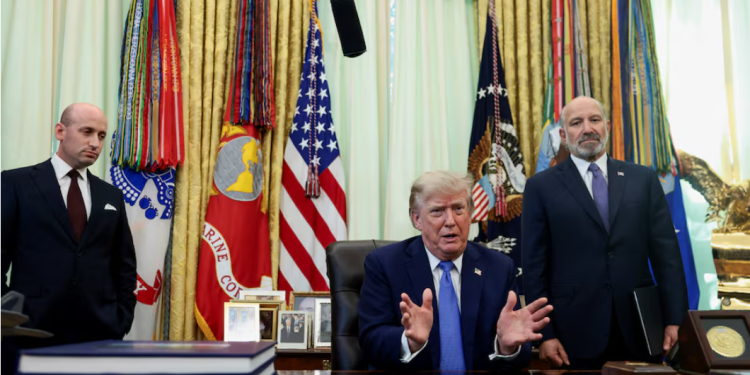
U.S. President Donald Trump has signed two new executive orders seeking to restrict birthright citizenship, days after the Supreme Court rejected his earlier attempt to limit the constitutional right.
The latest move marks a renewed effort by Trump’s administration to curb automatic citizenship for some children born in the United States, particularly those whose parents are foreign nationals.
Birthright citizenship has been a major focus of Trump’s immigration agenda, with his administration arguing that the policy has encouraged what it describes as “birth tourism” — the practice of pregnant foreigners travelling to the U.S. to give birth and secure citizenship for their children.
Trump’s earlier executive order, issued on his first day in office in 2025, sought to deny citizenship to children born in the U.S. when neither parent was an American citizen or lawful permanent resident.
The Supreme Court, however, struck down that broader approach in a 6-3 decision on June 30, ruling that the administration could not implement the policy in that form.
Rather than abandon the issue, Trump has now turned to two narrower executive orders. The administration argues that the new directives focus on historical exceptions to birthright citizenship and therefore fall outside the scope of the Supreme Court’s ruling.
At a signing ceremony in the Oval Office on Thursday, White House adviser Stephen Miller said the orders would end what the administration considers “birth tourism.”
The new directives also seek to restrict citizenship rights for certain children born to foreign government employees in the U.S. and children of people classified as enemy aliens. They could also have implications for people born in U.S. territories if Congress passes proposed legislation affecting citizenship there.
The move is expected to face fresh legal challenges.
Immigration advocates and legal experts have questioned whether the new orders can withstand constitutional scrutiny, arguing that the 14th Amendment broadly guarantees citizenship to people born in the United States.
Deborah Fleischaker, a former Biden administration official now with UnidosUS, described the orders as an attempt to circumvent the Supreme Court’s recent decision.
“Just five weeks ago, the Supreme Court made clear that birthright citizenship is not subject to a president’s whims,” she said.
Trump, meanwhile, has continued to defend his position, calling the Supreme Court’s June ruling “very unfortunate” and arguing that people are exploiting the citizenship system through birth tourism.
The 14th Amendment, adopted after the Civil War, contains the Citizenship Clause, which states that all persons born or naturalised in the United States and subject to its jurisdiction are citizens of the country and the state where they reside.
The provision has historically been understood to guarantee citizenship to nearly all children born on U.S. soil, with limited exceptions, including children of foreign diplomats.
Trump’s latest orders are therefore likely to reignite a major constitutional and immigration battle over the meaning and limits of birthright citizenship in the United States.
Source: Reuters