
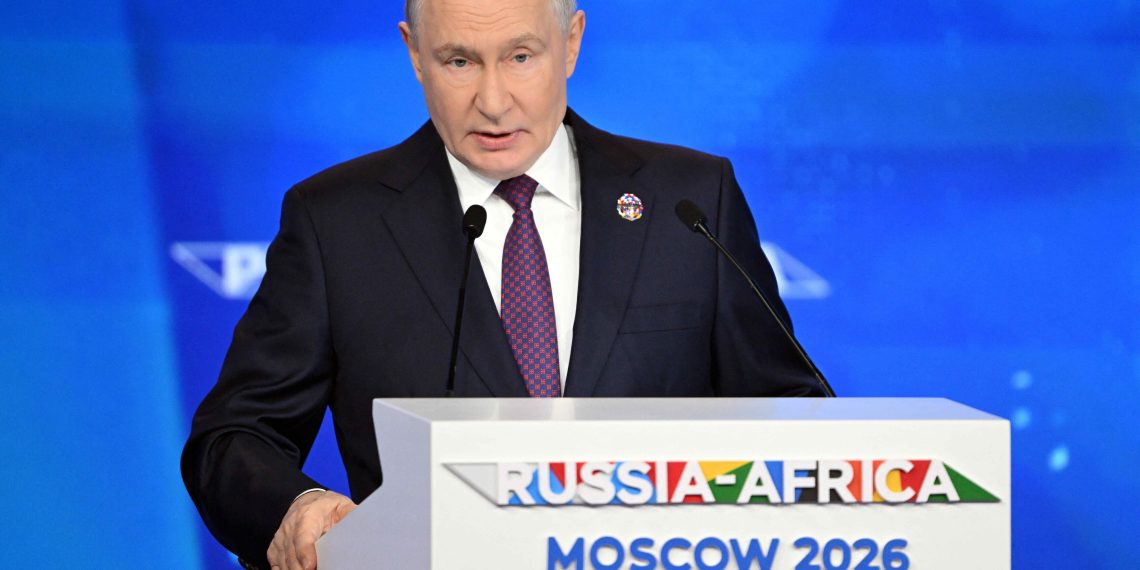
Russian President Vladimir Putin has presented Russia as a better development partner for Africa, promising technology transfer, infrastructure investment, local manufacturing and support for greater African representation in global financial institutions.
Speaking at the third Russia-Africa Summit in Moscow, Putin criticised Western countries for what he described as continued exploitation of Africa’s natural resources and the use of expensive loans that leave countries struggling with debt.
The two-day summit has brought together delegations from 48 African countries, including 22 heads of state, to discuss trade, food security, mining, energy, transport, education and digital technology.
Putin described Africa as an increasingly influential force in global affairs, arguing that the continent’s growing political and economic importance reflects the emergence of a multipolar world.
“Africa is increasingly asserting itself as one of the key players in the global economy and politics,” he said.
He accused Western powers of maintaining relationships rooted in colonialism and using financial arrangements that restrict Africa’s development. Russia, he argued, offers a different approach based on knowledge-sharing, local production and processing raw materials within African countries.
“Our business does not engage in the predatory, neo-colonial exploitation of natural and human resources, but rather expands the processing of raw materials locally, thereby creating new jobs and generating tax revenue,” Putin said.
The promise of local processing speaks to a longstanding challenge facing African economies. Many countries continue to export raw minerals, crude oil and agricultural commodities while importing finished products made from those same resources. This limits job creation and reduces the economic benefits retained within the continent.
Putin said Russia was prepared to expand cooperation in agriculture, mining, transport, power generation, healthcare and digital technology. He also pledged to increase grain and fertiliser supplies, noting that more than 40 African countries already receive Russian agricultural products.
Russia reportedly supplied about 13 million tonnes of agricultural products to Africa during the first nine months of 2026.
Moscow is also promoting agricultural-processing and machinery centres, irrigation projects, hydropower facilities and local production of medicines and vaccines. In education, Putin said about 40,000 Africans were studying at Russian universities, with government scholarship places for African students rising to 5,500 for the 2026–2027 academic year.
These proposals suggest that Russia wants to broaden its relationship with Africa beyond defence and security. However, their success will depend on whether they lead to actual investments, factories, infrastructure and sustainable jobs rather than remaining promises announced at diplomatic meetings.
Russia’s economic presence in Africa remains relatively small compared with those of China and the European Union. Russia-Africa trade was estimated at about US$27 billion in 2025, below the US$40 billion target Putin announced at the first summit in 2019.
The European Union’s trade with Africa stood at approximately US$395 billion in 2025, while China-Africa trade reached about US$348 billion.
Putin has now proposed doubling Russia-Africa trade and pushing it beyond US$50 billion in the coming years. Achieving that target will require Russia to expand its exports beyond grain, fertiliser, arms and energy-related products while creating greater opportunities for African goods to enter the Russian market.
African exports to Russia remain modest, and trade is concentrated in a limited number of countries. Better shipping connections, direct air links, banking relationships and trade-finance arrangements will be necessary to support wider commercial activity.
Sanctions against Russia also present challenges for payments, insurance and logistics, potentially increasing the cost and risk of doing business with Russian companies.
Putin proposed greater use of national currencies, Russia’s financial-messaging system and the Pan-African Payment and Settlement System to facilitate trade. Although these arrangements could reduce reliance on Western-controlled financial infrastructure, participating countries would still need to consider currency volatility, convertibility and regulatory risks.
Agriculture is one area where cooperation could deliver practical benefits. Russia is an important supplier of wheat and fertiliser to African markets, making access to these products significant for countries facing high food-import costs and climate-related production challenges.
However, long-term food security will require African countries to strengthen their own agricultural industries. Partnerships should therefore help provide machinery, improved seeds, fertiliser-production capacity, irrigation, storage facilities and food-processing technology, rather than deepen dependence on imported supplies.
Energy is another major area of interest. Russia’s state-owned nuclear company, Rosatom, has entered into agreements with several African countries involving nuclear power, research reactors and training.
Reliable electricity is essential for industrial development, healthcare and digital services. Nuclear energy could contribute to meeting Africa’s power needs, but such projects require substantial upfront investment, long construction periods and long-term commitments to fuel, maintenance and technical support.
Governments must carefully assess the costs, safety requirements and debt implications before signing agreements that could impose financial obligations for decades.
Russia’s engagement with Africa has also been shaped by security cooperation. Moscow has strengthened ties with several countries in the Sahel, particularly Mali, Burkina Faso and Niger, whose governments have moved away from traditional security relationships with France and other Western partners.
Russia provides military equipment, training and security assistance to governments battling armed insurgencies. Western governments have accused Moscow of using these relationships to expand its influence and gain access to strategic resources, allegations Russia rejects.
Burkina Faso’s Prime Minister, Rimtalba Jean Emmanuel Ouedraogo, praised cooperation with Moscow, describing it as transparent and respectful of African interests.
“This is completely different from what we had with imperialist France,” he said.
Nevertheless, the effectiveness of Russia’s security partnerships will be judged by their results. Parts of the Sahel continue to face serious militant violence despite changes in security alliances and the expansion of military operations.
Military assistance alone cannot address the underlying causes of instability, including weak governance, unemployment, limited public services and political exclusion. African governments must also ensure that security agreements are transparent and subject to public oversight, particularly where access to natural resources forms part of the relationship.
Putin also expressed support for stronger African representation at the International Monetary Fund and the World Bank, reflecting longstanding calls for reforms to global financial institutions.
African countries have argued that their voting power in these institutions does not adequately reflect their population or development needs. They have pushed for greater influence over debt restructuring, climate finance, international taxation and access to affordable development funding.
Russia’s support could strengthen calls for reform, but meaningful changes will require broader agreement among African governments, emerging economies and the existing shareholders of these institutions.
For Africa, the objective should be a more representative international system rather than alignment with one geopolitical bloc against another.
Putin’s criticism of colonialism and unequal economic relationships is likely to resonate with African governments seeking to retain greater control over their resources. However, historical solidarity and political rhetoric alone cannot establish whether Russia will deliver a better economic partnership.
Russia, China, Europe, the United States, India, Türkiye and Gulf countries all have commercial and strategic interests in Africa. The responsibility lies with African governments to assess each partnership on its own merits.
That means demanding transparent contracts, fair financing, technology transfer, local employment, environmental protection and clear commitments to domestic value addition. Infrastructure agreements should disclose their repayment terms, while mining partnerships should ensure that African countries receive a fair share of the value generated from their resources.
The Moscow summit demonstrates Russia’s determination to expand its influence and deepen its economic ties with Africa. The participation of dozens of African delegations also shows that governments are interested in widening their international partnerships.
Engaging Moscow does not necessarily require abandoning relationships with Western countries, China or multilateral institutions. Instead, African countries can use their growing range of options to negotiate better terms and advance their own development priorities.
Ultimately, Russia’s claim to be a better partner will depend on what it delivers after the speeches and agreements. African leaders must ensure that cooperation produces investment, industrial growth and employment without creating new forms of economic or political dependence.
The continent stands to benefit from competition among global powers, but only if African governments negotiate strategically and ensure that the benefits reach their economies and citizens.