

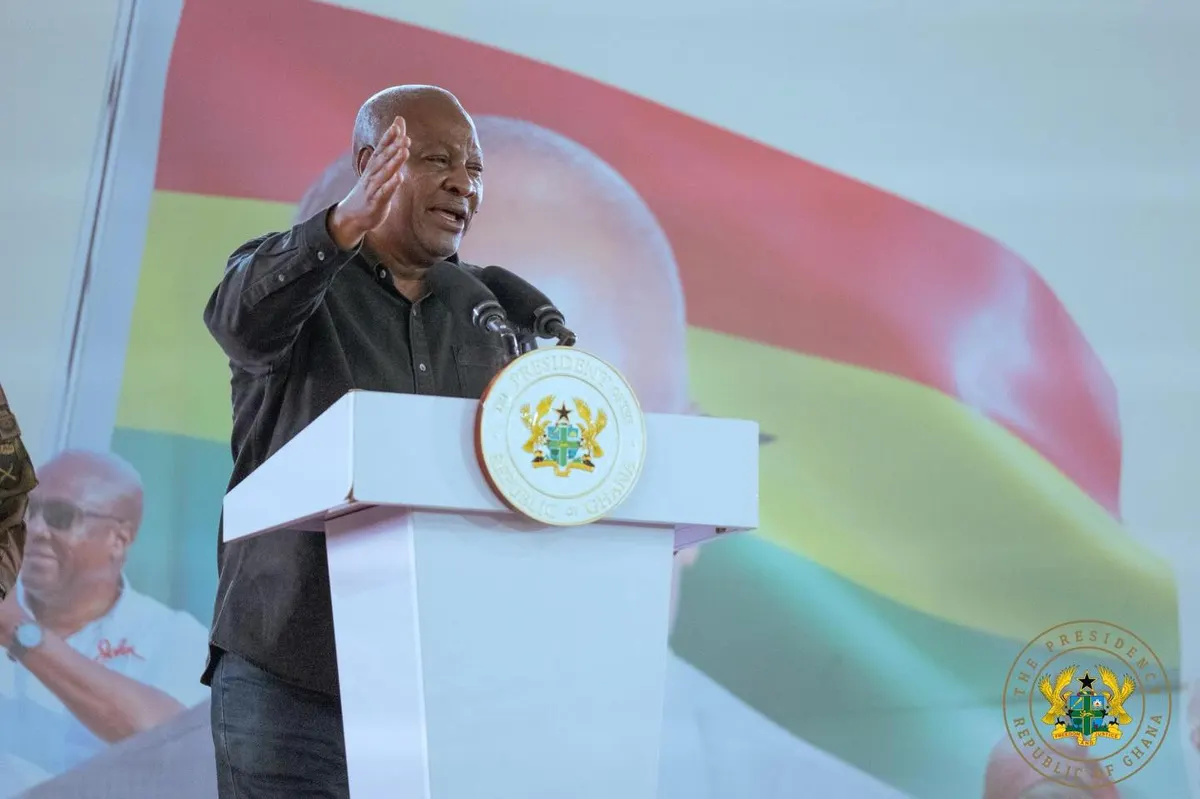
President John Dramani Mahama has called for a new law to criminalise the practice of employers demanding romantic or sexual relationships in exchange for jobs, describing the act as unacceptable and exploitative.
Speaking during a town hall meeting at Adweso in Koforidua on Saturday, May 2, 2026, the President said Ghana must take a firm stand against the growing concerns over “sex-for-jobs” demands in some workplaces.
Mr Mahama made the remarks while responding to a question from a female student of Ghana Senior High School in Koforidua during the final day of his two-day tour of the Eastern Region.
The student had raised concerns about gender inequality in employment opportunities, arguing that men are often favoured over women in many institutions. She also pointed to Eastern Regional Minister Rita Akosua Adjei Awatey as an example of what women can achieve when given equal opportunities.
Responding to the concern, President Mahama condemned the practice where some male employers allegedly demand intimate relationships from women before offering them jobs.
“One of the worst things, and I think we should pass a bill to make it punishable, is that sometimes if the employer or the person responsible for employing is a male, they demand some romantic relationship before they give them jobs,” he said.
“It is unacceptable. It must stop. There should be a law that deals with anybody who engages in that very strongly,” the President added.
Mr Mahama stressed that women are equally capable of excelling in all sectors and called for a shift in attitudes toward female participation in the workforce.
He noted that during his visits to road construction sites under the government’s Big Push Programme, he had been impressed by the number of female engineers supervising projects.
“I find it very admirable when I see the girls doing those kinds of jobs,” he said, adding that he often takes photographs with them to encourage more young women to pursue such careers.
The President also reaffirmed his administration’s commitment to implementing the Affirmative Action law and achieving gender parity in public appointments by 2028.
According to him, the government remains determined to work towards the law’s target of a 50-50 balance between men and women in public sector leadership and appointments.
“It is a tough call, but we will work at it,” he stated.