
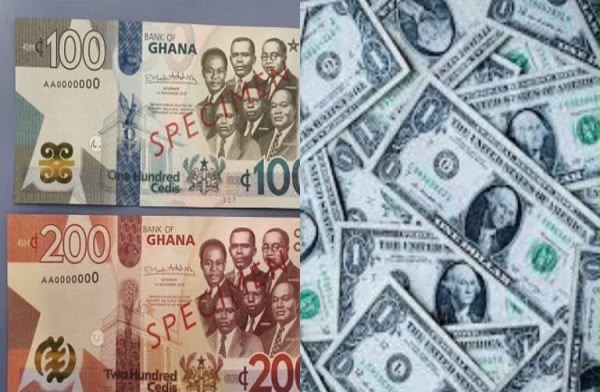
The Ghanaian cedi has come under renewed pressure in September, with its year-to-date depreciation against the US dollar widening to 9.50% after recording some gains in August.
Data from the Bank of Ghana show that the cedi traded at GH¢11.55 to the US dollar as of September 18, compared with GH¢11.25 at the end of August and GH¢10.45 in December 2025.
The latest figures point to a reversal of the currency’s August recovery, when the cedi strengthened after several months of volatility.
In July, the cedi had recorded a year-to-date depreciation of 10.60% against the dollar. That improved to 7.10% in August before worsening again to 9.50% in September.
The movement from GH¢11.25 to GH¢11.55 per dollar represents an increase of about 2.67% in the cedi cost of the US currency over the period.
The cedi has also weakened against the British pound and the euro.
Against sterling, the local currency traded at GH¢15.4464 per pound in September, up from GH¢15.2432 in August. This represents an increase of about 1.33% in the cedi cost of the pound.
The Bank of Ghana’s year-to-date figures show the cedi’s depreciation against sterling widening from 7.80% at the end of August to 9.00% in September.
Against the euro, the cedi moved from GH¢13.0681 in August to GH¢13.2445 in September, representing an increase of approximately 1.35%.
The year-to-date depreciation against the euro consequently widened from 6.10% to 7.30%.
Of the three major currencies, the US dollar continues to record the largest year-to-date gain against the cedi.
The cedi’s performance this year has been marked by significant fluctuations.
The currency started January at GH¢10.95 to the dollar and strengthened to GH¢10.6865 in February. It subsequently weakened to GH¢10.9980 in March and GH¢11.19 in April.
The pressure intensified in May, when the exchange rate reached GH¢11.73, before the cedi recovered to GH¢11.35 in June.
It then weakened again to GH¢11.69 in July before making a stronger recovery to GH¢11.25 in August.
The September figures indicate that some of those gains have now been reversed.
This performance is a notable change from 2025, when the cedi recorded a strong appreciation against the major currencies. According to the Bank of Ghana, the currency ended December 2025 with a year-to-date appreciation of 40.70% against the dollar, 30.90% against sterling and 24.00% against the euro.
The renewed weakness has also come amid a stronger US dollar internationally.
The US Dollar Index increased from 99.4 in August to 100.3 in September. The Bank of Ghana notes that an increase in the index indicates a strengthening of the US dollar against a basket of six major currencies.
A stronger dollar can add pressure to emerging-market currencies by increasing demand for dollar-denominated assets and raising the local-currency cost of imports and foreign-currency obligations.
The broader emerging-market currency index also weakened slightly, falling from 46.4 in August to 46.2 in September.
While these developments provide an external context for the cedi’s performance, they do not by themselves establish that global dollar strength was the sole cause of the depreciation.
Continued exchange-rate weakness could have implications for businesses and consumers, particularly where imported goods and inputs are involved.
Fuel, machinery, pharmaceuticals, raw materials and other imports priced in foreign currencies could become more expensive when the cedi loses value.
Businesses with dollar-denominated obligations may also face higher costs when their liabilities are converted into cedis. Similarly, a weaker cedi increases the domestic-currency value of Ghana’s external debt.
The actual impact on inflation and government finances, however, will depend on how long the depreciation lasts and how significant the movement becomes.
Another measure of the currency’s position, the Real Effective Exchange Rate, also points to some depreciation pressure. The index rose from 96.4 in July to 98.5 in August. The Bank of Ghana explains that an increase in the index represents a real depreciation of the cedi.
September data for the index were not yet available in the latest published summary.
Despite the recent weakness, the cedi remains stronger than some of the levels recorded in 2025. The exchange rate, for instance, reached GH¢12.42 to the dollar in September 2025.
The key issue heading into the final quarter of 2026 will therefore be whether the September decline develops into a sustained depreciation or proves to be a temporary reversal following the cedi’s August recovery.
As of September 18, the cedi had recorded year-to-date losses of 9.50% against the US dollar, 9.00% against sterling and 7.30% against the euro.