

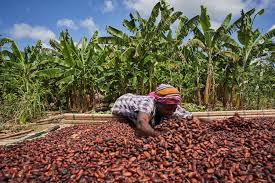
Ghana’s cocoa production could fall by at least 16% in the 2026/27 crop season, with climate change, disease, ageing farms and illegal mining posing growing threats to the country’s cocoa industry.
The warning from the Ghana Cocoa Board (COCOBOD) comes as the world’s second-largest cocoa producer faces a combination of environmental and production challenges that could affect both farmers and the global chocolate supply chain.
COCOBOD has linked the projected decline to the possible return of El Niño conditions, unusually heavy rainfall recorded in May and June, and the natural alternate-bearing cycle of cocoa trees, where a strong harvest is often followed by a weaker one.
The situation is particularly concerning in the Western and Western North regions, which have traditionally been among Ghana’s major cocoa-producing areas.
One of the biggest challenges facing farmers is Cocoa Swollen Shoot Virus Disease (CSSVD), which continues to affect cocoa farms across the country.
The disease can be devastating because infected trees often have to be removed before farms can be replanted. This means affected farmers may experience several years of reduced income before newly planted trees mature and begin producing commercially.
Ageing cocoa farms are adding to the problem. Many farms have moved beyond their most productive years, resulting in lower yields and increasing the need for rehabilitation and replanting.
COCOBOD is seeking to address some of these challenges through farm rehabilitation, expanded insecticide and fungicide spraying, as well as the reintroduction of a nationwide free fertiliser programme for the 2026/27 season.
However, the impact of these interventions will depend on how quickly ageing and diseased farms can be restored.
Illegal small-scale gold mining, popularly known as galamsey, presents an even more permanent threat to cocoa production.
Mining activities in cocoa-growing communities can destroy farms, degrade soil and pollute water bodies, while permanently reducing the amount of land available for agricultural production.
The growing overlap between major cocoa-producing areas and mining activities has therefore turned galamsey from an environmental problem into a direct threat to Ghana’s agricultural and export sectors.
Unlike disease, which can be tackled through rehabilitation and improved farm management, land destroyed by illegal mining can be extremely difficult and costly to restore to productive cocoa farmland.
Weather conditions are also creating uncertainty for the coming crop season.
Excessive rainfall can increase the spread of disease, disrupt flowering and affect pod development. At the same time, a return of El Niño could bring higher temperatures and irregular rainfall, placing additional stress on cocoa trees.
The potential impact extends beyond Ghana. Ghana and Côte d’Ivoire together account for a significant portion of global cocoa production, meaning a substantial decline in Ghana’s harvest could tighten global supplies and potentially put further pressure on cocoa and chocolate prices.
Broader warnings about the possible economic effects of a strong El Niño across Africa have also raised concerns about weaker agricultural production and wider economic pressures.
For Ghana, the implications of a weaker cocoa harvest go beyond international commodity prices.
Cocoa remains an important source of export earnings, rural employment and government revenue. A decline in production could therefore reduce foreign-exchange inflows at a time when Ghana is working to strengthen its external position and support currency stability.
Farmers could also face lower overall incomes, even if cocoa prices remain favourable.
This is particularly important following Ghana’s move to guarantee cocoa farmers at least 70% of the free-on-board export price, giving producers a stronger link to international cocoa prices.
However, a higher share of the export price cannot fully protect farmers if the amount of cocoa they produce and sell falls significantly.
Ghana’s production challenges come as major cocoa-producing countries in West Africa are pushing for closer cooperation on pricing, production and value addition.
Regulators from Ghana, Côte d’Ivoire, Nigeria and Cameroon have been discussing greater coordination to strengthen the influence of producing countries in the global cocoa market.
Nigeria, meanwhile, has been pushing for greater domestic processing rather than relying heavily on the export of raw cocoa beans.
The broader goal is to address a long-standing imbalance in the cocoa industry: African countries produce a large share of the world’s cocoa beans but capture a much smaller portion of the value generated by chocolate and other finished products.
A sustained decline in Ghana’s cocoa output could make that ambition more difficult.
Domestic processors need a reliable supply of cocoa beans, while lower production could create greater competition between export commitments and the needs of local processing companies.
The projected 16% decline is therefore more than a warning about one difficult cocoa season.
It highlights the growing interaction between climate change, farm productivity, disease, illegal mining and Ghana’s ambition to generate more value from its cocoa industry.
For policymakers, the challenge is no longer simply ensuring that farmers receive a fair price. It is also about protecting the productive capacity that allows farmers to produce enough cocoa to benefit from those prices.
Without sustained action to rehabilitate ageing farms, control disease and prevent the destruction of cocoa lands through galamsey, higher international cocoa prices alone may not be enough to put Ghana’s cocoa sector back on a path of sustained growth.