


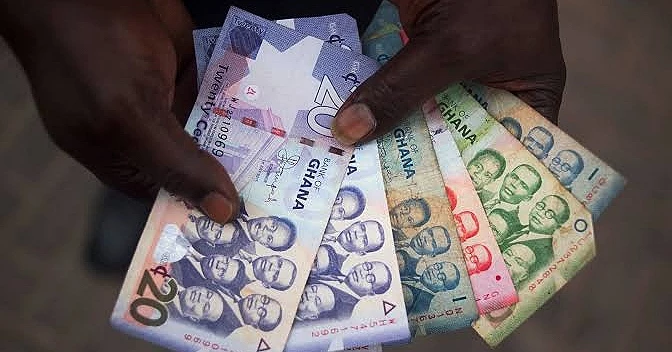
The Ghana cedi has continued to weaken against the US dollar, losing about 1.06% in less than a week as rising global oil prices threaten to add fresh pressure to the country’s foreign exchange market.
The Bank of Ghana’s September 9 reference rate put the dollar at GH¢11.4143 buying and GH¢11.4257 selling, giving a midpoint of about GH¢11.42 to the dollar.
This compares with around GH¢11.30 on September 3, indicating a depreciation of approximately 1.06% over the period.
The cedi also weakened between September 8 and 9, with the BoG’s selling rate rising from GH¢11.4007 to GH¢11.4257. The buying rate similarly increased from GH¢11.3893 to GH¢11.4143.
At the retail level, the dollar was being sold by some forex bureaux at around GH¢12.15 on Wednesday, significantly above the BoG’s selling rate of GH¢11.4257. The difference represents a premium of about 6.34%, reflecting tighter retail dollar liquidity and transaction costs.
The latest movement comes as Brent crude prices climb above US$100 a barrel, creating a potential new source of pressure for Ghana’s foreign exchange market.
Brent was trading at about US$100.95 a barrel on Wednesday afternoon after reaching US$101.58, amid growing concerns over supply disruptions linked to escalating US-Iran hostilities and attacks on shipping routes.
“The move towards and back above $100 Brent is reflecting a market that increasingly has to change its view on how long the Middle East crisis will continue to curb supply from the region,” Ole Hansen, head of commodity strategy at Saxo Bank, told Reuters.
The development is significant for Ghana because demand for US dollars was already rising before crude prices crossed the US$100 mark.
Reuters reported on September 3 that importers were increasing their dollar purchases, while foreign investors were repatriating coupon payments. Strong demand was also being recorded at the Bank of Ghana’s foreign exchange auctions.
A prolonged period of high oil prices could increase those pressures because Ghana, despite being an oil producer, imports large quantities of refined petroleum products.
Higher crude prices could boost Ghana’s oil export earnings, but they could also increase the amount of foreign currency needed to pay for petrol, diesel and other refined products. The overall impact on the cedi will depend largely on the timing and scale of oil export receipts compared with the country’s import requirements.
The situation is being compounded by disruptions in global oil and refined fuel markets. Reuters reported that physical crude benchmarks have remained above US$100 since September 3, while disruptions to refining and shipping capacity have tightened fuel markets.
The Strait of Hormuz has emerged as a major concern. Around one-fifth of global oil and gas supply traditionally passes through the waterway, while flows that had recovered to between 8 million and 9 million barrels per day before fighting resumed on August 30 have since fallen below 2 million barrels per day, according to Reuters.
For Ghana, the concern is therefore not coming from a single source. Importers, companies servicing foreign-currency obligations and foreign investors repatriating funds are already creating demand for dollars. A sustained rise in oil prices could add further demand from petroleum importers.
If these pressures occur at the same time as weaker foreign-exchange inflows or reduced central-bank supply, the cedi could face stronger depreciation pressures.
The Bank of Ghana has meanwhile introduced a new foreign exchange operations framework aimed at providing greater clarity on how it participates in the market while maintaining a flexible exchange-rate regime.
The central bank has said the framework reinforces its commitment to macroeconomic stability under its inflation-targeting mandate and a market-determined exchange rate.
This means the BoG can provide liquidity and intervene to smooth disorderly market conditions, but its interventions are not designed to permanently fix the value of the cedi.
Beyond the currency market, sustained high oil prices could also affect inflation. Higher fuel prices tend to increase transportation, logistics and production costs, potentially putting additional pressure on consumer prices.
That could create another challenge for the Bank of Ghana if higher energy costs begin to generate broader inflationary pressures.
For now, the cedi’s 1.06% decline since September 3 does not point to a disorderly market. However, the combination of rising corporate demand for dollars, foreign-investor repatriation and oil prices above US$100 presents a risk that could become more serious if the global energy shock persists.
The direction of the cedi in the coming weeks will therefore depend heavily on whether dollar inflows can keep pace with growing demand, particularly if Brent crude remains above US$100 a barrel.