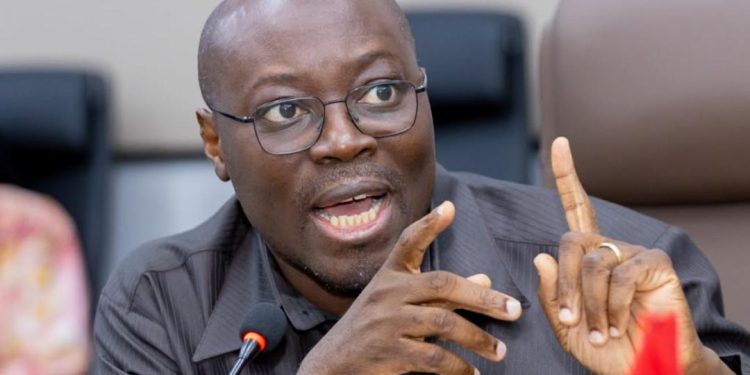


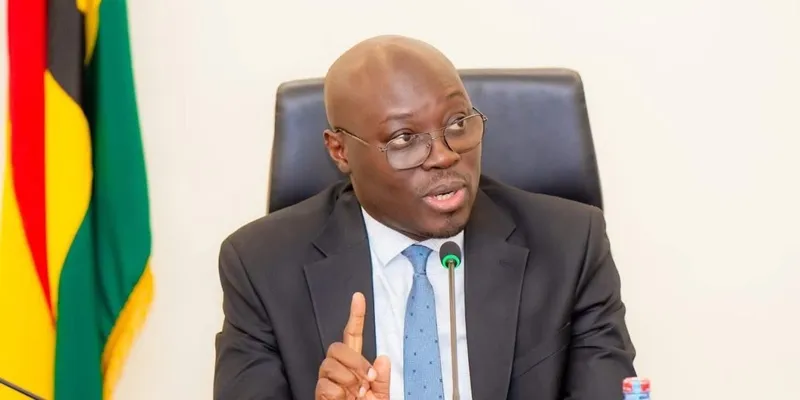
Finance Minister Dr Cassiel Ato Forson has assured Ghanaians that the government’s US$13 billion New Economy Programme will be funded without contracting new loans, insisting that the initiative will rely on domestic revenue and adjustments to fiscal targets.
Speaking at a forum with students and staff of the Kwame Nkrumah University of Science and Technology (KNUST) in Kumasi, Dr Ato Forson outlined the funding arrangements for the four-year programme, which will run from 2027 to 2030.
He explained that the government intends to dedicate an amount equivalent to 1.5 per cent of Gross Domestic Product (GDP) annually to the programme.
According to him, 0.5 per cent of GDP will come from government revenue, while the remaining 1 per cent will be made available by reducing the primary surplus target from 1.5 per cent to 0.5 per cent.
The Finance Minister said the two measures are expected to generate at least US$13 billion over the four-year period without adding to the country’s public debt.
His explanation comes after President John Dramani Mahama announced at the Hogbetsotso durbar on Saturday that the New Economy Programme would invest more than US$9 billion in job-creating sectors between 2027 and 2030.
However, the relationship between the US$9 billion investment figure and the broader US$13 billion funding envelope has not yet been clearly explained. The Institute for Economic Research and Public Policy (IERPP) has urged the government to provide a detailed breakdown in the 2027 Budget.
Dr Ato Forson also clarified that the Ghana Gold Board (GoldBod) does not contribute revenue to the government or the Finance Ministry, explaining that government financing comes from direct and indirect taxes as well as non-tax revenue.
On public debt, he maintained that the government’s target is to reduce the debt-to-GDP ratio to 45 per cent by 2028.
He pointed to the 2025 primary surplus of 2.5 per cent of GDP and an expected 1.5 per cent surplus in 2026, saying the combined fiscal performance would contribute to reducing the debt ratio by about four percentage points.
From 2027, however, the government plans to slow the pace of annual debt reduction to 0.5 per cent of GDP to create room for increased spending under the New Economy Programme.