

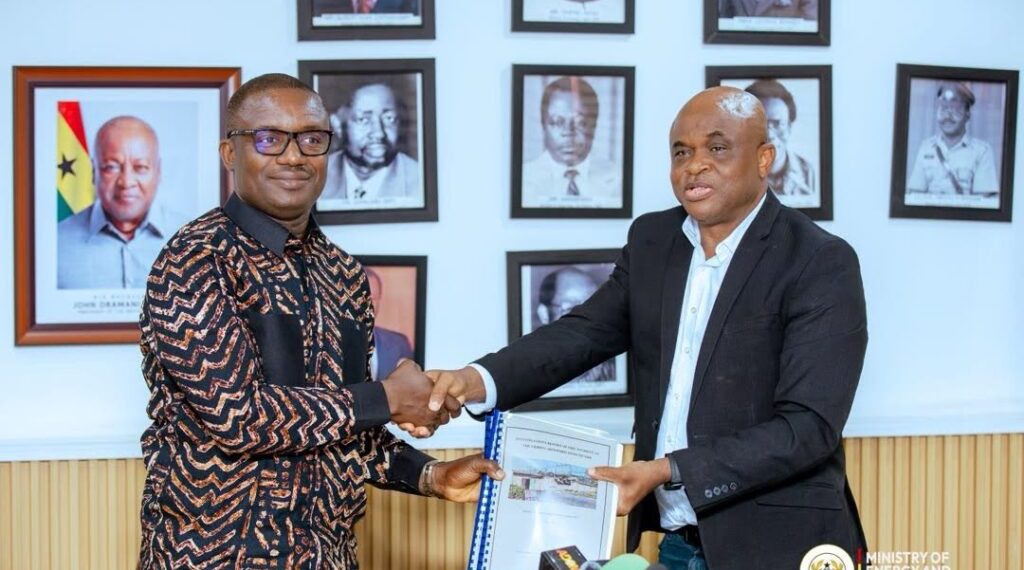
The Minister for Energy and Green Transition, Dr John Abdulai Jinapor, has received the final report on the fire outbreak at the Akosombo Substation, with the findings calling for urgent reforms to strengthen Ghana’s electricity transmission system and improve emergency response capacity.
The committee, chaired by Ing. Amuna, was mandated to determine the cause of the incident and propose measures to prevent a recurrence. Presenting the report, the Minister commended the team for what he described as their professionalism, diligence, and thorough work.
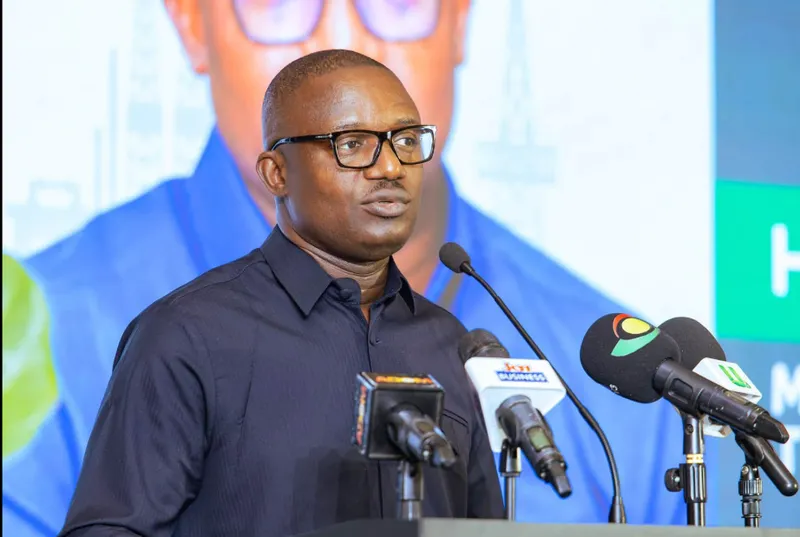
Dr Jinapor said government will carefully study the report and implement its recommendations, noting that the incident should serve as a serious warning for the power sector. He highlighted the need for improved maintenance practices, stronger emergency preparedness, and increased investment in critical transmission infrastructure.
According to him, the findings point to gaps that must be addressed to make the national grid more resilient and responsive. He stressed that Ghana must avoid a repeat of such incidents by strengthening systems and operational safeguards.
The Minister also indicated that accountability will not be ruled out where investigations establish lapses, even as he praised engineers for restoring power after the incident. He added that the report will be submitted to the President for further consideration.
As part of immediate measures, Dr Jinapor disclosed that a temporary control centre is being constructed using container-based structures to support ongoing operations. However, he noted that this is only a short-term solution, adding that Ghana requires a modern, purpose-built control facility to replace the outdated system currently in use.
He pointed out that the existing control infrastructure, which dates back to the 1960s, is no longer adequate for the demands of today’s power system. Upgrading it, he said, will require significant investment but must be done carefully and efficiently to avoid waste.
Dr Jinapor further argued that a more efficient energy sector should gradually reduce its dependence on government support and instead become financially sustainable, allowing public resources to be directed toward other national priorities such as health and education.
The Minister said relevant institutions have been tasked to develop an action plan based on the committee’s recommendations. The plan is expected to include stronger safety protocols, infrastructure upgrades, improved risk management systems, and regular audits of key installations across the transmission network.
Security at power facilities has also been strengthened following the incident, with support from national security and other agencies, although specific arrangements were not disclosed for operational reasons.
The committee also recommended the construction of a new control building but did not provide cost estimates, as its mandate was limited to technical investigation and recommendations. Detailed feasibility studies and financing decisions are expected to follow.
Energy analysts have long warned that Ghana’s power stability depends not only on generation capacity but also on the reliability of transmission infrastructure. A failure at a single critical substation, they note, can have nationwide consequences.
The Akosombo incident has therefore renewed calls for long-term investment in grid resilience, preventive maintenance, and stronger protection of critical energy assets.
Dr Jinapor’s comments suggest that government views the incident as part of a broader need to reform and modernise the power sector. The next phase will depend on how quickly recommendations are translated into funded projects and concrete implementation.
While Ghana has often responded to such incidents with strong technical reports, challenges have sometimes emerged at the implementation stage due to funding constraints and delays.