
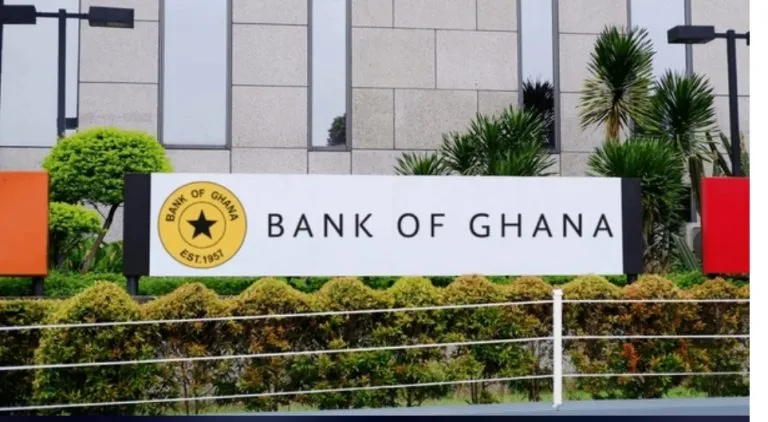
The Bank of Ghana (BoG) has absorbed GH¢13.83 billion through its 14-day bills, significantly increasing the amount sold at its latest auction while keeping the annual interest rate at 10.50 per cent.
Results of Tender 883, held on Monday, October 12, 2026, show that the central bank allotted GH¢13.83 billion through the short-term instrument, with a weighted-average discount rate of 10.4578 per cent and an annual interest rate of 10.50 per cent.
The latest sale represents a 53.5 per cent increase from the GH¢9.008 billion sold on October 7. It was also 31.4 per cent higher than the GH¢10.524 billion recorded on October 5.
Combined, the three operations generated approximately GH¢33.36 billion in gross sales, highlighting the scale of the central bank’s liquidity management activities in the short-term money market.
The sale does not represent new government borrowing. Unlike Treasury bills, which the government issues to finance its spending needs, Bank of Ghana bills are monetary-policy instruments used to manage liquidity in the financial system.
When the central bank sells these bills, participating financial institutions temporarily lock up funds that would otherwise remain available in the banking system. The money is returned when the securities mature, together with the applicable interest, unless the liquidity is absorbed again through subsequent operations.
Consequently, the GH¢13.83 billion sale does not necessarily represent the net amount withdrawn from the financial system. Repayments of maturing bills and other transactions could have injected funds into the banking system around the same period.
The published results do not provide details of maturing securities, the auction target or total bids submitted. It is therefore not possible to determine the net liquidity withdrawn or conclude that the auction was oversubscribed.
However, the volume sold indicates that financial institutions committed GH¢13.83 billion to the two-week securities at an annualised return of 10.50 per cent.
The interest rate remained virtually unchanged despite the significant increase in the amount sold. The weighted-average annual rate edged up from approximately 10.4987 per cent on October 7 to 10.5000 per cent on October 12, a negligible increase of about 0.13 basis points.
The latest auction also recorded a narrower range of discount rates, with bids concentrated between 10.4577 and 10.4578 per cent. This compares with a wider range of 10.4000 to 10.4578 per cent at the two earlier auctions.
The outcome suggests the Bank of Ghana was able to absorb a substantially larger volume of funds without materially changing the return offered to participating institutions.
The 10.50 per cent yield is also below the central bank’s policy rate of 14 per cent, leaving a gap of 3.50 percentage points, or 350 basis points. The difference highlights the distinction between the headline policy rate and the return on a specific short-term liquidity management instrument.
Through these operations, the central bank can withdraw excess balances from financial institutions and influence short-term interest rates. Without sufficient liquidity absorption, excess funds in the banking system could put downward pressure on money-market rates and weaken the transmission of monetary policy.
Liquidity management may also have implications for the foreign-exchange market. Excess cedi balances can contribute to demand for dollars as businesses and investors seek foreign currency for imports and other payments. Temporarily absorbing cedi liquidity can help moderate one potential source of pressure, although exchange-rate movements also depend on export earnings, remittances, foreign investment and the central bank’s foreign-exchange operations.
For commercial banks, the bills offer a relatively low-risk avenue for investing temporary surplus funds while earning a predictable return over a short period. However, sustained reliance on central-bank securities could influence how financial institutions allocate funds between these instruments and lending to businesses and households.
At the stated annual interest rate of 10.50 per cent, the GH¢13.83 billion transaction implies an estimated interest cost of about GH¢55.7 million over 14 days, using a simple 365-day calculation. The actual amount may vary depending on the Bank’s settlement and discounting conventions.
The interest cost represents part of the price of absorbing liquidity and must be considered alongside the potential risks of leaving excess funds in the banking system, including pressure on short-term interest rates and broader financial conditions.
The October 12 auction therefore points to an increase in the volume of liquidity being absorbed rather than a significant change in the price offered to investors.
Whether the larger sale reflects fresh liquidity pressures or the replacement of maturing securities will depend on subsequent auction results and maturity data.
For now, the Bank of Ghana continues to rely on short-term bills to manage money-market conditions, with the latest GH¢13.83 billion operation reinforcing the central bank’s commitment to maintaining its two-week bill yield around 10.50 per cent.