
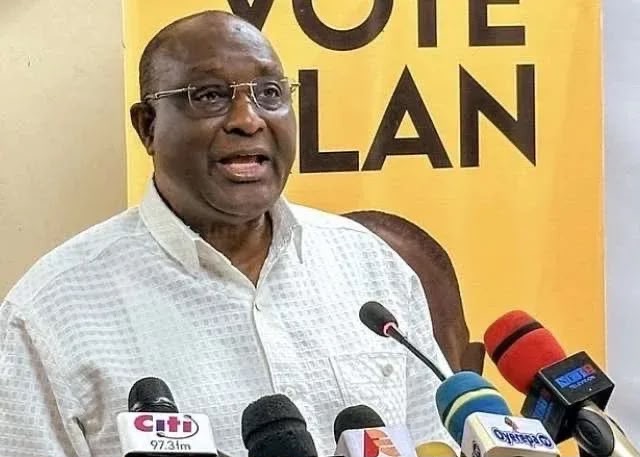
Founder and Leader of the United Party, Alan Kwadwo Kyerematen, has questioned the government’s decision to use public funds to finance the proposed US$4 billion Accra–Kumasi Expressway.
According to the former Trade and Industry Minister, a major tollable road project of that scale should attract private-sector financing rather than place the full financial burden on government.
Mr Kyerematen made the remarks on Wednesday, September 23, 2026, during a public lecture organised by the Center for Strategic African Development (CENSADEV) in Accra.
The lecture was held on the theme, “Transformation of the Ghanaian Economy: From Stability to Prosperity.”
While commending the Mahama administration for pursuing the long-awaited expressway project, Mr Kyerematen urged government to reconsider its approach to financing the project.
“We should commend the NDC government for thinking about the Accra-Kumasi Expressway. But I think government should not fund the $4 billion expressway. Why should you fund a road that can be tolled? It should have been given to the private sector. Four billion dollars could have done a lot for Ghana,” he said.
Government has estimated the project to cost about US$4 billion and has indicated that it intends to finance the project without borrowing, using domestic resources.
President John Dramani Mahama has also disclosed that US$2 billion has already been set aside, with government expecting to mobilise the full amount by the end of 2026.
The planned expressway will cover approximately 198.7 kilometres and feature a new six-lane carriageway. Government says the project is expected to reduce travel time between Accra and Kumasi to about two hours, lower transportation costs and create thousands of jobs during construction.
Mr Kyerematen’s concerns are consistent with his broader economic vision under his Great Transformational Plan, which calls for increased private-sector participation in major infrastructure projects.
The plan promotes financing arrangements such as Build-Operate-Transfer (BOT) models and other public-private partnerships as a way of reducing the direct financial burden on the state.
Beyond the expressway project, Mr Kyerematen said Ghana’s economic progress should not be measured only by improvements in inflation, the exchange rate and other macroeconomic indicators.
He argued that economic stability should serve as a foundation for investment, industrialisation, job creation and improved living standards.
He also criticised what he described as poor coordination in Ghana’s development planning and called for clear national performance indicators to measure the country’s progress.
“It’s a big joke if a country like Ghana does not set KPIs for where it wants to get to. How do you know you have reached your destination?” he asked.
The former Trade Minister further raised concerns about the high cost of credit, arguing that sustained reductions in inflation and the Bank of Ghana’s policy rate would be necessary to make borrowing more affordable for businesses.
He said Ghana should ultimately target a single-digit policy rate to create a more favourable environment for private-sector investment and business expansion.
Mr Kyerematen also questioned Ghana’s continued lack of a functioning national airline, saying it was an example of the country’s difficulty in turning its strategic advantages into productive national assets.
He maintained that Ghana’s economic conversation must now move beyond stability and focus on building a coordinated system that can deliver sustained growth, investment, infrastructure development and improved living standards.