

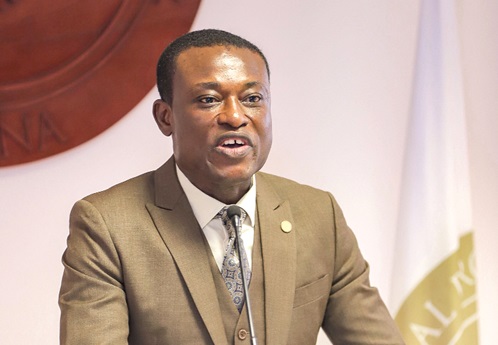
Special Prosecutor Kissi Agyabeng has called for the Office of the Special Prosecutor (OSP) to be constitutionally entrenched and given greater financial independence to enable it to fight corruption more effectively.
According to Mr Agyabeng, five years of leading the OSP has given him enough practical experience to identify the structural challenges that continue to limit Ghana’s anti-corruption institutions.
Speaking at the National Anti-Corruption Dialogue, he said political commitment alone would not be enough to deliver lasting results if institutions responsible for investigating corruption remain constrained by their legal and financial arrangements.
“After five years in office as the Special Prosecutor, at least we can say, if for nothing at all, we know what we are doing now,” he said. “And by knowing what we are doing, we can say we know what works and what doesn’t work.”
Mr Agyabeng acknowledged what he described as the government’s commitment to the fight against corruption since January 2025, including cooperation among the OSP, the Commission on Human Rights and Administrative Justice (CHRAJ) and government.
However, he maintained that goodwill would not be enough to address the weaknesses within the country’s anti-corruption framework.
“What doesn’t work is the state of the anti-corruption institutions at the moment,” he said, pointing to their statutory framework and financing as major concerns.
His strongest proposal is for the OSP, or whatever institution may succeed it in future, to be protected by the Constitution.
“If we do not write into the Constitution the office of the Special Prosecutor, however it is called, we are going nowhere,” Mr Agyabeng said.
He explained that constitutional protection would give the institution a stronger legal foundation and reduce the risk of future governments weakening or altering its mandate through ordinary legislation.
But he stressed that constitutional protection must be matched with financial independence.
“If you do not grant it financial independence,” he warned, the institution would remain vulnerable to the limitations associated with dependence on annual government budget allocations.
Mr Agyabeng disclosed that proposals had been presented to Parliament for a dedicated funding mechanism for anti-corruption institutions, including the OSP and CHRAJ.
He said reliable funding was particularly important because corruption investigations can involve complex financial transactions, forensic accounting, cross-border dealings and sophisticated asset-tracing exercises that require significant resources and specialised expertise.
The Special Prosecutor also called for stronger asset-recovery laws, particularly legislation allowing the state to pursue assets linked to illicit enrichment without necessarily securing a criminal conviction first.
He argued that non-conviction-based asset recovery would give authorities another avenue to target suspicious wealth while still operating within appropriate legal safeguards.
“If we do not stamp that firmly in the pieces of legislation, we are going nowhere,” he said.
Mr Agyabeng further proposed a reverse-onus provision that would require individuals to explain wealth that appears significantly disproportionate to their legitimate sources of income.
“The presumption of corruption should be instituted where it is very clear that a person is unable to explain their wealth as much to their lawful sources of income,” he said.
He linked the proposal to lifestyle audits, which would allow authorities to examine whether an individual’s assets and standard of living are consistent with their declared income.
“This is lifestyle audit: show that you are able to afford these things that you claim you have,” he explained.
The proposals, however, would require strong legal and constitutional safeguards to protect legitimate property rights and ensure judicial oversight.
Mr Agyabeng ultimately identified four key reforms he believes are necessary to strengthen Ghana’s anti-corruption fight: constitutional independence, financial independence, a reverse-onus presumption in cases of unexplained wealth, and non-conviction-based asset recovery.
“If we do not commit to these things,” he said, “it won’t work.”
His comments shift the focus of Ghana’s anti-corruption debate from simply having institutions in place to whether those institutions have the independence, resources and legal powers needed to deliver results.
After five years at the OSP, Mr Agyabeng believes the country has learnt enough about what works and what does not. The bigger question, he suggests, is whether Ghana is willing to make the structural changes needed to turn its anti-corruption ambitions into sustained enforcement.