
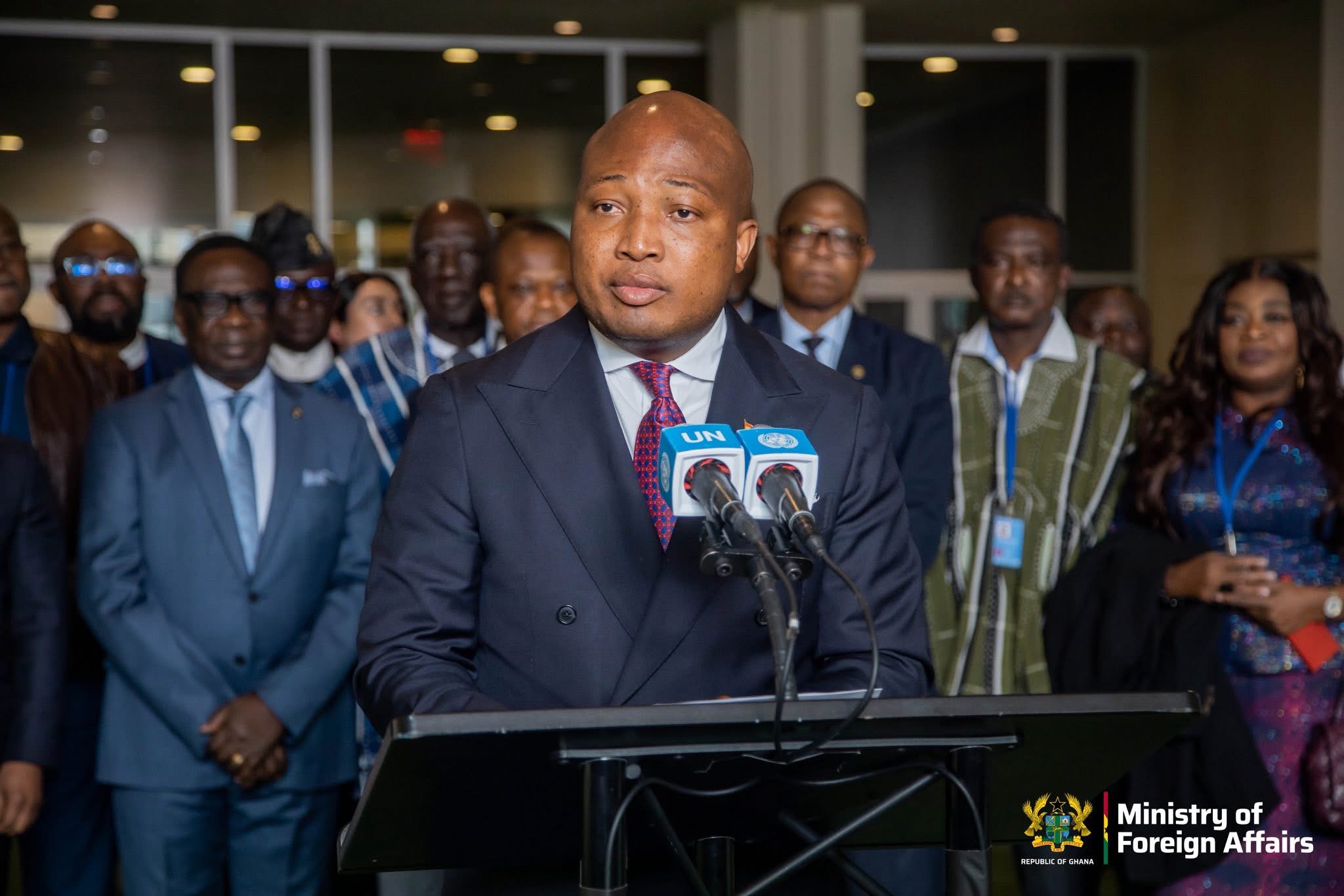
Ghana’s Minister for Foreign Affairs, Samuel Okudzeto Ablakwa, has clarified that ongoing calls for reparatory justice are not aimed at securing direct financial payouts for political leaders, but rather at addressing deep-rooted inequalities affecting African communities.
Speaking at a press conference in Accra on March 31, 2026, the Minister stressed that the focus of the reparations agenda is on long-term development and empowerment.
“As leaders, we are not interested in direct payments to us. This is not a profit-making venture,” he stated. “However, there is a need for financial support to fund education, infrastructure, skills training, entrepreneurship, and even psychosocial care for affected communities.”
Ablakwa encouraged stakeholders to examine the CARICOM 10-point plan, which outlines a comprehensive framework for reparatory justice. According to him, the plan addresses not just economic disparities but also historical and health-related consequences of slavery.
He noted that research has linked some of the health challenges faced by people of African descent to the inhumane conditions endured during the transatlantic slave trade, including the experiences in slave ships, dungeons, and coastal forts.
While acknowledging the impossibility of fully compensating for the scale of historical injustices, the Minister said the newly adopted resolution provides a structured pathway for global engagement. Key areas include compensation, institutional reform, historical research, and the restitution of cultural heritage.
Ablakwa also rejected claims that the transatlantic slave trade was a mutually beneficial system involving Africans. He described such narratives as misleading and divisive, emphasizing that the system lacked consent and was driven by coercion and violence.
“What transpired was organised human trafficking driven by external demand and enforced through transcontinental systems,” he explained, adding that although local intermediaries existed, they neither controlled nor owned the system.
The United Nations resolution, A/RES/80/250, was adopted on March 25, 2026, after being championed by President John Dramani Mahama in his role as the African Union Champion on Reparations.
A total of 123 UN Member States voted in favour of the resolution, with three countries opposing and 52 abstaining.
The Minister expressed gratitude to the African Union, CARICOM, the Community of Latin American and Caribbean States (CELAC), and all supporting nations for their commitment to advancing the reparations agenda.