
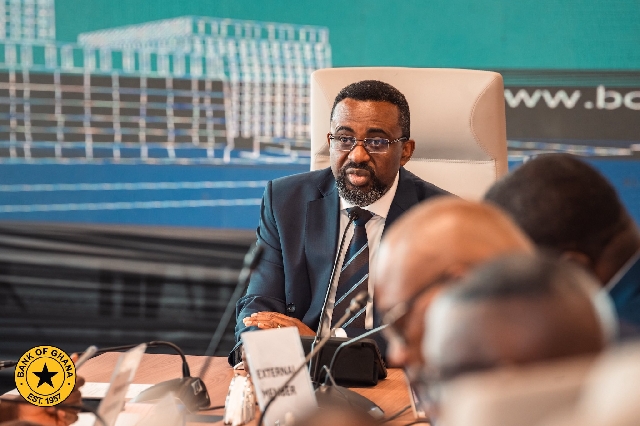
The Secretariat spearheading Ghana’s flagship 24-Hour Economy programme has held high-level talks with the Bank of Ghana as part of efforts to align the initiative with the country’s broader macroeconomic policy direction.
The engagement forms part of an ongoing stakeholder consultation process aimed at presenting the policy framework, gathering institutional feedback, and forging partnerships critical to the programme’s rollout. With the policy transitioning from the planning phase to implementation, the Secretariat is intensifying collaboration with key economic actors to ensure coherence and sustainability.
Presidential Advisor on the 24-Hour Economy Programme, Goosie Tanoh, expressed appreciation to the central bank’s leadership and technical teams for their openness and support during the discussions.
He noted that Ghana’s immediate economic priority remains the consolidation of macroeconomic stability and the strengthening of resilience. According to him, the stabilising role played by the Bank of Ghana has helped lay a solid foundation for economic recovery, expansion in productive sectors, and growth in domestic output and exports.
Mr. Tanoh explained that the 24-hour economy policy is designed to build on these gains by introducing targeted, sector-specific interventions that translate macroeconomic stability into sustained and inclusive growth. He cited recent improvements, including steady treasury bill performance and easing inflationary pressures, as signs of a more stable environment conducive to long-term development.
A major focus of the meeting was the proposed establishment of a Food Security and Price Stabilisation Fund. The fund is expected to help manage commodity price volatility, reduce food inflation, and enhance national food security, while complementing existing monetary policy tools.
The discussions also explored potential areas of collaboration between the Secretariat, commercial banks and the central bank. Among the proposals considered were a 24H+ credit policy and enterprise financing framework, joint credit assessment mechanisms, syndicated and direct lending models, and balance sheet support for eligible businesses operating under the 24-hour economy initiative subject to strict due diligence.
Additional topics included the use of credit insurance schemes to strengthen collateral frameworks, regulatory considerations for loan portfolios tied to the programme, foreign exchange hedging instruments to support SME lending at competitive rates, and digital platforms to expand access to trade and financial services.
The engagement is expected to pave the way for strategic regulatory and policy measures aimed at strengthening Ghana’s financial services architecture to support the growth and competitiveness of enterprises operating within the 24-hour economy framework.