


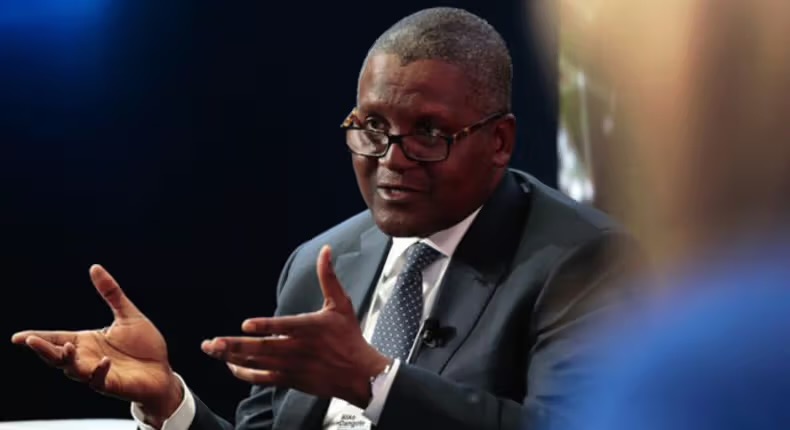
Nigerian industrialist Aliko Dangote has urged Ghana to expand its industrial ambitions beyond its domestic market and position itself to serve the estimated 450 million people across West Africa.
Speaking at the maiden Invest in Ghana Summit, Dangote said Ghana had a much larger market within reach than its population alone suggests, urging businesses to invest in manufacturing, agriculture and regional infrastructure to take advantage of the opportunity.
“When you are talking about Ghana’s market, it’s not only the population of Ghana. Ghana’s market, I was telling you, is 450 million people’s market,” he said.
He argued that Ghana could become a major manufacturing and distribution hub for the sub-region if local businesses increased production and took advantage of regional trade opportunities.
Dangote identified rice, sugar and cocoa processing as areas where Ghana could attract significant investment. He disclosed that discussions were ongoing with the government over a proposed sugar investment that could create nearly 50,000 jobs.
He also expressed interest in establishing an additional 500,000 metric tonnes of rice-processing capacity in Ghana, subject to an agreement with the government. Cocoa processing was another area he identified as having investment potential.
Although the proposals could strengthen Ghana’s agricultural and manufacturing sectors, they remain at the discussion and proposal stages. Their impact will depend on whether the investments secure the necessary agreements, financing and infrastructure to become operational.
Dangote also called on African countries to reduce their dependence on imported finished products, arguing that local production was essential to creating jobs and building lasting prosperity.
“If you are a consumer, you are not a producer; you will never, ever create jobs. You will never, ever create prosperity,” he said.
Using rice production as an example, he urged Ghana to support local farmers and processors, even where the cost of locally produced rice is slightly higher than imported alternatives.
“Even if today in Ghana you are producing rice at a little bit more expensive than the imported one, it’s okay,” he added.
His remarks highlight the importance of building a strong local production base rather than relying heavily on imported goods. However, sustaining such a shift will require improvements in productivity, production costs and product quality to ensure locally manufactured goods remain affordable and competitive.
Beyond production, Dangote stressed the need for stronger transport connections between West African countries to make regional trade easier.
He proposed the construction of a 1,000-kilometre road linking Nigeria, Ghana and Côte d’Ivoire, saying improved connectivity would support the movement of goods and strengthen economic relations among the three countries.
He said he intended to engage President John Dramani Mahama and other regional leaders to push the proposal forward.
The proposed road could improve access to markets and reduce transportation challenges for businesses, although details regarding its route, financing and implementation are yet to be established.
Dangote’s remarks bring attention to a key challenge facing Ghana’s industrial ambitions: having access to a large regional market is one thing, but having the capacity to supply it is another.
For Ghana to benefit, businesses must be able to produce consistently, secure reliable raw materials and transport finished goods at competitive costs. Stronger regional trade arrangements and investment in infrastructure will also be important.
The proposed sugar and rice investments could create opportunities for farmers, processors and workers if they materialise. But their success will ultimately depend on execution and the extent to which they strengthen local production.
West Africa’s 450 million-person market presents a significant opportunity for Ghanaian businesses. The challenge is to build the production capacity, infrastructure and competitiveness needed to turn that market into real economic gains.