
The Bank of Ghana (BoG) has withdrawn GH¢28.24 billion from the financial system through its latest 14-day bills auction, underscoring its continued efforts to manage excess liquidity and maintain stability in the money market.
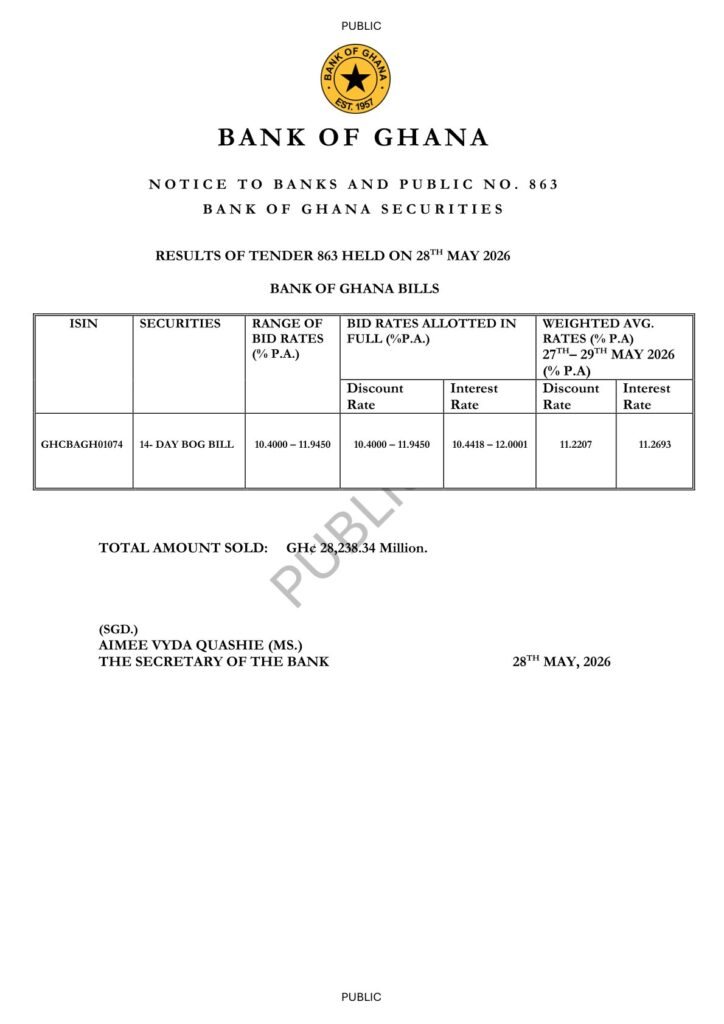
Results from Tender 863, conducted on May 28, 2026, showed that the central bank sold GH¢28.24 billion worth of 14-day Bank of Ghana bills under ISIN GHCBAGH01074.
The auction attracted strong participation from banks and institutional investors, with bid rates ranging between 10.40 percent and 11.95 percent. All successful bids were accepted within that range.
BoG’s weighted average discount rate for the auction stood at 11.22 percent, while the weighted average interest rate settled at 11.27 percent.
The sizeable operation highlights the central bank’s ongoing reliance on short-term securities to absorb excess liquidity from the banking sector. Such interventions are aimed at supporting monetary policy objectives, preserving recent gains in inflation reduction, and ensuring stability in short-term interest rates.
The 14-day bill remains one of the Bank of Ghana’s key open market instruments for regulating liquidity and influencing conditions in the money market.
The latest auction also reflects the significant amount of liquidity currently being sterilised through short-dated central bank securities, even as interest rates have moderated considerably from the elevated levels experienced during Ghana’s recent inflation and debt crisis.
For commercial banks and other institutional investors, the bills provide a relatively low-risk short-term investment option. For the central bank, however, they serve as an important tool for transmitting monetary policy and preventing excess liquidity from exerting pressure on inflation and exchange rate stability.
Market analysts say the strong demand recorded at the auction points to growing confidence in Ghana’s macroeconomic outlook and continued investor appetite for safe, short-term instruments.
At the same time, the scale of liquidity absorption is expected to keep attention on the cost of sterilisation and its impact on the Bank of Ghana’s finances, particularly following recent public discussions about the central bank’s financial position and the cost of monetary operations.
While the strategy remains crucial for maintaining price stability, policymakers continue to face the challenge of balancing effective liquidity management with the financial costs associated with large-scale sterilisation.
The outcome of Tender 863 reinforces the Bank of Ghana’s active role in the short-term money market and highlights the continuing importance of liquidity management in supporting the country’s post-stabilisation economic recovery.