

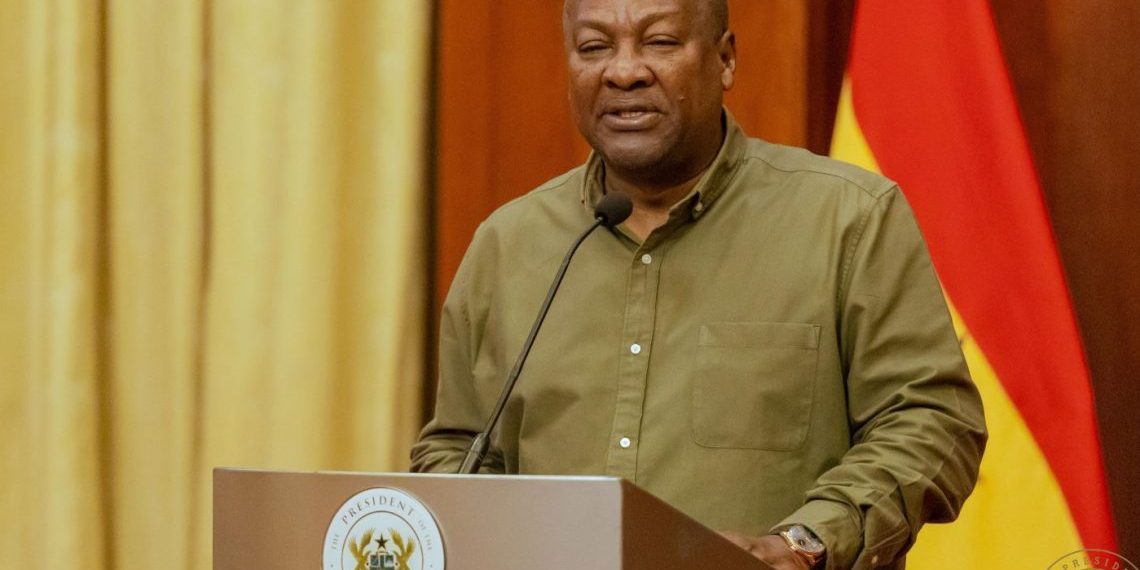
President John Mahama has warned mining companies operating in Ghana to prepare for a planned ban on the export of unprocessed mineral ores by 2030, as the government seeks to retain more of the value generated from the country’s natural resources.
Speaking at the Council on Foreign Relations in New York, President Mahama said companies extracting minerals in Ghana should begin investing in local processing facilities ahead of the proposed deadline.
“By 2030 we’re not going to export any raw ores,” he said, adding that mining companies should undertake “at least primary and secondary processing” in Ghana.
The proposed policy is expected to have greater implications for minerals such as manganese, bauxite, iron ore and lithium than gold, which is already exported largely in semi-refined doré form.
The government’s broader objective is to move Ghana’s mining industry away from an extract-and-export model and make it a stronger foundation for local industrialisation, employment, technology transfer and economic growth.
Ghana has significant deposits of gold, manganese, bauxite, diamonds and lithium. However, much of the value generated after extraction, including refining, manufacturing, fabrication and specialised services, continues to take place outside the country.
The proposed 2030 deadline is intended to change that. However, the policy will have to overcome significant legal and practical challenges before it can be fully implemented.
At present, Ghana has no general law requiring all minerals to be processed domestically before export. The Minerals and Mining Bill presented to Parliament in May would give the sector minister powers to restrict the export of unprocessed mineral concentrates and require local processing.
However, the bill does not itself establish a 2030 deadline or make such a ban automatic. Separate regulations would be required to give effect to the proposed restrictions.
This legal uncertainty could be important for mining companies making long-term investment decisions. Building refineries, smelters and other processing facilities requires significant capital, and companies would need clarity on what will qualify as “raw” or “processed” minerals, the implementation timeline and the penalties for non-compliance.
Lithium could be one of the areas where the policy raises the biggest questions.
Ghana’s Ewoyaa lithium project is expected to produce spodumene concentrate. While concentrate has undergone processing beyond the raw ore stage, it is still several steps away from the lithium chemicals used in battery manufacturing.
It remains unclear whether the government’s proposed policy would allow the export of concentrate or eventually require companies to undertake chemical conversion in Ghana.
The timing of the proposed ban also raises questions about political continuity. President Mahama’s current constitutional term ends in January 2029, one year before the proposed 2030 deadline.
That means the implementation of the policy could ultimately depend on the next administration maintaining the commitment and completing the necessary legislative and regulatory processes.
Mining companies may therefore seek greater certainty before committing large amounts of capital to domestic processing facilities.
Ghana has made similar commitments in the past. In 2024, former President Nana Akufo-Addo told Parliament that his administration intended to prohibit the export of raw bauxite and said negotiations for a $450 million manganese refinery were nearing completion.
The continued debate over mineral processing suggests that the challenge has been less about political declarations and more about creating the conditions needed for commercially viable processing.
Reliable electricity, financing, transport infrastructure, technology and access to markets will all be critical if Ghana is to process more of its minerals locally.
The government will also have to determine whether processing plants should be built by individual mining companies, joint ventures, private operators or through public-private partnerships serving several producers.
Gold provides an early example of the administration’s approach.
Since July, large-scale mining companies have been required to sell 30 per cent of their gold production to the Ghana Gold Board in doré form for local refining. The government also wants at least one Ghanaian refinery to obtain London Bullion Market Association accreditation by 2030, which would help locally refined gold gain wider acceptance in international markets.
GoldBod has also entered agreements with two domestic refineries, while restrictions have been placed on the export of unrefined artisanal gold without confirmation that the gold has been refined locally.
These measures suggest that future mineral policies could increasingly link access to export markets with domestic processing requirements.
However, local processing alone will not automatically create a large industrial base. To generate greater economic benefits, Ghana will need to connect mineral processing to downstream activities such as manufacturing, fabrication, technology and skills development.
There is also a risk that imposing a processing requirement before sufficient capacity is available could disrupt production or discourage new investment.
Manganese and bauxite processing, for example, require large and reliable supplies of electricity and significant investment in infrastructure, while lithium conversion requires specialised technology, chemicals and environmental safeguards.
The government will therefore need to balance its industrial ambitions with the cost of doing business in Ghana. If local processing is significantly more expensive than competing jurisdictions, companies could delay investments or reconsider planned projects.
President Mahama has effectively given mining companies four years to prepare for the proposed change.
Whether the 2030 target becomes a lasting transformation of Ghana’s mining industry will depend on what happens between now and then particularly the passage of clear laws, the development of processing capacity, reliable energy and infrastructure, and whether the policy survives a change of government.