


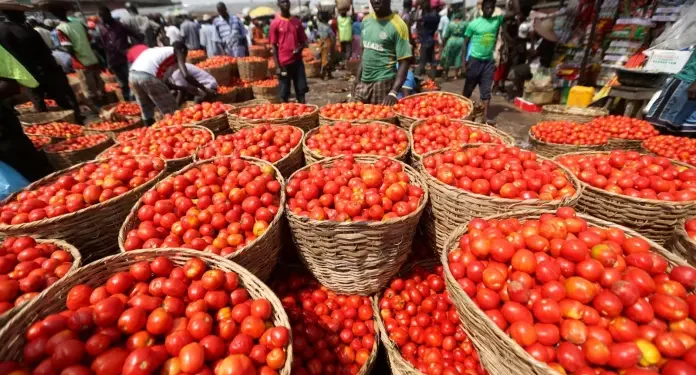
Ghana’s ambition to achieve tomato self-sufficiency could face a major production challenge, with the country’s supply gap potentially approaching 400,000 metric tonnes when post-harvest losses are taken into account.
The Chamber of Agribusiness Ghana says the estimated shortfall raises questions about whether the government’s plan to produce an additional 100,000 tonnes under the Ghana Tomato Self-Sufficiency Initiative (GHATSI) will be enough to meet national demand.
Chief Executive Officer of the Chamber, Anthony Morrison, told Citi Business News that Ghana’s annual tomato demand is estimated at about 800,000 metric tonnes, while peak domestic production stands at approximately 510,000 tonnes.
This puts the country’s existing supply deficit at about 290,000 tonnes.
However, Mr Morrison said the gap becomes significantly wider when post-harvest losses, estimated at between 20% and 30%, are factored in.
“That tells you that our peak supply gap is around almost 400,000,” he said.
His comments follow the launch of GHATSI, which aims to produce an additional 100,000 tonnes of tomatoes from more than 10,000 acres across 35 districts in 10 regions.
While welcoming the initiative, the Chamber says the government needs to provide more clarity on how the 100,000-tonne target will be achieved.
Mr Morrison questioned whether the additional production would come from new farmers, increased production by existing farmers, expanded acreage, or improved yields.
“How do we mitigate that with regards to working around bringing on board additional 100,000? Are these additional 100,000 new farmers or already existing farmers?” he asked.
He also questioned whether the more than 10,000 acres identified under GHATSI represent entirely new farmland or an expansion of land already being cultivated by tomato farmers.
“If they are already existing farmers, are their current crop size being increased? By what? Who is doing the data analysis?” he asked.
According to the Chamber, these details are important because simply identifying additional acreage does not necessarily translate into a specific volume of tomatoes. The expected yield per acre and the production capacity of participating farmers will determine how much the initiative can actually add to Ghana’s national supply.
The Chamber is therefore calling for clear production data and assumptions to be made available to properly assess whether GHATSI’s 100,000-tonne target can significantly narrow the country’s tomato supply gap.