

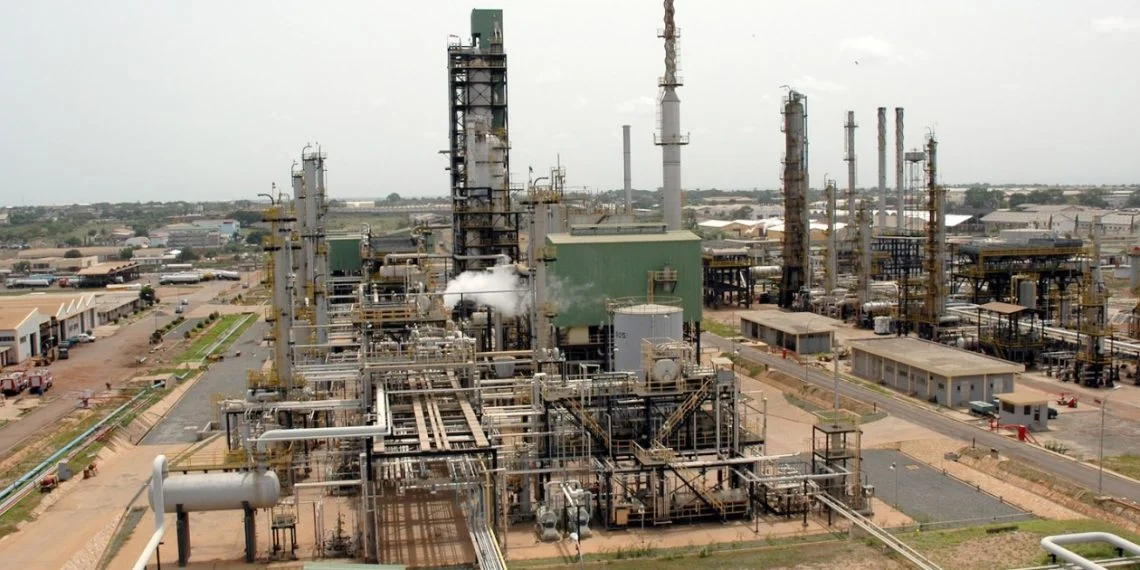
President John Dramani Mahama has directed the Ministry of Energy and Green Transition, together with the Board and Management of the Tema Oil Refinery (TOR), to develop a strategic roadmap to expand the refinery’s capacity to 100,000 barrels of crude oil per day.
The directive signals a broader ambition for TOR beyond simply restoring its operations. Government wants to reposition the state-owned refinery as a commercially viable processing hub that can support Ghana’s industrialisation, strengthen energy security and serve the wider West African market.
President Mahama announced the plan on August 1 during the commissioning of the refurbished refinery at the Tema Industrial Enclave.
The commissioning followed TOR’s successful processing of one million barrels of locally produced Jubilee Field Medium Sweet Crude into finished petroleum products, marking an important step in reconnecting Ghana’s upstream oil production with its domestic refining industry.
According to the President, the objective is not merely to keep TOR running but to transform it into a more efficient, competitive and financially sustainable refinery.
Over the past months, TOR has undergone a number of rehabilitation works, including the refurbishment of its Crude Distillation Unit, restoration of the Residual Fluid Catalytic Cracking Unit, installation of a new F-61 crude heater and the return of Boiler No. 8 to service.
Mahama said the investments demonstrate renewed confidence in Ghana’s ability to operate and develop strategic industrial assets.
However, expanding TOR to 100,000 barrels per day would require a much larger investment and a clear strategy for ensuring the refinery remains commercially sustainable.
At full capacity, TOR could play a significantly bigger role in meeting Ghana’s domestic petroleum needs while potentially supplying refined products to neighbouring West African countries.
The success of such an expansion would depend on several factors, including reliable access to crude oil, sufficient working capital, efficient operations and competitive production costs.
Government is also considering institutional reforms aimed at protecting TOR from political interference, which has historically affected the management and performance of some state-owned enterprises.
For TOR, good governance could be just as important as the physical expansion of the refinery.
A refinery may have functioning equipment but still struggle if crude procurement, financing, pricing, maintenance and management decisions are not handled with strong commercial discipline.
President Mahama has also announced plans to upgrade TOR’s Single Buoy Mooring infrastructure to improve the handling and offloading of crude oil and petroleum products.
The broader vision is to position Ghana as a regional petroleum refining, storage and logistics hub.
TOR’s planned expansion also comes at a time when private-sector refining capacity is growing.
Sentuo Oil Refinery, also located in Tema, is pursuing an expansion of its own capacity from 40,000 barrels per day to 100,000 barrels per day under its second phase.
If both projects achieve their targeted capacities, Ghana could have about 200,000 barrels per day of refining capacity between the two facilities.
That could significantly change the structure of Ghana’s downstream petroleum industry.
However, installed capacity does not necessarily translate into actual production. The real test will be whether both refineries can consistently operate at commercially viable utilisation rates and secure adequate crude supplies at competitive prices.
TOR received one million barrels of crude on May 27 and resumed refining operations on June 3, according to Energy Minister John Abdulai Jinapor.
TOR Managing Director Edmond Kombat has also confirmed that the refinery is currently operating on a 24-hour basis, a development that aligns with government’s wider 24-Hour Economy programme.
President Mahama said businesses operating around the clock would benefit from incentives such as tax relief, favourable energy tariffs and duty-free importation of capital equipment needed for expansion and new installations.
For Ghana, increasing domestic refining capacity could bring significant economic benefits.
The country produces crude oil but continues to spend substantial foreign exchange importing petrol, diesel and other refined petroleum products. Greater domestic processing could help reduce some of that import dependence, create jobs, increase local value addition and strengthen the country’s resilience to disruptions in global petroleum markets.
The financial sustainability of the expansion, however, will remain critical.
Government will have to ensure that TOR’s growth does not create additional financial burdens for the state and that the refinery can generate sufficient revenue to finance its operations, maintenance and future investments.
The proposed 100,000-barrel-per-day target is therefore more than an engineering project. It is a test of whether Ghana can transform TOR from a historically troubled state asset into a commercially disciplined refinery capable of competing with private refiners and international suppliers.
The successful processing of one million barrels of Jubilee crude is an important milestone and proof that TOR is operating again.
The bigger challenge now is to scale up, remain financially sustainable and establish TOR as a dependable pillar of Ghana’s petroleum and industrial economy.