
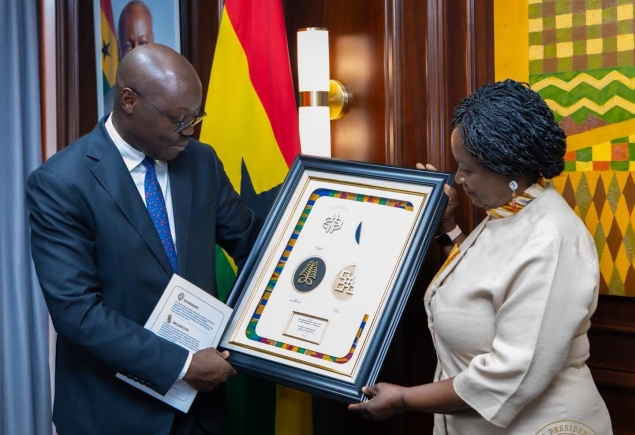
The government has taken a major step towards establishing the long-awaited Women’s Development Bank (WDB) after depositing GH¢400 million into an escrow account at the Bank of Ghana to serve as the institution’s required capital.
Finance Minister Dr Cassiel Ato Forson announced that the funds had been transferred to the central bank, paving the way for the Bank of Ghana to begin the regulatory assessment and licensing process for the proposed bank.
He made the disclosure during a working visit by Vice President Professor Naana Jane Opoku-Agyemang to the Ministry of Finance, where he reaffirmed government’s commitment to ensuring that the bank becomes operational before the end of 2026.
“We will do whatever it takes to make sure that the bank is operationalised this year,” Dr Forson said.
The GH¢400 million deposit represents a significant milestone in government’s plan to establish a financial institution dedicated to supporting women-owned businesses and women-led enterprises across the country.
The Women’s Development Bank is expected to provide affordable financing to traders, entrepreneurs, farmers, agro-processors, small business owners and other women operating within Ghana’s micro, small and medium-sized enterprise (MSME) sector.
For many women entrepreneurs, access to credit remains one of the biggest challenges. Although thousands of women contribute significantly to Ghana’s informal economy through trading, agriculture, food processing, fashion and services, many struggle to secure loans from traditional banks due to high interest rates, strict documentation requirements and limited access to collateral.
Government says the new bank will address these challenges by offering more flexible financing options tailored to the realities of women-led businesses.
Earlier updates indicated that WDB Ghana Limited had already been incorporated on January 26, with an application submitted to the Bank of Ghana for an operating licence. Deputy Finance Minister Thomas Ampem Nyarko also disclosed that GH¢51.3 million had been allocated in 2025 as seed funding for the initiative.
The 2026 Budget further provided an additional GH¢401 million capital injection to strengthen the bank and expand financing opportunities for women-owned enterprises.
Trade, Agribusiness and Industry Minister Elizabeth Ofosu-Adjare has said the institution will provide low-interest loans, flexible collateral requirements and business support services to help women entrepreneurs grow their businesses.
However, experts and stakeholders have stressed that the success of the Women’s Development Bank will depend on more than just government funding.
While the GH¢400 million deposit clears a major financial requirement, the bank will also need strong governance structures, competent management, transparent lending processes and strict accountability measures to protect public funds.
The Bank of Ghana’s licensing process will therefore be crucial in ensuring that the institution is built on a sustainable foundation.
Vice President Professor Naana Jane Opoku-Agyemang has previously cautioned that the bank’s establishment must be carefully managed to avoid rushing the process at the expense of long-term stability.
For the bank to make a meaningful impact, analysts believe it must go beyond Accra and reach women entrepreneurs in rural communities, markets and farming areas. Collaboration with rural banks, fintech companies, savings groups and other financial institutions could help expand its reach.
The government sees the Women’s Development Bank as a key part of its broader economic inclusion agenda, arguing that supporting women-owned businesses will contribute to job creation, enterprise growth and household income improvement.
For women entrepreneurs, however, the true measure of success will be whether the bank delivers practical benefits — cheaper loans, easier access to financing, fairer collateral requirements and business support services that help their enterprises grow.
The GH¢400 million escrow deposit marks an important beginning, but the real test will come when the bank starts lending.
If properly managed, the Women’s Development Bank could become a major driver of women’s economic empowerment in Ghana. But its long-term success will depend on professional management, responsible lending and a commitment to serving the women it was created to support.