

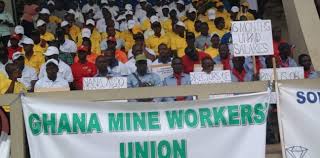
The Ghana Mineworkers’ Union (GMWU) has called on the government to suspend the ongoing transition from owner-mining operations to locally contracted mining services, warning that the move could reduce tax revenues, weaken pension contributions and undermine labour standards across the mining industry.
While the union supports efforts to increase Ghanaian participation in the extractive sector, it believes the current implementation of local content regulations could create unintended economic and social challenges if adequate safeguards are not put in place.
Speaking on the sidelines of the 98th Annual General Meeting of the Ghana Chamber of Mines in Accra, the Deputy General Secretary of the GMWU, Jerry Kwabena Andoh, said local participation should not come at the expense of workers’ welfare or government revenue.
According to him, replacing established owner-mining operations with local contractors who pay lower wages could result in reduced Pay-As-You-Earn (PAYE) tax collections, lower pension contributions and diminished employee benefits.
“What does the nation stand to gain if you give a contract to a Ghanaian contractor who pays lower wages, resulting in lower pay-as-you-earn taxes, reduced pension contributions and generally lower benefits? Everything goes down,” Mr Andoh stated.
The union explained that large multinational mining companies often operate structured employment systems that offer better wages, stronger collective bargaining arrangements and more consistent pension payments. Many emerging local contract mining firms, however, may struggle to maintain similar standards due to financial and operational constraints.
The GMWU fears that a rapid shift to contractor-led mining could lead to the replacement of higher-quality jobs with lower-paying positions, ultimately reducing tax revenue and social security contributions that support national development.
The concerns stem from the enforcement of the Minerals and Mining (Local Content and Local Participation) Regulations, 2020 (L.I. 2431). Under the sixth edition of the Local Procurement List, which took effect on January 1, 2025, the Minerals Commission directed major mining companies to phase out owner-mining operations.
The directive requires surface mining activities to be undertaken by wholly Ghanaian-owned contract mining firms, while underground mining contracts must have at least 50 percent indigenous ownership and local representation on their boards.
According to the union, the policy should not be expanded in its current form until stronger measures are introduced to protect workers, safeguard government revenue and ensure genuine local participation.
Mr Andoh noted that many workers prefer employment with multinational mining firms because they are generally more reliable in meeting salary obligations, pension contributions and other employee benefits.
“If you conduct a survey among workers in the mining sector and ask them to choose between working for a local company and a foreign company, most will choose the foreign company,” he said.
The union also expressed concern about the possibility of corporate fronting, where companies appear Ghanaian-owned on paper but are effectively controlled by foreign interests. Such arrangements, Mr Andoh warned, would defeat the purpose of localisation while exposing workers to weaker employment conditions and reducing the expected benefits to the state.
The GMWU stressed that it is not opposed to local content policies. Instead, it is advocating a more cautious and structured approach that ensures local contractors have the financial strength, technical expertise and operational capacity to meet industry standards.
The union is calling for stricter due diligence, transparent ownership disclosures, labour protection measures, pension compliance monitoring and technical capacity assessments before local contractors are granted exclusive operational roles.
It also wants assurances that workers transferred from owner-mining operations to contractor-managed arrangements will retain rights and benefits secured through existing collective bargaining agreements.
“We align with the objective, but it should not be extended for now until we have cleaned up the system,” Mr Andoh emphasized.
As Ghana pursues greater local participation in its mining industry, the GMWU believes the transition must be carefully managed to ensure that localisation strengthens, rather than weakens, jobs, tax revenues and long-term economic benefits.
The union argues that successful local content policies should create competitive Ghanaian mining companies capable of paying decent wages, honouring pension obligations, maintaining high safety standards and contributing meaningfully to national development.
For that reason, it is urging government to pause the current transition, engage stakeholders and establish enforceable standards that protect both workers and the national interest.