

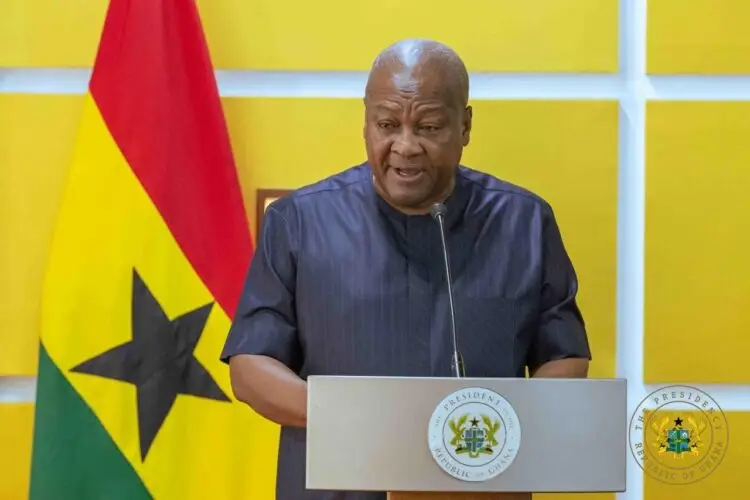
President John Dramani Mahama has announced the creation of three high-level global panels aimed at advancing the reparatory justice agenda beyond symbolic recognition and into concrete action.
Speaking at the Next Step High-Level Consultative Conference on Reparatory Justice in Accra, President Mahama said the time had come for the international community to move from acknowledging historical injustices to developing practical mechanisms for addressing their lasting consequences.
He called for stronger collaboration among African and Caribbean nations, governments, international organisations, academic institutions, civil society groups, faith communities and cultural bodies to drive the next phase of the reparations movement.
According to the President, reparatory justice should not be viewed solely as a matter of remembering the past but as a pathway toward correcting structural inequalities, expanding opportunities and building a fairer future.
“The question before us is whether we have the courage to learn from history, the wisdom to confront it, and the determination to transform remembrance into responsibility and responsibility into action,” he said.
To support this transition, President Mahama unveiled three global panels designed to provide the expertise, coordination and institutional support needed to advance the agenda.
The first, the Global Advisory Panel on Reparatory Justice, will comprise heads of state, distinguished leaders and influential public figures tasked with providing strategic guidance and strengthening international cooperation on reparatory justice.
The second, the Expert Panel on the Restitution of Cultural Artefacts, will focus on facilitating the return of cultural property, archives and sacred objects removed from their countries and communities during slavery, colonialism and imperial rule.
The third, the Global Legal Panel on Reparatory Justice, will bring together legal scholars and jurists to examine legal pathways for pursuing reparatory justice in line with international law and human dignity.
President Mahama said the panels would complement existing national and international efforts by offering technical expertise, policy support and intellectual leadership.
“These panels will provide technical and intellectual support for the global transition from recognition to action,” he stated.
The announcement places Ghana at the forefront of renewed global efforts to transform the moral case for reparations into practical policies and measurable outcomes.
For years, calls for reparatory justice have centred on recognition of the transatlantic slave trade, colonial exploitation, racial injustice and their enduring social and economic consequences. President Mahama argued that the next phase must focus on implementation through truth-telling, education, memorialisation, cultural restitution and stronger international partnerships.
He also stressed the importance of ensuring that the African diaspora remains central to the process, describing descendants of those affected by slavery and colonialism as key stakeholders whose voices must help shape future outcomes.
The inclusion of a dedicated panel on cultural restitution reflects growing international pressure for the return of African artefacts currently held in museums and institutions across Europe and other parts of the world. Such returns, supporters argue, are linked not only to historical accountability but also to cultural identity and sovereignty.
Similarly, the legal panel is expected to explore how existing international legal frameworks can support claims, negotiations and policy reforms aimed at addressing historical injustices and their continuing effects.
President Mahama noted that the Accra conference seeks to strengthen cooperation among governments, institutions and advocacy groups already involved in the reparatory justice movement. He said better coordination would help align efforts and create a more unified approach to achieving meaningful results.
As part of the conference, participants will also take part in a commemorative event at Christiansborg Castle in Osu to mark the first joint observance of Juneteenth between Africa and the United States.
The President described the event as an opportunity to honour memory, celebrate resilience and reinforce the historical ties between Africa and its diaspora. The choice of Christiansborg Castle, a site closely linked to the transatlantic slave trade, underscores the broader significance of the reparatory justice movement and its global dimensions.
In his closing remarks, President Mahama urged the international community to embrace justice, truth and partnership rather than denial, indifference and delay.
“Let them say that in Accra we chose truth over denial. Let them say that in Accra we chose partnership over indifference. Let them say that in Accra we chose justice over delay. And let it be said that when history called, we answered with courage,” he said.
The success of the initiative will now depend on how quickly the newly announced panels move from concept to implementation. Their membership, mandates and work programmes are expected to determine whether the Accra conference becomes a defining moment in the global reparatory justice movement or another chapter in a long-running conversation.
If successful, the initiative could establish Accra not only as a venue for discussing reparatory justice but as the place where the movement gained the institutional structures needed to pursue meaningful action.