

The Bank of Ghana has withdrawn GH¢21.89 billion from the financial system through its latest 14-day bill auction, underlining the central bank’s continued efforts to tightly manage liquidity despite improving economic conditions.
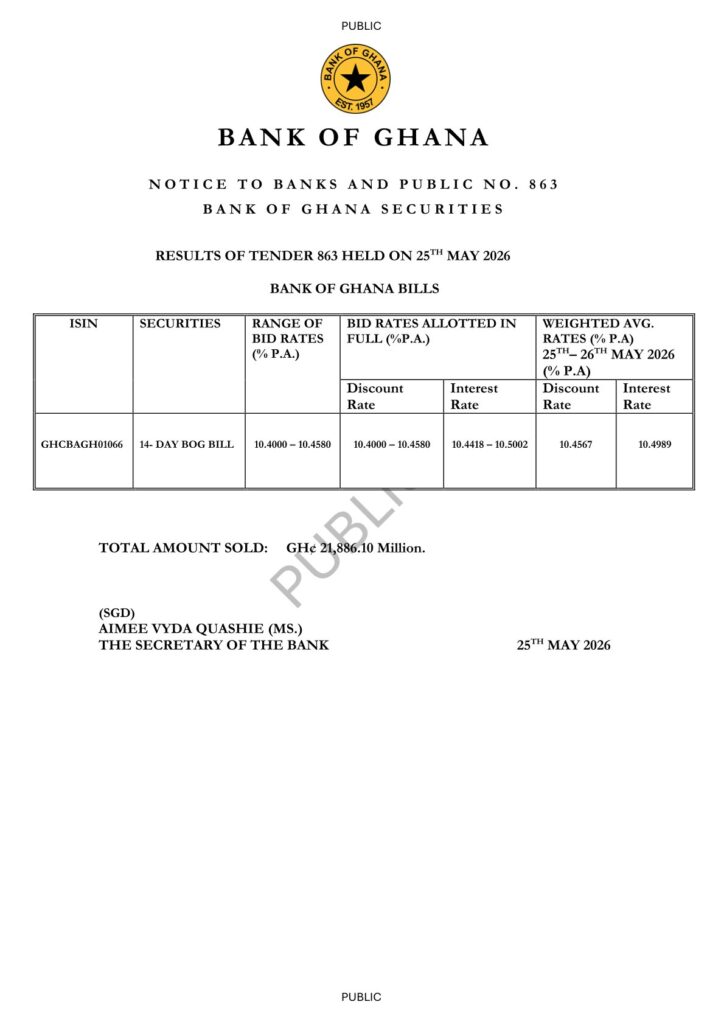
Results from Tender 863 showed that the central bank sold GH¢21,886.10 million worth of 14-day Bank of Ghana bills under ISIN GHCBAGH01066. The bills were issued at bid rates ranging between 10.4000 per cent and 10.4580 per cent per annum, with all bids within that range accepted in full.
The auction recorded a weighted average discount rate of 10.4567 per cent and a weighted average interest rate of 10.4989 per cent for the period between May 25 and May 26, 2026.
The operation effectively removed nearly GH¢22 billion from circulation for two weeks, making it one of the central bank’s significant recent liquidity absorption exercises.
Bank of Ghana bills are short-term instruments used by the central bank to control excess liquidity in the banking system. By selling the bills to banks and other eligible investors, the BoG temporarily takes money out of circulation, helping to reduce excess cash that could fuel inflation, exchange rate pressures or speculative activity in the foreign exchange market.
The latest auction suggests that although inflation has eased considerably and macroeconomic conditions have improved, the central bank is still maintaining a cautious monetary policy stance.
Analysts say the large size of the liquidity mop-up reflects the substantial amount of cash still circulating within the financial system. It also highlights the BoG’s determination to maintain stability in money markets while protecting recent gains in inflation control and cedi stability.
The interest rate on the 14-day bill, which stood around 10.50 per cent, remains significantly lower than the elevated yields recorded during Ghana’s recent economic crisis. This points to the broader decline in interest rates following improvements in inflation, exchange rate performance and overall macroeconomic conditions.
Even so, the continued large-scale sterilisation of liquidity indicates that the central bank is not yet ready to fully relax monetary conditions.
For commercial banks and other market participants, the short-term bills provide a relatively safe investment avenue for excess funds. For the wider economy, however, the latest operation signals that the Bank of Ghana is still carefully balancing lower interest rates with the need to prevent renewed inflationary and currency pressures.