

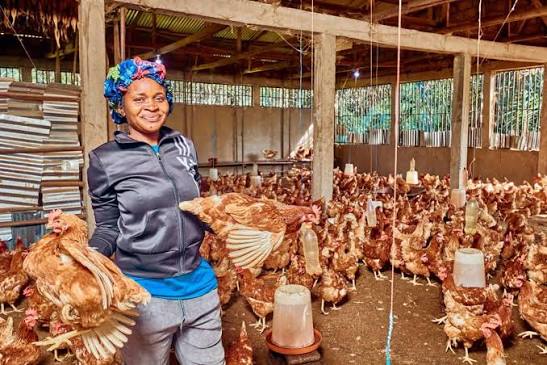
Ghana’s ambition to revive its poultry industry and reduce dependence on imported chicken is facing an early test, with poultry farmers warning that the government’s Nkoko Nkitinkiti programme could fall short of its objective unless key implementation challenges are addressed.
The concerns raised by the Poultry Farmers Association of Ghana go beyond a routine industry complaint. They highlight a broader challenge that has often affected agricultural interventions in Ghana — getting the policy announcement right but struggling to build the systems needed to make the policy sustainable.
The Nkoko Nkitinkiti initiative was introduced as a flagship agricultural programme aimed at revitalising local poultry production, creating jobs, supporting agribusiness and reducing the country’s reliance on imported poultry products.
The idea behind the programme is straightforward. Ghana has a strong demand for chicken, while local producers continue to struggle with high production costs, limited access to markets and competition from imports. A successful poultry revival strategy could strengthen the local economy by supporting farmers, boosting feed production, creating jobs and keeping more value within the country.
However, poultry farmers say increasing the number of birds alone will not solve the industry’s problems.
Speaking on Joy FM, President of the Poultry Farmers Association of Ghana, George Dassah, said farmers initially welcomed the programme as a major opportunity to transform the sector, but warned that weaknesses in implementation could undermine its purpose.
His comments followed remarks by the Minister of Food and Agriculture, Eric Opoku, suggesting that increased production under the initiative had contributed to lower poultry prices.
But Dassah disagreed with the interpretation, arguing that falling prices do not always mean the industry is becoming more productive or competitive.
According to him, the current challenge facing farmers is not production but the inability to find reliable markets for their birds.
“As we speak, the issue has to do with marketing. We are producing, but we, the commercial farmers, are actually not getting a market for what we produce. And because we are unable to sell, if you want to actually sell, you have to reduce your prices.”
In a healthy market, lower prices may reflect improved efficiency, reduced production costs or stronger competition. However, in a struggling market, falling prices can also indicate that farmers are being forced to sell below cost because they cannot find buyers.
For poultry farmers, unsold birds create serious financial pressure. Farmers continue to spend money on feed and other inputs while mature birds remain on farms longer than planned, reducing profit margins and threatening the sustainability of their businesses.
This makes market access one of the most important parts of any poultry development strategy.
A programme that increases bird production without addressing processing facilities, cold storage, distribution networks, institutional buying and reliable markets risks creating temporary growth without building a strong industry.
Dassah also raised concerns about the first phase of the programme, particularly reports that some beneficiaries consumed the birds they received instead of raising them for production.
He suggested that some beneficiaries may not have received enough education or preparation before taking part in the initiative.
“We heard that some of the farmers also consumed their birds. We thought that in the first place, maybe there wasn’t enough orientation or basic education for these people.”
The situation, he said, points to a deeper issue with programme design.
Agricultural support programmes must be built around the interests, capacity and commitment of beneficiaries. Not every household has the space, resources or willingness to become a poultry farmer.
“If we think every Ghanaian household has the passion for rearing birds, we will be mistaken,” Dassah warned.
The success of a poultry intervention depends on careful beneficiary selection, training, access to feed, veterinary support, monitoring and connection to markets. Without these, distributing birds may create short-term visibility but fail to deliver long-term economic impact.