
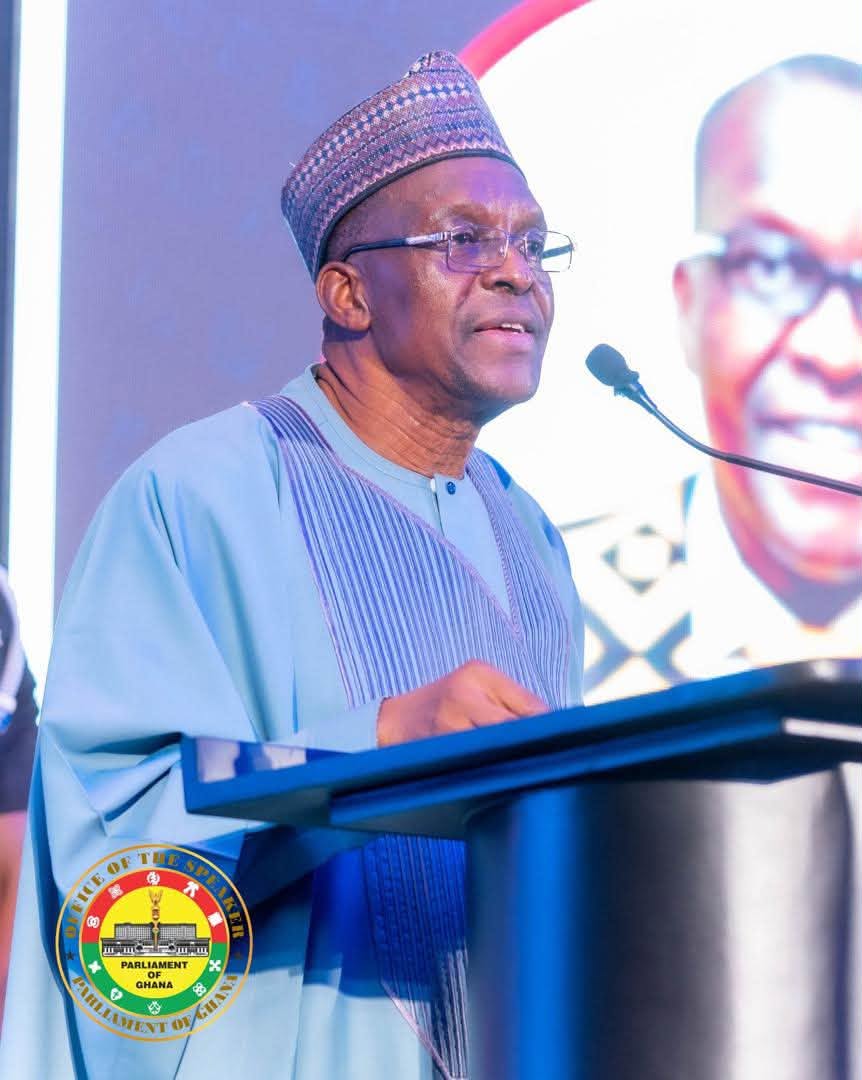
Speaker of Ghana’s Parliament, Alban Sumana Kingsford Bagbin, has warned that democracy across Africa is facing a serious threat as money increasingly determines political success, eroding public trust and weakening democratic institutions.
Speaking at the High-Level Regional Convening on the Financialisation of Politics in Africa at the Kempinski Hotel in Accra, Bagbin said politics is becoming increasingly commercialised, with public office now viewed by some as an investment rather than a position of public service.
“When money becomes the primary measure of political success, public office ceases to function as a public trust and instead becomes an investment to be recovered,” he told participants.
The Speaker expressed concern over the growing influence of opaque campaign financing, vote buying and state capture, describing them as major factors driving citizens away from democratic participation. He stressed that Africa’s democratic challenges have moved beyond mere concerns and now constitute a crisis that requires decisive action.
According to Bagbin, the continent must move beyond discussing the problem and focus on implementing practical reforms that restore integrity, accountability and public confidence in political systems.
Despite the challenges, the Speaker highlighted what he described as a major diplomatic success for Ghana on the international stage. He noted that Ghana played a leading role in securing the adoption of UN Resolution 11/7 at the Conference of State Parties held in Doha in December 2025.
The resolution, co-sponsored by Ghana, Norway and Mongolia, calls for greater transparency in the financing of political parties, candidates and election campaigns as part of global efforts to tackle corruption and strengthen democratic governance.
Bagbin singled out Ambassador Matilda Osei-Agyeman for her contribution, praising her diplomatic leadership in helping secure what he described as a historic milestone in promoting transparency in political financing.
However, he cautioned that adopting the resolution was only the first step.
“The role of Parliament in advancing reform in this direction cannot be overemphasized. A true measure of success, however, will not be the adoption of the resolution itself, but its effective implementation by state parties.”
He urged African countries to use the regional convening as a platform to transform international commitments into enforceable national laws, with parliaments playing a central role in ensuring that resolutions lead to tangible reforms rather than remaining symbolic declarations.
Bagbin also outlined several governance reforms underway within Ghana’s Parliament to strengthen transparency and accountability. These include the establishment of a Legal and Governance Services Division, which will oversee dedicated departments for Anti-Corruption, Investigations and Human Rights.
He further announced the creation of an Ethics and Standards Committee, supported by an independent Commissioner who will be responsible for monitoring parliamentary conduct and promoting accountability.
According to the Speaker, the reforms are intended to strengthen Ghana’s democratic institutions from within and reinforce public confidence in Parliament’s commitment to good governance.