

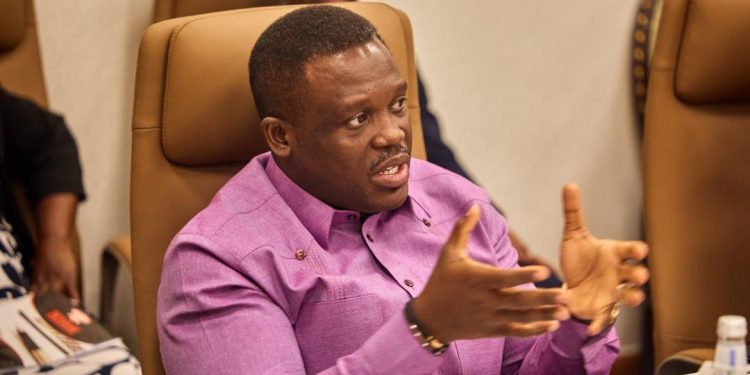
The government has begun implementing a series of measures to address gaps in Ghana’s digital infrastructure, artificial intelligence (AI) capacity and cybersecurity resilience, Minister for Communication, Digital Technology and Innovation Samuel Nartey George has announced.
Speaking at the ongoing UNESCO Global Forum on the Ethics of Artificial Intelligence during a ministers’ closed-door forum, Sam George said Ghana had used UNESCO’s Readiness Assessment Methodology (RAM) to identify areas where the country needs to strengthen its digital transformation efforts.
He said the assessment provided a useful benchmark for Ghana’s progress in areas including AI skills, cybersecurity, digital infrastructure and the contribution of digital technologies to the economy.
According to the Minister, although Ghana continues to perform strongly in international cybersecurity assessments, the readiness exercise also exposed gaps that require urgent attention.
One of the key areas, he noted, is AI governance. Ghana currently does not have comprehensive legislation covering all aspects of artificial intelligence, making the development of appropriate regulatory and technical frameworks a priority.
Sam George, however, stressed that the government had already begun responding to several of the challenges identified.
He disclosed that a US$200 million digitalisation project is being implemented to strengthen critical components of the country’s digital infrastructure. The project includes upgrading the National Data Centre, operationalising a national data exchange hub, expanding last-mile connectivity and improving cybersecurity resilience.
The Minister also revealed that Cabinet has approved US$250 million for the establishment of a National AI and Computing Centre.
The facility is expected to provide researchers, universities, start-ups and other technology innovators with affordable and sovereign access to high-performance computing and AI infrastructure.
Sam George stressed that the initiative was not simply a policy proposal, but a funded programme already being implemented by the government.
He further called for stronger international cooperation in developing AI capacity, describing UNESCO’s readiness assessment as a tool for collaboration rather than simply an exercise for individual countries.
He said countries at similar stages of digital development could learn from one another and develop common solutions, particularly because no single country could independently build the entire AI and advanced computing ecosystem.
The Minister also raised concerns about developing countries’ growing dependence on foreign cloud-computing providers, urging governments to carefully structure partnerships with international technology companies to protect strategic data and national interests.
He called on UNESCO and its partners to provide developing countries with more practical support through funding, infrastructure and technical expertise, rather than guidance alone.
Sam George said Ghana would welcome continued support from UNESCO in establishing and operationalising its national computing infrastructure, while strengthening the regulatory and technical capacity needed to ensure AI is developed and deployed responsibly.
He reaffirmed Ghana’s commitment to working with UNESCO and other stakeholders to harness artificial intelligence and digital technologies for national development.