

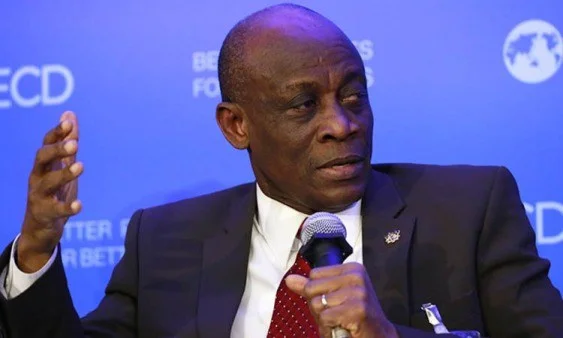
Ghana’s conversation on public-sector reform is increasingly echoing global trends: artificial intelligence (AI) is often touted as the next big leap in efficiency a way to expand the tax net, detect fraud, and reduce leakages. But at the Ghana Economic Outlook 2026 Business Forum, Seth Terkper, former Finance Minister and now Economic Advisor to the President, issued a cautionary note: without solid fiscal foundations, AI risks becoming an expensive distraction rather than a solution.
Mr. Terkper argued that Ghana could become “tech-forward but systems-poor.” He explained that even if the government captures VAT invoices and receipts through AI, the benefits would vanish without an integrated fiscal architecture to analyze the data and enforce compliance. “If you collect VAT invoices through AI and you don’t have a domestic tax system and domestic tax analytics… you are not going anywhere,” he said.
The core of his message was clear: no single technology can fix deep-rooted institutional challenges. This was not a rejection of AI itself but a reminder about sequencing. Applying AI to fragmented systems, he warned, only “automates confusion.”
According to Mr. Terkper, Ghana is currently developing a comprehensive domestic tax system capable of meaningful coverage and enforcement. He stressed the need to strengthen core tax infrastructure for both income tax and VAT, including an analytics layer that can convert collected data into assessed liabilities and enforceable compliance measures.
Integration was another key theme. Ghana’s fiscal system must connect revenue collection, border controls, and spending processes so the government can track trading activity, imports, tax obligations, and public expenditure in real time. He highlighted the importance of linking domestic tax with customs processes and completing modules of GIFMIS, the government’s integrated financial management system, to improve spending control and transparency. “For and expenditure control is not a separate battle,” he noted. “Tighten one side while the other remains porous, and macro discipline cannot hold.”
Mr. Terkper also touched on the politics of reform. AI is appealing because it represents visible, modern progress that can be announced quickly. But fiscal plumbing the hard work of improving data standards, reconciling databases, integrating platforms, and enforcing consistent workflows is slow, invisible, and politically harder to sell. Postponing these foundational reforms, he warned, risks a scenario where digitisation happens on the surface while leaks persist underneath.
The broader context is Ghana’s pursuit of durable economic stability following a period of crisis. Businesses are looking for signs that reforms will endure beyond immediate stabilisation efforts. Mr. Terkper’s prescription is clear: the focus should not be on the flashy promise of AI, but on whether the government can deliver the unglamorous but essential foundations coherent tax administration, credible compliance enforcement, and robust spending control.
He framed the challenge as a gap between “collecting” and “using” data. Capturing VAT invoices is only the first step; without analytics and enforcement, the process becomes a digital archive rather than an effective tax system. The same principle applies to other fiscal processes: digitisation alone cannot produce strong outcomes if it rests on fragmented databases with inconsistent rules.
For the private sector, the takeaway is nuanced. Ghana should not slow down its technology adoption, but the success of any AI agenda will depend on the government’s integration strategy: which systems are being linked, which datasets are standardized, who controls the architecture, what controls are embedded, and how compliance will be consistently enforced.
Mr. Terkper’s views carry extra weight given his experience. As a former Finance Minister and current senior economic advisor to the President, he has direct insight into fiscal policy, debt management, and stabilisation strategy. His emphasis on state capacity over tools reflects that perspective.
His warning is clear: if Ghana enters an AI race without a coherent systems roadmap, reform announcements risk becoming empty gestures. But if the country uses the current policy window to build integrated tax and financial management systems, AI can be a powerful multiplier rather than a mirage.
In the end, Mr. Terkper’s message was simple: fiscal capacity is not built with slogans it is built with working systems and the discipline to fix the plumbing before installing smart meters.