

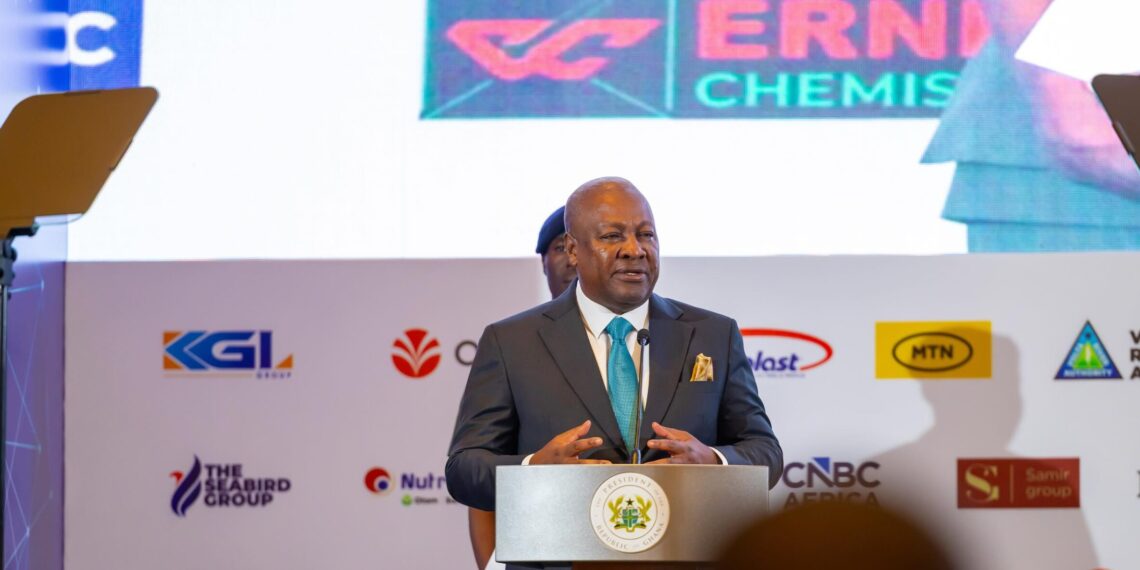
President John Dramani Mahama has called on Ghana’s business community to partner government in transforming the country’s recent economic stability into higher production, more jobs and improved living conditions for citizens.
Speaking at the 10th Ghana CEO Summit, President Mahama said Ghana’s economic reset agenda would only succeed if the private sector actively participates in driving industrial growth, investment and innovation.
According to him, economic transformation cannot be achieved by government alone, stressing that stronger collaboration between policymakers, investors, innovators and development partners is essential for long-term national development.
“Ghana’s economic transformation requires engagement between policymakers, business leaders, investors, innovators, development partners, and not the government alone,” he said.
President Mahama noted that while Ghana has spent considerable time discussing economic recovery, fiscal discipline and macroeconomic stability, the country must now shift attention toward production and job creation.
He said economic progress should not only be measured through macroeconomic indicators, but by whether ordinary citizens experience better incomes, stronger businesses and renewed confidence in the economy.
“We’ve talked long enough. It is time to take off,” the President stated.
Mr Mahama assured investors and business leaders that government intends to sustain the country’s improving macroeconomic stability following recent economic challenges, including debt restructuring, high inflation and exchange rate volatility.
He disclosed that Ghana had completed its Extended Credit Facility programme with the International Monetary Fund and would transition into a Policy Coordination Instrument arrangement aimed at maintaining policy credibility, fiscal discipline and economic stability over the next three years.
The President explained that stability must directly support production and enterprise growth.
“A farmer must be able to produce with confidence that he has a reliable market and will get a fair return for his production. A factory owner must have access to raw materials, energy, finance, and equipment without avoidable uncertainty,” he said.
President Mahama also raised concerns about inefficiencies within Ghana’s business regulatory environment, warning that excessive bureaucracy, duplication of procedures and inconsistent directives from state agencies continue to discourage investment.
“A business person should not waste productive time shuttling between public offices to obtain routine approvals. A serious investor should not receive conflicting signals from agencies of the same state,” he noted.
He said government is committed to improving transparency, reducing delays and accelerating public service delivery to create a more business-friendly environment.
On industrialisation, the President said special economic zones must serve as engines of technology transfer, export growth and employment creation rather than isolated enclaves disconnected from the wider economy.
He further highlighted agribusiness as a major area for expansion, arguing that Ghana must bridge the gap between farmers and processors to strengthen local value chains.
According to him, sectors such as cocoa, cashew, shea, oil palm, rice, poultry, textiles, pharmaceuticals and light manufacturing hold significant potential for industrial growth and value addition.
“We must move beyond just exporting raw materials and paying higher prices for finished imports. We have the people, we have the enterprise, and we certainly have the opportunity to retain more value within our economy,” he said.
President Mahama also clarified that the proposed 24-hour economy policy is intended to improve productivity and maximise the use of Ghana’s productive capacity rather than simply extending working hours.
He explained that businesses operating under the policy may require support in areas such as logistics, transportation, digital systems, security and access to reliable utilities.
“Our clear objective is to help businesses grow, create quality jobs, and maximise our resources. When businesses thrive, government thrives, and the country prospers,” he added.
The President urged CEOs and investors to continue demonstrating confidence in Ghana through long-term investments, innovation and expansion of local production.
He also launched the CEO Government Compact 2026, a new framework designed to strengthen cooperation between government and the private sector on investment climate reforms, industrial growth, exports and job creation.
President Mahama concluded by urging Ghana to move decisively from “dialogue to delivery, from policy to production, and from production to better lives for our people.”