
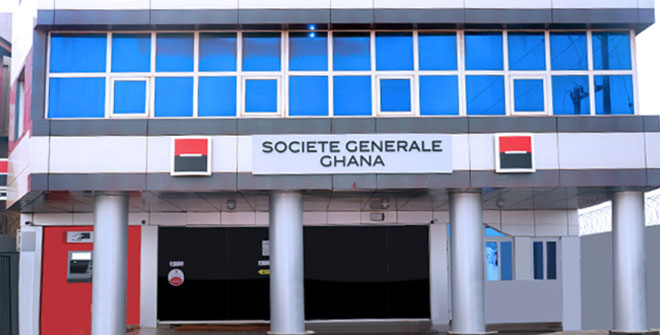
Société Générale Ghana’s profit after tax fell by 56.4 per cent to GH¢150 million, down from GH¢344.30 million in the corresponding 2025 period, as declining interest income, weaker trading revenue and rising credit impairment costs weighed on its financial performance.
The bank’s profit before tax also dropped by 56.2 per cent, from GH¢529.98 million to GH¢232.14 million, while earnings per share declined from GH¢0.65 to GH¢0.28, reflecting a sharp reduction in returns to shareholders.
The decline was largely driven by weaker interest earnings, which remain a major source of income for commercial banks. Interest income fell by 31.3 per cent to GH¢750.42 million from GH¢1.09 billion. Although interest expenses declined by 24.9 per cent to GH¢126.43 million, the reduction was not enough to cushion the impact of lower earnings from interest-bearing assets.
Consequently, net interest income fell by 32.4 per cent to GH¢623.99 million from GH¢923.35 million, representing a decline of GH¢299.36 million.
The bank’s trading performance also weakened, with net trading revenue falling by 37.9 per cent to GH¢59.70 million from GH¢96.18 million. This contributed to a 23 per cent decline in overall operating income, which stood at GH¢797.10 million, compared with GH¢1.04 billion in the previous year.
However, the bank recorded improvements in fee-based income and other operating revenue. Net fees and commission income increased by 31 per cent to GH¢84.35 million, supported by higher gross fee income and a reduction in commission expenses.
Other operating income also rose to GH¢88.75 million from GH¢48.05 million. The improvement included a reversal of the GH¢60.96 million expense recorded in the corresponding period of 2025, alongside GH¢14.30 million in income from other financial instruments carried at fair value.
These gains were partly offset by higher credit impairment costs. The bank recorded a net impairment loss of GH¢27.17 million, compared with an impairment gain of GH¢32.97 million a year earlier, marking an adverse year-on-year movement of approximately GH¢60.13 million.
Operating expenses remained broadly stable at GH¢537.80 million, compared with GH¢538.78 million in 2025. Personnel expenses, however, rose by 18.3 per cent to GH¢238.26 million, while depreciation and amortisation increased by 17.8 per cent to GH¢109.21 million.
Other operating expenses declined by 22.2 per cent to GH¢190.32 million, helping to offset the increases in staffing and depreciation costs. Despite this, the sharp fall in operating income pushed the bank’s cost-to-income ratio to approximately 67.5 per cent from 52 per cent, indicating that a larger share of its revenue was being absorbed by operating costs.
Despite the decline in profitability, Société Générale Ghana continued to expand its balance sheet. Total assets increased by 7.1 per cent to GH¢11.08 billion from GH¢10.35 billion, while loans and advances to customers grew by 8.2 per cent to GH¢4.67 billion.
Customer deposits recorded stronger growth, rising by 14.4 per cent to GH¢7.16 billion from GH¢6.25 billion. The faster growth in deposits compared with lending reduced the loan-to-deposit ratio to approximately 65.3 per cent from 69.1 per cent.
The bank also maintained a strong liquidity position, although its reported liquidity ratio declined to 100.43 per cent from 109.68 per cent. Cash and cash equivalents increased by 52.7 per cent to GH¢3.96 billion, while debt instruments measured at amortised cost fell by 44.5 per cent to GH¢1.31 billion.
The shift towards cash and other liquid assets may have strengthened the bank’s capacity to meet its obligations, although the effect on earnings depends on the returns generated by those assets compared with loans and securities.
Capital indicators improved during the period. The capital adequacy ratio increased to 18.52 per cent from 17.90 per cent, while the leverage ratio rose to 12.91 per cent from 12.53 per cent. Shareholders’ funds edged up by 1.1 per cent to GH¢2.58 billion.
Asset quality remained a concern, with the non-performing loan ratio rising to 13.98 per cent from 13.51 per cent. The increase suggests some deterioration in the quality of the bank’s loan portfolio, particularly as lending continued to expand and impairment charges returned.
Cash flow from operating activities provided a positive development. The bank generated GH¢1.13 billion in net operating cash flow, reversing an outflow of GH¢448.14 million recorded in the corresponding period of 2025. Growth in customer deposits contributed to the improvement, although operating cash flow does not necessarily translate directly into higher profits.
Dividend payments declined to GH¢173.67 million from GH¢241.11 million in 2025. Nevertheless, shareholders’ funds fell from GH¢2.60 billion at the beginning of 2026 to GH¢2.58 billion at the end of September, as dividend payments weighed on retained capital.
The results leave Société Générale Ghana facing the challenge of restoring earnings while maintaining its liquidity and capital strength. Stronger fee income and deposit growth provide some support, but they have yet to compensate for the decline in net interest income and trading revenue.
The bank’s performance in the coming periods will depend on its ability to improve returns from its assets, manage credit risks and control costs as revenue recovers. For shareholders, the key question is whether the decline reflects temporary pressure on earnings or a more sustained weakness in the bank’s profitability.