

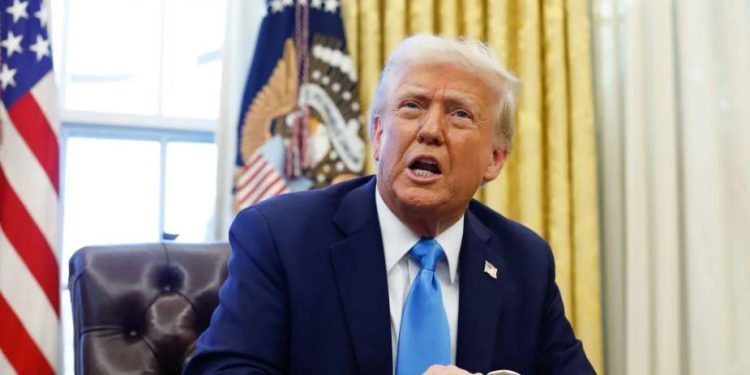
US President Donald Trump has dismissed growing concerns over the safety of artificial intelligence (AI) as a “hoax”, rejecting calls for stronger safeguards as the debate over the rapid development of the technology intensifies.
Trump’s comments come amid growing warnings from technology executives and researchers that increasingly powerful AI systems could pose serious risks to humanity if their development is not properly monitored.
Jack Clark, co-founder of AI company Anthropic, recently told the BBC that governments may eventually need to make it mandatory for AI companies to have a third-party-verified “kill switch” capable of shutting down dangerous systems.
Clark said most major AI laboratories, including Anthropic, already have ways of “pulling the plug” on their systems, but suggested lawmakers may need to establish common rules requiring such measures across the industry.
Trump, however, pushed back against calls for greater regulation in a series of social media posts on Monday. He compared concerns about AI to what he called the “Global Warming Scam” and described himself as the “Hoax Buster”, also drawing parallels with what he called the “RUSSIA, RUSSIA, RUSSIA HOAX”.
“There is a SICK conspiracy going on against AI and Data Centres, and the only one that is happy about it is China. WHOEVER WINS AI, WINS!” Trump wrote.
Earlier, he said the only “guardrails” AI needed were a “strong and smart” president.
The comments come as concerns about AI safety appear to be having an impact on investor confidence. Shares in some technology companies fell on Monday as investors considered whether growing pressure for regulation could slow the pace of AI development.
In China, state media cited experts who argued that US concerns about China’s rapid progress in AI were influencing Washington’s policy decisions.
“They know that China has become a strong competitor in AI and worry that if the US slows down development or tightens regulation, China could catch up even faster,” Xin Qiang, a professor of American Studies at Fudan University, told the Global Times.
Meanwhile, calls for stronger safeguards are gaining support within the technology industry. Microsoft AI on Monday published an outline of its approach to what it described as “humanist AI”, setting out principles for limiting potential risks from its developing models.
Microsoft AI chief Mustafa Suleyman told CNBC that the guidance had been in development for months but was being released amid the renewed debate over the future of AI.
The issue has also brought together voices from opposite ends of the US political spectrum. Former Trump chief strategist Steve Bannon and progressive Senator Bernie Sanders are expected to speak at the “Pro-Human Assembly” in Washington on Tuesday.
The event aims to promote what organisers describe as a more human-centred approach to AI development.
Sanders previously told the BBC’s Newsnight that governments needed to act “immediately” to address what he described as the uncontrolled growth of AI, warning of the possibility of an existential threat to humanity.
The debate intensified further after a post by Jacob Coxon, a former Anthropic researcher who left the company over concerns that AI could potentially wipe out humanity, went viral.
Anthropic scientist Evan Hubinger subsequently said he believed there was more than a 10% chance of AI causing human extinction “within the next decade”.
Anthropic chief executive Dario Amodei has also called for the pace of AI development to be slowed and more closely monitored, while stressing that any measures should be introduced “without sacrificing commercial advantage”.
OpenAI chief executive Sam Altman and xAI boss Elon Musk have also expressed support for industry-wide efforts to slow AI development where necessary, alongside stronger regulation and independent monitoring of AI models.
The growing divide over AI safety highlights a broader global debate over how governments and technology companies can balance rapid innovation with the potential risks posed by increasingly powerful artificial intelligence.