
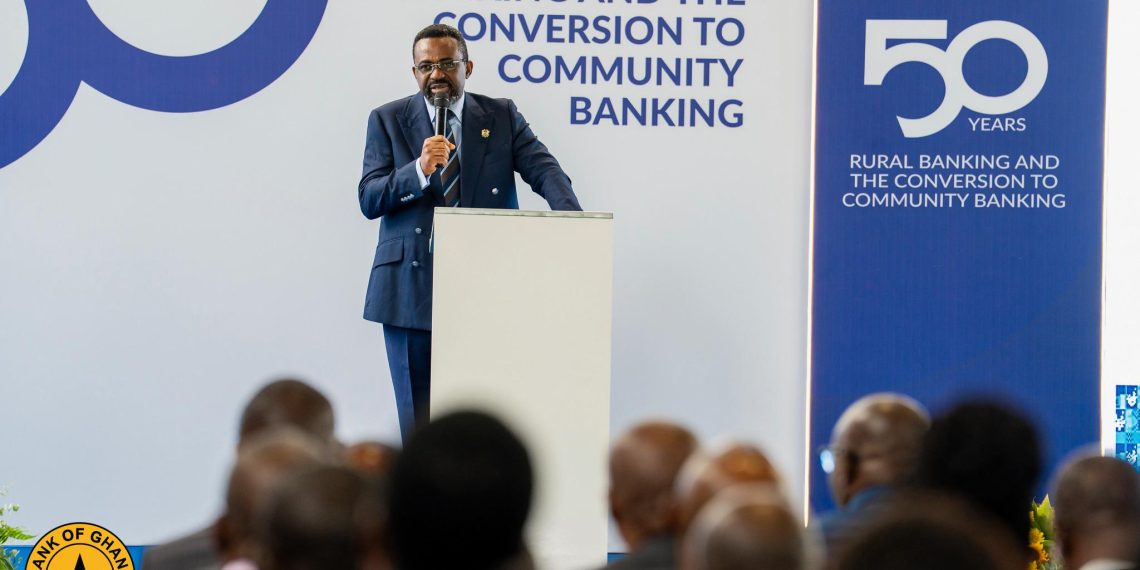
The Bank of Ghana (BoG) is repositioning Ghana’s rural banking sector into community banking institutions as part of efforts to address persistent challenges in accessing credit among traders, artisans, start-ups and small businesses.
The BoG Governor, Dr. Johnson Asiama, said the reform is aimed at moving financial inclusion beyond simply providing access to banking services to ensuring that underserved businesses can secure financing to grow.
Speaking at the commemoration of 50 years of rural banking in Ghana, Dr. Asiama noted that many individuals and businesses remain excluded from formal credit despite living close to commercial bank branches.
He explained that physical access to banks does not always translate into access to financial support.
“There are households in Accra right here that can see a bank tower from their front door, but they have never had a loan from it. Access is not the same as service,” he said.
According to the Governor, while mobile money and digital financial services have expanded access to financial transactions, many small businesses still struggle to obtain loans needed for expansion and sustainability.
He said the new community banking model will allow financial institutions to be established in areas where businesses require financing, whether in rural communities or urban centres.
Dr. Asiama cited possible examples such as East Lagoon Community Bank, Cantonment Community Bank and Airport Hills Community Bank, explaining that the need is not necessarily for more bank branches but for institutions willing to lend to local entrepreneurs.
“East Lagoon is not short of bank branches. It is short of banks that will lend to the woman who trades there, the artisan, the carpenter who works there, and the young business that has just opened its doors,” he added.
The reform comes as Ghana’s rural banking sector marks 50 years since the establishment of Nyakrom Rural Bank, the country’s first community-owned bank.
Over the past five decades, the sector has expanded into a GH¢26 billion industry, serving more than eight million customers through 147 licensed rural and community banks with over 1,000 branches nationwide.
Rural and community banks have played a major role in supporting agriculture, micro, small and medium-sized enterprises (MSMEs), and local economic development by extending financial services to communities that were previously underserved.
The BoG believes the transition to community banking will help close the credit gap facing Ghana’s informal sector, which accounts for a significant share of employment and business activity.
The initiative is expected to improve access to productive loans for traders, artisans, farmers and micro-enterprises while supporting entrepreneurship, job creation and economic growth.