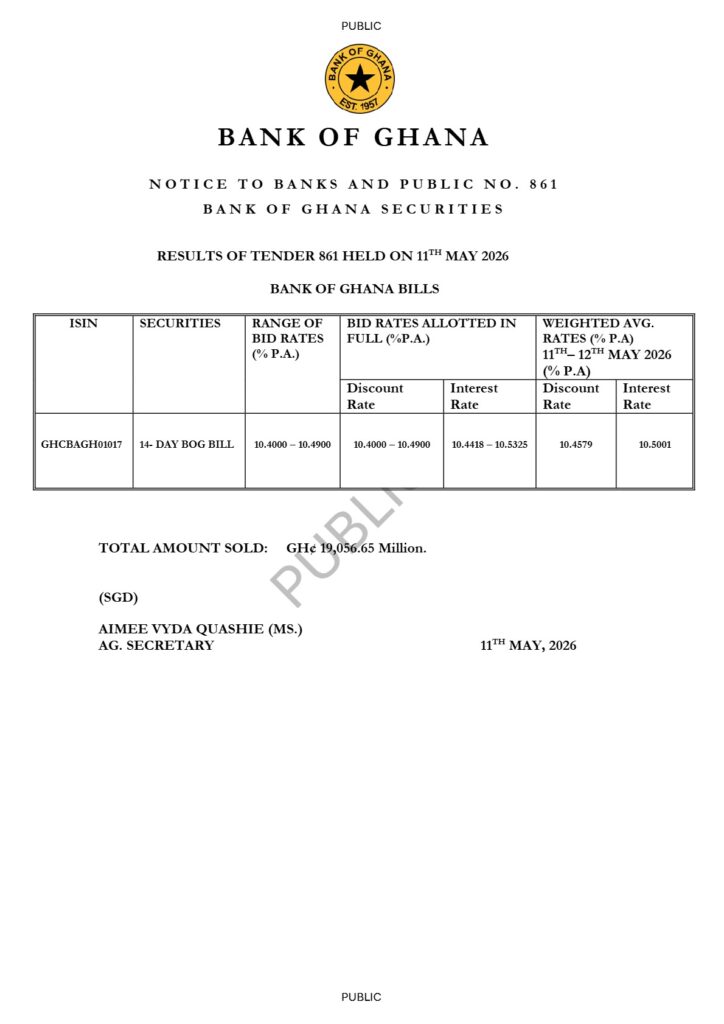

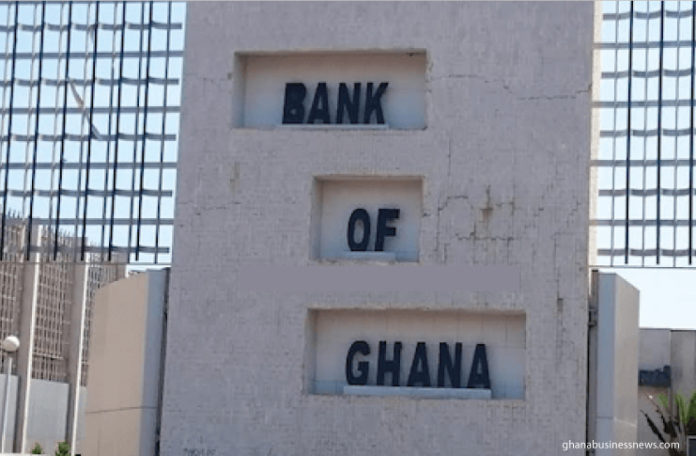
The Bank of Ghana (BoG) has raised GH¢19.06 billion through its latest 14-day bill auction as part of ongoing efforts to regulate liquidity in the financial system and maintain stability in the money market.
According to the results of Tender 861 conducted on May 11, 2026, the central bank issued the short-term securities at a weighted average discount rate of 10.4579%, translating into an effective interest rate of about 10.50% for the investment period.
The auction attracted strong participation from banks and money market investors, with bid rates ranging between 10.40% and 10.49%. All successful bids were accepted within the same range, while the effective interest rates allotted in full stood between 10.44% and 10.53%.
The GH¢19.06 billion raised makes the operation one of the central bank’s biggest short-term liquidity mop-up exercises in recent weeks, highlighting BoG’s continued focus on managing excess cash within the banking sector.
Bank of Ghana bills are commonly used by the central bank to absorb excess liquidity from the financial system, helping to stabilise short-term interest rates and reduce potential pressure on inflation and the foreign exchange market.
The latest auction comes at a time when Ghana’s interest rate environment has shifted downward significantly following a steady decline in inflation and recent monetary policy easing measures by the central bank.
Despite the easing cycle, the size of the latest operation signals that liquidity control remains a key priority for the Bank of Ghana as it seeks to maintain macroeconomic stability while navigating changing market conditions.
For commercial banks and institutional investors, the 14-day bill continues to serve as a relatively safe short-term investment option amid falling yields on Treasury bills and other government securities.
Analysts say the strong demand for the instrument reflects investor preference for low-risk assets while the market gradually adjusts to lower interest rates across the economy.
The auction further reinforces the Bank of Ghana’s active role in steering money market conditions and ensuring that excess liquidity does not undermine recent gains made in inflation control and economic stability.