

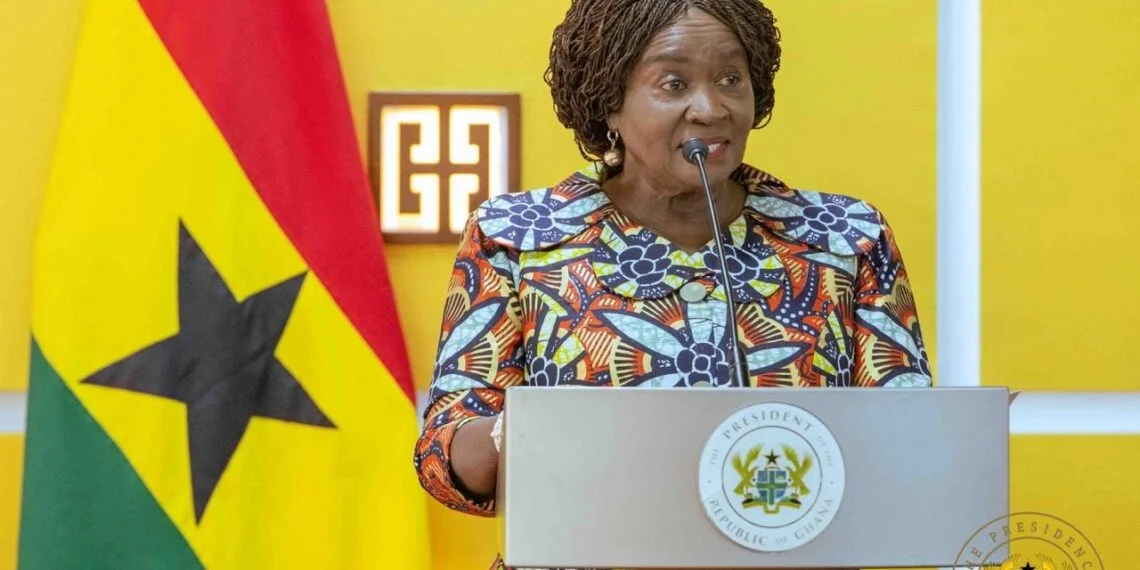
Vice President Professor Jane Naana Opoku Agyemang has reaffirmed the full commitment of the Presidential Advisory Group on the Economy to helping Ghana move beyond short-term crisis management toward what she describes as durable and sustainable economic success.
Speaking at the group’s formal engagement, she expressed appreciation to President John Dramani Mahama for establishing the advisory body at a critical moment in the country’s economic journey. According to her, although Ghana has endured a period of acute strain, there are emerging signs of renewed confidence and improved visibility within the economy.
“After a period of acute strain, visibility is returning, and confidence is gradually rebuilding, even as we continue to navigate global and domestic challenges. This moment must be used not only to recover, but to reset our economic direction,” she stated.
The Vice President noted that while progress is being made, the country must not be complacent. Instead, she called for deliberate thinking and disciplined choices that go beyond emergency interventions. She stressed that Ghana’s current position presents an opportunity not just to stabilise the economy, but to redefine its long-term direction.
Professor Opoku Agyemang explained that the Presidential Advisory Group has a clear but demanding mandate: to provide independent, rigorous and practical advice to support government decision-making. She clarified that the group is not intended to replace existing state institutions. Rather, its role is to complement them by offering fresh insight, challenging assumptions, and proposing solutions informed by global best practices while remaining grounded in Ghana’s realities.
She further emphasised that the group will promote dialogue, intellectual honesty and collective responsibility in its work. By engaging across various sectors of the economy, the advisory body aims to help the country transition from a posture of constant crisis response to one of resilience and long-term stability capable of withstanding future shocks.
Drawing on her academic background, the Vice President urged members to reflect deeply on what the “economy” should mean to ordinary Ghanaians. She argued that the concept must not remain abstract or detached from everyday life.
In practical terms, she said, a functioning economy should guarantee stability for teachers in classrooms and nurses on night duty. It should ensure fair prices and dependable markets for farmers, predictable costs and access to credit for traders and small business owners, as well as stable incomes and affordable housing and transport for workers.
For young people especially women the economy should create real opportunities and access to skills development. For labourers and the elderly, it should provide security, dignity and decent care. These lived realities, she stressed, must guide how policies are crafted and evaluated.
Professor Opoku Agyemang concluded by reiterating the group’s pledge to deliver leadership that is independent, evidence-based and focused on the national interest. She underscored the importance of frank, honest guidance and noted that the advisory body’s strength lies in its diversity, with members drawn from different professional backgrounds and disciplines.
Ultimately, she said, the task ahead is to help build an economy that feels tangible to citizens one where effort is rewarded, risks are shared, and honest work is recognised.