

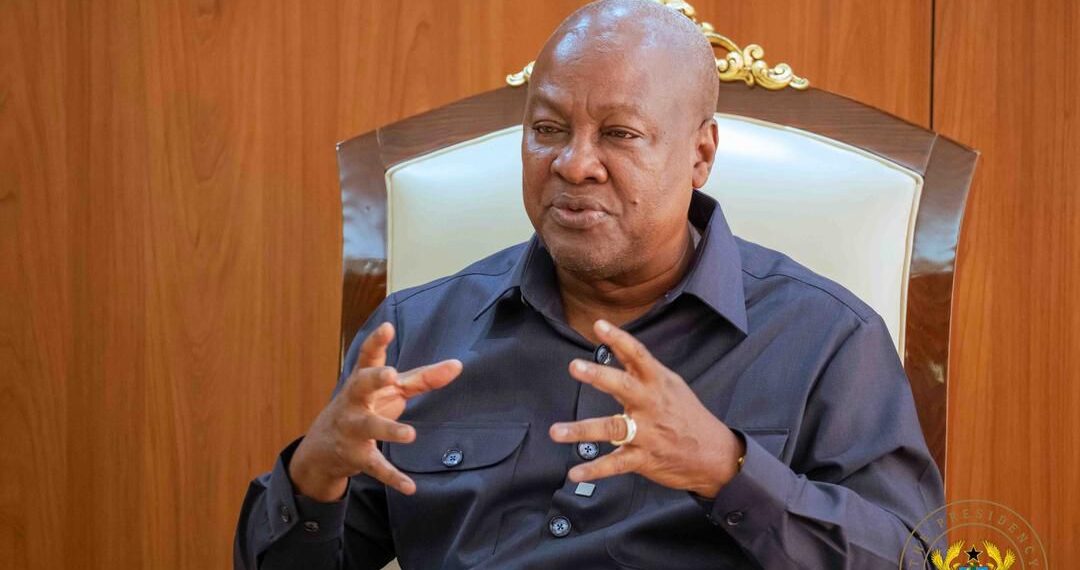
President John Dramani Mahama has called on public office holders and traditional authorities to take a leading role in revitalising Ghana’s agricultural sector, urging them to actively engage in farming as both an economic imperative and a personal commitment.
Addressing participants at the Ghana Tree Crops 2026 Investment Summit and Exhibition, President Mahama spoke passionately about his lifelong connection to agriculture, describing himself first and foremost as a farmer.
“I have two experiences. One, the son of a farmer. My father was at one time the biggest commercial rice farmer in Ghana, and so I grew up on the farm. And so, for me, agriculture is a passion, it’s a hobby,” he said.
The President noted that agriculture remains one of the strongest pillars of Ghana’s economy, contributing significantly to gross domestic product, yet it continues to be socially undervalued. He stressed that farming should not be treated as a fallback option but embraced with pride and seriousness.
According to him, watching crops grow brings him personal satisfaction and reinforces his conviction that agriculture is both a viable business and a fulfilling pursuit. He emphasised that leaders must demonstrate commitment to the sector by investing their time and resources, just as they do in other professional responsibilities.
President Mahama observed that in some regions, leaders successfully combine public service with farming, reflecting a culture that respects land use, food security, and wealth creation through agriculture. He argued that Ghana must cultivate a similar mindset to unlock the full potential of its agricultural sector.
He further highlighted access to land as a key challenge confronting tree crop development in the country. In that regard, he called on traditional rulers, as custodians of the land, to actively support and facilitate initiatives aimed at expanding tree crop cultivation nationwide.
The President concluded by urging all stakeholders to view farming not as incompatible with leadership or governance, but as an extension of national responsibility and a pathway to sustainable economic growth.