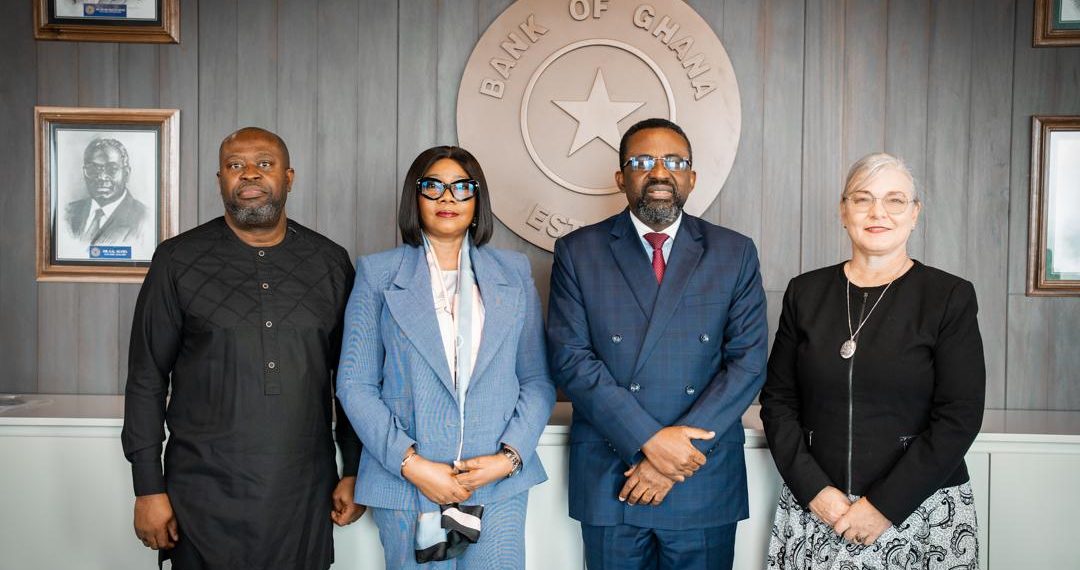



Managing Director of the Agricultural Development Bank (ADB), Edward Ato Sarpong, has challenged young professionals to rethink their understanding of leadership, describing it as a responsibility rooted in impact and legacy rather than titles or personal ambition.
Speaking at the Jospong Leadership Conference 2026, Mr Ato Sarpong said leadership is often mistakenly associated with power and position, when in reality it is defined by results, service and the ability to build people and institutions.
“Leadership is never about your life. It is about your legacy,” he told participants.
“Leadership is not in titles. It is in the task you accomplish.”
Drawing from his own journey, Mr Ato Sarpong revealed that when he was appointed Managing Director of ADB in February 2025, he had no prior background in banking. However, he said this did not deter him because his confidence was grounded in leadership, not technical expertise.
“When I was going to the bank, I had one thing clear in my mind. I was just going to lead the bank because I don’t know banking,” he said.
“All I knew is that I could lead.”
He recounted the dire state of the bank at the time he assumed office, noting that ADB was grappling with a cost-to-income ratio of 98 percent, non-performing loans above 70 percent, and a negative capital adequacy ratio of –3.17 percent.
According to him, strong leadership, discipline and cultural change led to a remarkable turnaround within 11 months.
“In 11 months, we have moved the cost-to-income ratio from 98 percent to 57 percent,” he said.
“We have eliminated 18 million Ghana cedis in cost. Our capital adequacy ratio was negative 3.17 percent. We are currently 17.5 percent.”
Mr Ato Sarpong attributed these gains to long working hours, strict discipline and a deliberate effort to reshape mindsets within the organisation.
“I’ve been working 13 to 14 hours a day,” he said. “I was working on their minds.”
He stressed that leadership is not automatically granted by authority or office but earned through purpose, vision and proven results.
“Power does not confer leadership. Position does not confer leadership,” he said.
“Leadership is conferred based on the task accomplished.”
Using global examples, including China’s long-term economic planning and the revival of brands such as Lego and IBM, he argued that progress in societies and institutions is impossible without effective leadership.
“Without leadership, nothing grows. Without leadership, nothing expands. Without leadership, nothing advances.”
He also distinguished between managers and leaders using the metaphor of tigers and lions, explaining that while managers focus on rules and procedures, leaders take responsibility and pursue purpose.
“The lion has a high sense of responsibility,” he said.
“Leadership is not about what you want. It is about what needs to be done.”
Acknowledging the personal cost of leadership, Mr Ato Sarpong noted that it is often lonely and demanding, despite how attractive it may appear from the outside.
“You see leadership as glorious on the outside, but within it is lonely.”
He identified perspective, personality and passion as the three defining qualities of effective leaders, while warning of three common leadership crises: identity crisis, competence crisis and eminence crisis.
“The first is identity crisis. Do you know who you are?” he asked.
“The second is competence crisis, not knowing what you don’t know. The third is feeling inferior.”
Ultimately, he said leadership should be measured by the lives transformed and the institutions strengthened along the way, sharing stories of individuals he had mentored who now occupy senior roles.
“Leadership is not about the life you lead. It’s about the legacy you leave.”
On the subject of micromanagement, Mr Ato Sarpong rejected the idea that leaders must always remain distant.
“Leadership is by example,” he said. “Be with the people. Show them.”
He announced plans by the Jospong Group to mentor young professionals under 40 to help build the next generation of leaders, warning that the current generation is gradually fading.
“Our country needs leaders. Our institutions need leaders,” he said.
“This generation is fading. We must build the next one.”
He concluded by urging participants to embrace leadership as service, not self-promotion.
“Leadership is never neutral,” he said. “It is either for good or for bad.”