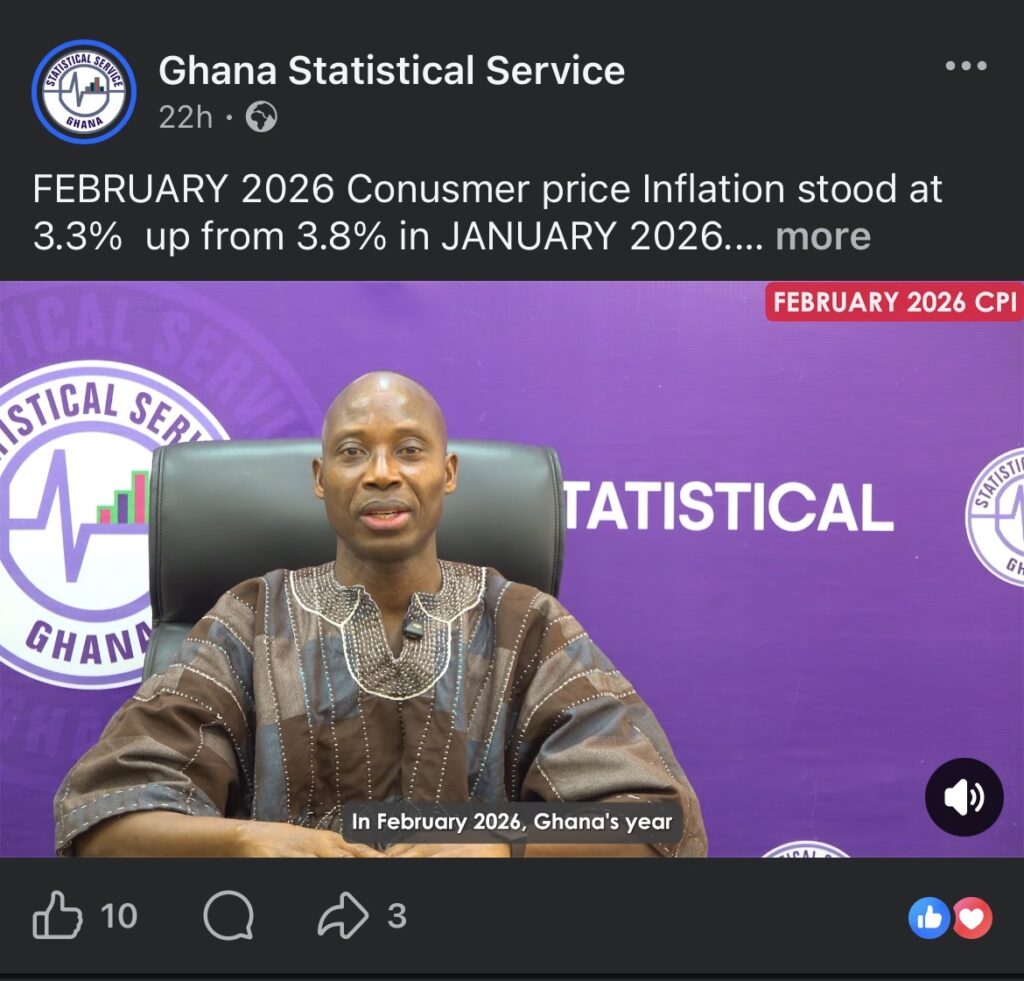

Ghana’s year-on-year inflation rate has dropped further to 3.3 percent in February 2026, marking the 14th consecutive month of decline and the lowest level recorded since the 2021 rebasing of the Consumer Price Index (CPI).
Data released by the Ghana Statistical Service (GSS) shows that prices in February 2026 were 3.3 percent higher than in February 2025, reflecting a continued easing in price pressures across the economy.
“This represents a 0.5 percentage point decline from the 3.8 percent recorded in January 2026 and a 19.8 percentage point drop from the 23.1 percent recorded in February 2025,” the Service noted during the presentation of the latest inflation figures.
On a month-on-month basis, inflation stood at 0.8 percent, meaning prices increased by less than one percent between January and February this year.
Food inflation saw a notable slowdown, declining to 2.4 percent in February 2026 from 3.9 percent in January. On a monthly basis, food prices increased by just 0.2 percent.
According to the Ghana Statistical Service, this easing is significant because food carries a large weight in the CPI basket and directly impacts household spending.
“Food inflation has eased considerably, which is positive for households,” the Service explained.
In contrast, non-food inflation rose slightly to 4.0 percent, up from 3.8 percent in January, with month-on-month prices increasing by 1.2 percent.
Inflation for goods slowed to 3.2 percent in February from 3.7 percent in January, while services inflation also declined to 3.7 percent, down from 4.2 percent the previous month.
The report also showed differences between locally produced and imported goods. Inflation for locally produced items fell marginally to 4.5 percent, while inflation for imported goods declined sharply from 2.0 percent to 0.6 percent.
“This suggests that exchange rate stability and global price conditions are helping moderate imported inflation,” the Service explained.
Regionally, inflation remained uneven across the country. The North East Region recorded the highest year-on-year inflation rate at 8.9 percent, while the Savannah Region recorded negative inflation of 5.6 percent, indicating an overall decline in prices there.
On a monthly basis, Greater Accra recorded the highest price increase at 2.4 percent, while the Western Region recorded the lowest at negative 2.7 percent.
At the item level, the main contributors to inflation included charcoal, green plantain, cinema or cultural services, secondary school fees, and river fish, which together accounted for 55.5 percent of the overall inflation rate.
Some food items recorded particularly sharp increases. Green plantain led with an inflation rate of 67.9 percent, followed by ginger (59.1 percent), shrimps (58.1 percent), charcoal (53.1 percent), and crab (46.9 percent).
However, several items experienced significant price declines, helping to ease overall inflation. These included garden eggs (-58.7 percent), pawpaw (-49.3 percent), fried fish (-49.2 percent), kontomire (-47.3 percent), and fresh okro (-42.4 percent).
“These items together dragged inflation down by 17.3 percent in February 2026,” the Service stated.
The Ghana Statistical Service noted that the current trend shows inflation is now being driven by a smaller number of items rather than widespread price increases across the economy.
“Inflation has fallen significantly and consistently over the past year, signalling improving macroeconomic stability,” the Service concluded.