

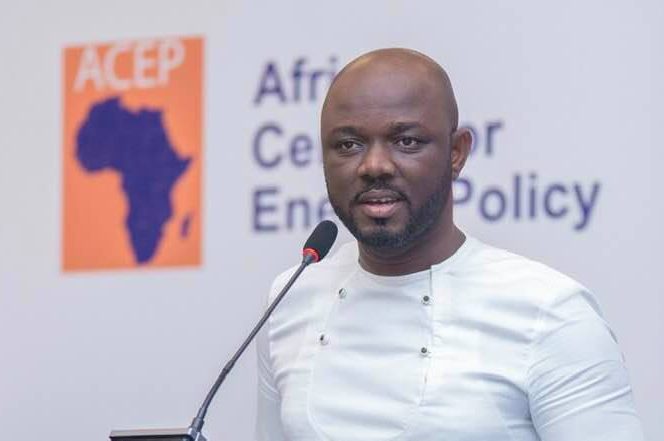
The Executive Director of the Africa Centre for Energy Policy (ACEP), Ben Boakye, has warned that Ghana’s energy sector remains structurally weak and heavily dependent on government support, despite the current calm among Independent Power Producers (IPPs).
Speaking during a discussion hosted by NorvanReports and the Economic Governance Platform (EGP) on the topic “Energy Sector ‘Reset’: Will It End the Circular Debt or Recreate It?”, Mr. Boakye said the apparent stability in the power sector is being sustained largely by direct fiscal intervention from the Ministry of Finance rather than improvements in operational efficiency.
According to him, the government is absorbing between $70 million and $75 million every month to pay for gas supplied to the power sector — costs that should ordinarily be covered through electricity tariffs.
He explained that while power plants are running and recovering investment costs and profits, the fuel component remains the responsibility of the Finance Ministry. The monthly payments, he said, are financed through the national budget as well as levies and margins imposed on liquid fuels.
Mr. Boakye cautioned that the absence of public complaints from IPPs should not be interpreted as evidence of sustainability. Instead, he argued that the sector is functioning because key government officials are making deliberate efforts to ensure that payments continue to flow.
He warned that if future policymakers choose to prioritise other sectors such as roads or education over energy payments, the country could quickly slide back into a crisis where gas suppliers go unpaid and debts begin to accumulate again.
Beyond the monthly gas costs, Mr. Boakye revealed that the Finance Ministry also shoulders about $400 million annually in negotiated legacy debts owed to IPPs. This, he noted, further underscores the sector’s reliance on state intervention.
He identified inefficiencies at the Electricity Company of Ghana (ECG) as a central driver of the problem. While acknowledging that ECG has improved in accounting for the revenue it collects, he said the utility continues to struggle with weak revenue mobilisation and widespread power theft.
According to him, many consumers still bypass meters and consume electricity without paying, worsening the company’s financial position.
Mr. Boakye stressed that incorporating gas costs into tariffs does not necessarily require continuous tariff hikes. Instead, he argued for stronger enforcement, improved billing systems and better revenue collection to ensure the sector pays for its own inputs.
He warned that repeated tariff increases without corresponding efficiency gains could actually deepen the problem. As electricity becomes more expensive, some consumers may resort to illegal connections, further reducing collections and increasing pressure on the state.
“Tariff adjustment alone is not enough,” he said, explaining that when consumers are unable to afford higher tariffs, credible customers may slip into power theft, compounding ECG’s financial challenges.
Mr. Boakye concluded that Ghana’s energy sector cannot be considered stable as long as it depends on discretionary government payments rather than operating as a self-sustaining business.