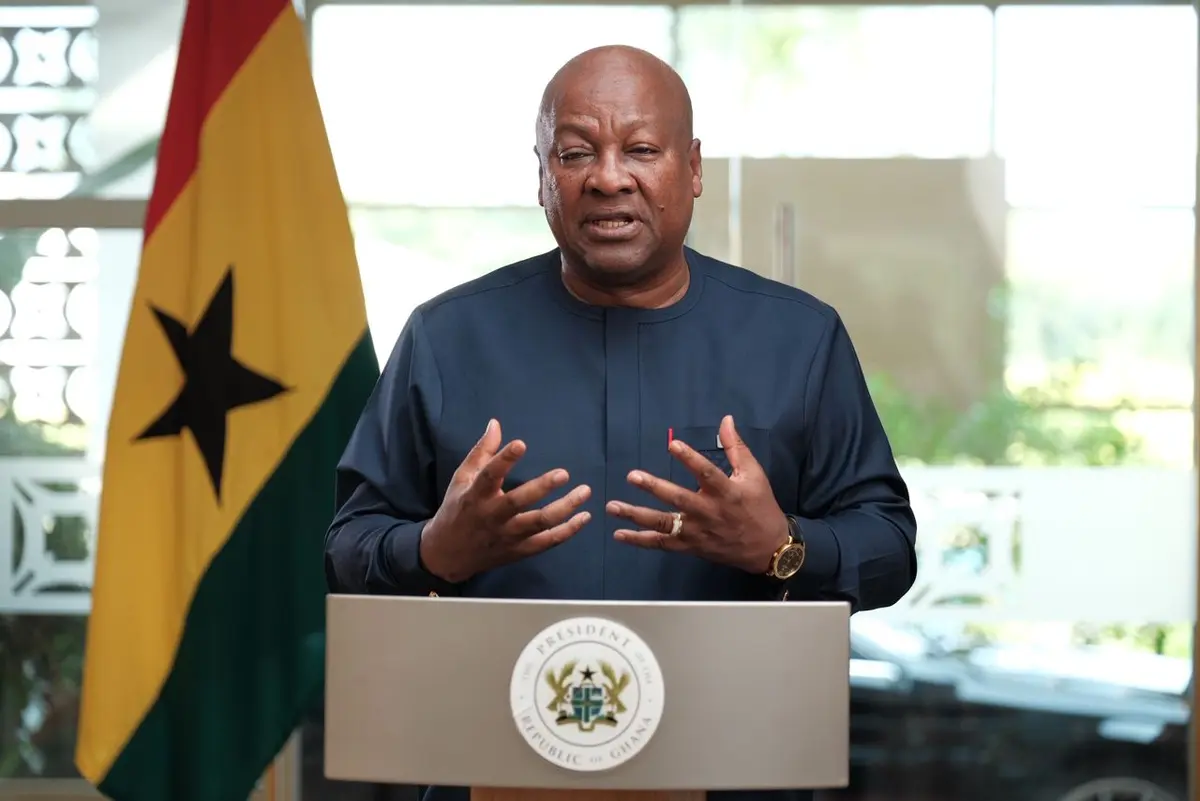
President John Dramani Mahama has revealed that Ghana’s progress alone is not what concerns him most, but rather Africa’s inability to move forward together as a united force.
Speaking at the Davos Convening on Accra Reset on January 22, President Mahama said Ghana’s recent economic turnaround will amount to little if the rest of the continent continues to lag behind due to fragmentation and dependency.
According to him, his first year back in office has demonstrated that democracy and accountable leadership can deliver real results.
“In my first year of being back in the office, we’ve shown that democracy works and that change is possible when leadership is focused and accountable to the people,” he said.
President Mahama highlighted Ghana’s recovery from a debt-distressed and crisis-ridden economy, pointing to single-digit inflation, a strengthened currency, and renewed business confidence as signs of progress. However, he stressed that Ghana cannot thrive in isolation.
“Here’s what keeps me up at night: Ghana’s success alone is not enough,” he noted.
He warned that Africa risks producing isolated success stories that fail to transform the continent as a whole.
“However admirable Ghana’s turnaround story is, we cannot be a jewel in the dirt. We must work together as Africa. We must knit together the patchwork of success stories.”
President Mahama said the purpose of the Davos engagement was to scale successful development models across Africa and the Global South, rather than resetting one country at a time.
Addressing Africa’s development challenges, he identified what he termed a “triple dependency” trapping many African nations: reliance on external powers for security, dependence on donors for health and education, and exporting critical minerals without capturing their value.
Describing the situation as a worsening trap, President Mahama said crises often bring clarity.
“We must build our own capacity to act,” he stated.
Drawing parallels with the global response to HIV/AIDS led by former UN Secretary-General Kofi Annan and other world leaders, he argued that collective action could once again transform Africa’s future.
President Mahama expressed concern over recent cuts in funding to the United Nations system by the United States, warning that the global environment has become increasingly unpredictable.
He said Africa is now facing a different kind of pandemic — one of unfulfilled potential, characterised by widespread youth unemployment, fragile health systems, and economies that extract resources without creating lasting value.
“If we could mobilise the world to fight a disease, why can’t we mobilise to fight poverty? To fight dependency? To fight the systems that keep brilliant young Africans locked out of the future?” he asked.